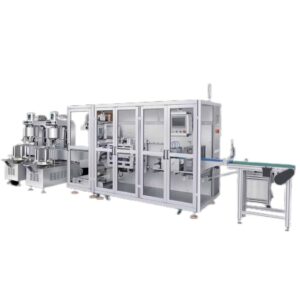
A monoblock filling-capping machine mounts the filling nozzles and the capping heads on one shared frame, and moves bottles between them on one continuous star-wheel carousel instead of two machines linked by a conveyor. The reward is a shorter, synchronized line with almost no bottle handling between fill and cap, which matters most for liquids that foam, settle, or pick up contamination while waiting. The price is flexibility: filler and capper share one speed, one frame, and one changeover, so the pairing must be right on the day it is built.
Những điểm chính cần lưu ý:
- One frame, one carousel, two operations. Fill valves sit on the upper tier, capping heads on the lower, and bottles index around a single star wheel through both.
- The win is synchronization, not speed. Monoblocks shine at 20-200 bottles per minute where conveyor handoffs and buffer queues cause more trouble than they solve.
- Fill and cap must be sized together forever. You cannot later speed up one half; buy the monoblock for the capper’s ceiling, because capping is almost always slower than filling.
- Foamy, oxygen-sensitive, and sterile products benefit most. Less open conveyor between fill and cap means less foam collapse time, less exposure, and less floor space.
- Many SKUs with different bottle shapes hurt monoblocks. Every format change is a double changeover of fill valves and capping chucks together.
- Giá tham khảo: liquid monoblocks start around $30,000-$60,000 at entry speed and run $150,000-$500,000+ for servo, aseptic-capable, or high-speed models.
For how the capping half works on its own (chuck types, torque control, cap sorting), read our capping machine comparison; this guide concentrates on what integration changes.
How a Monoblock Is Built
Picture one heavy base frame carrying two stacked working zones:
- Infeed. An infeed screw meters bottles from your conveyor into the first star-wheel pockets, at exact pitch.
- Filling zone. Bottles index under a ring of fill valves. Depending on product, these are gravity, overflow, piston, or mass-flow valves; the carousel rotates while each valve runs its fill cycle.
- Transfer star. A short intermediate star wheel lifts filled bottles out of the fill zone and seats them into capping pockets, with no conveyor, no accumulation, and minimal airtime.
- Capping zone. Capping heads (spindle chucks for screw caps, or press-on heads for snap caps) pick caps from a sorter feed, thread or press them on, and apply controlled torque.
- Discharge. A final star wheel hands finished bottles back to your conveyor, toward labeling, date coding, or case packing.
The defining engineering fact: fill valves and capping heads are geared to the same main drive. When the machine indexes, every station indexes. That mechanical marriage is where all the monoblock’s advantages and limits come from.
Monoblock vs Separate Filler and Capper
| Nhân tố | Monoblock | Separate filler + capper |
|---|---|---|
| Dấu chân | Compact, one frame | Two machines plus transfer conveyor |
| Bottle handoff | Direct star-wheel transfer | Conveyor with timing screws both ends |
| Independent speed tuning | Not possible (shared drive) | Yes, each machine runs its own pace |
| Changeover | One combined format change | Two, but can be scheduled separately |
| Buffer between operations | Minimal by design | Conveyor acts as a buffer |
| Retrofitting one station later | Very difficult | Replace one machine, keep the other |
| Indicative price | $30,000-$500,000+ by tier | Usually 10-30% more total for same speed |
Tất cả các mức giá trong hướng dẫn này chỉ là mức ước tính mang tính tham khảo để lập ngân sách, dựa trên quan sát thị trường. Vui lòng xác nhận giá hiện tại với các nhà cung cấp cho cấu hình cụ thể của bạn.
The pattern in the field: dedicated high-volume lines and foam-prone or hygienic products go monoblock; contract packers and plants with wide product portfolios keep separate machines for the flexibility. If your roadmap adds bottle shapes or products often, separation buys you options a monoblock cannot.
Where Monoblocks Clearly Win
Foaming liquids. Detergent, some juices, and oils foam on fill. On a two-machine line, bottles sit on a conveyor while foam collapses, and capping a foaming bottle traps air or spills product. A monoblock caps within one or two indexes of the fill, and machines for foamy products add neck-down nozzles and dive-and-rise fill profiles to cut foam at the source.
Hygienic and oxygen-sensitive products. Juice, dairy, and pharmaceutical liquids lose quality to air exposure. Shortening the open distance between fill valve and cap to centimeters is exactly what integration is for; aseptic monoblocks enclosure the whole carousel in sterile air.
Floor space. A monoblock replaces two machines and roughly 2-4 meters of transfer conveyor. In tight plants, that is the whole business case, before any process benefit.
Small-bottle high-count lines. Water, pharma vials, and cosmetic minis run counts where two timing-screw handoffs would dominate downtime; one integrated carousel removes one of them.
Where Separate Machines Still Win
Frequent format changes across very different bottles. A monoblock changeover re-times fill valves, star wheels, and capping chucks together. Lines that change bottles daily across wide diameter ranges pay that tax twice in one stop.
Mixed-speed futures. If you plan to upgrade filling technology (say, from gravity to mass-flow) but keep your capper, separate machines let you; a monoblock is an all-or-nothing replacement.
Very high speeds. At the top end (beyond roughly 300-400 bottles per minute on liquids), dedicated rotary fillers and cappers, each optimized, again pull ahead of shared-frame designs.
Choosing the Fill Side and the Cap Side Together
Because the halves cannot be changed independently, specify both honestly on day one.
Fill side by product:
| Product behavior | Recommended valve | Ghi chú |
|---|---|---|
| Thin, non-foaming (water, spirits) | Gravity or level-sensing overflow | Overflow gives cosmetic level fill for clear bottles |
| Viscous (syrup, detergent, sauce) | Piston | Positive displacement, handles 1,000+ cP |
| Foaming | Overflow with dive nozzle, or mass-flow | Level accuracy plus foam control |
| Value-dense (pharma, concentrate) | Mass flow (Coriolis) | Weighs product, not volume; audit trail |
Cap side by closure: screw caps need spindle chucks with torque control; snap or sport caps need press heads; aluminum ROPP needs rolling heads; pump and trigger sprayers usually need a half-press station plus torque, and they are the slowest common closure to apply. The monoblock’s speed ceiling almost always comes from the capper, so if you run pump dispensers, size the whole machine from capping rates.
The bottle line around the machine matters as much as the block itself; a monoblock feeding a labeler that cannot keep pace just moves the bottleneck downstream. Our giải pháp đóng gói chất lỏng overview shows how filling, capping, and labeling tiers fit together, and the classic bottle-filler landscape (manual benchtop through rotary) is covered in our bottle filling machines guide.
Commissioning and Changeover Realities
A worked sizing example. A juice producer targets 4,000 bottles per hour (about 67 per minute) of a 500 ml level-filled PET bottle with a 28 mm screw cap. On the fill side, a 12-valve gravity overflow carousel handles that rate at a relaxed carousel speed. On the cap side, spindle capping at that bottle pitch needs roughly 6-8 heads with cap sorter delivery of 70+ per minute. The correct monoblock is therefore specified from the capper: 12 fill valves and 8 capping heads on the same frame, not 20 fill valves whose extra capacity can never be used because the shared drive waits on capping. Sizing from the slower half, always.
CIP and hygiene options. Food and pharmaceutical monoblocks offer clean-in-place circuits that rinse and sanitize the product path without disassembly: spray balls in the hopper, valve bodies designed for circulation, and piping sloped to drain. Specify CIP at order time; adding it later means re-plumbing the product manifold. For cleanroom-adjacent operations, ask about IP ratings of the cabinet suite, crevice-free exterior design, and whether the frame admits hose-down. Every one of these is cheap at order and expensive after.
Three practical notes from installed lines:
- Water routing is the hidden utility. Monoblocks need product supply, CIP (clean-in-place) circuits, and sometimes sterile air. A plant without CIP capability should say so before order; the machine’s valve design changes.
- Torque audit at commissioning. Cap application torque drifts in the first weeks as chucks wear in. Log removal torque for every cap size during acceptance, and re-check monthly; cap torque failures are the top silent quality escape on integrated lines.
- Star-wheel change parts are consumables, not accessories. Each bottle format needs its star-wheel set and guide rails. Order spares for every current format with the machine, and store them properly; a damaged star wheel with a three-month lead time stops the entire line, filler and capper alike.
Những câu hỏi thường gặp
What speed monoblock do I need?
Multiply target bottles per minute by your shift availability factor, then check both halves: filling rarely limits, capping usually does. Buy the monoblock whose capper comfortably exceeds your target, and remember the shared drive means you can never run the halves at different speeds later.
Can a monoblock handle different bottle sizes?
Yes, within its format envelope, by changing star wheels, guide rails, and sometimes valve spacers. Expect a changeover of roughly 30-60 minutes with practiced staff on servo-recipe machines. Very different diameters (a 30 ml vial and a 1 liter bottle) usually cross the envelope boundary and need different models.
Is a monoblock harder to maintain than two machines?
Different, not harder: one drive train and one set of change parts instead of two, but a fault stops both operations at once. Plants that keep monoblocks happy schedule capper chuck inspection and torque audits as strictly as filler valve maintenance.
Monoblock or combiblock with labeling too?
Some suppliers offer filler-capper-labeler blocks. They save more floor space but bind three technologies to one frame and one supplier’s service. They pay off mainly on water lines with stable formats; most plants stop integration at fill-and-cap.
What spare parts should I stock from day one?
Star-wheel change parts you already own duplicates of, plus one spare set per current format; fill-valve rebuild kits (seals, O-rings, valve seats) sized for a full change; capping chuck springs and friction clutches; infeed screw drive belts; and the fuses and sensors listed in the manual’s consumables section. On a monoblock, a failed 200-dollar seal can idle a filler and a capper together, so the spare philosophy is stricter than on single-function machines: stock for the machine’s weakest consumable, not its average one.
Can monoblocks do carbonated beverages?
Yes, counter-pressure filling monoblocks exist for CSD and beer: they pressurize the bottle before filling to control CO2 loss, then cap under a crowner or chuck head. They are a specialized, higher-priced tier and demand experienced operation.
How do I budget a monoblock project?
Machine price is typically half to two-thirds of project cost; add bottle handling conveyors, CIP plumbing, cap elevator and sorter, commissioning, and format change parts for every bottle you run. Send us your product, viscosity range, closure types, and target rate, and liên hệ với chúng tôi for a configuration and budget breakdown.