You’re running a small production line (maybe 500 bags a day, maybe 5,000), and you’re hand-sealing everything or using a household impulse sealer that burns out every three months. You know you need a real packaging machine. But every search returns machines built for 200 bags per minute factories with six-figure price tags.
I’ve worked with enough small producers to know the gap between what you need and what most suppliers want to sell you. This guide covers the best packaging machine options for small businesses: machines that actually fit your volume, your space, your budget, and your team. No filler. No upsells. Just the five setups I’d recommend to a friend starting out.
Key takeaways:
- A semi-automatic VFFS is the best packaging machine for small business overall: it handles 20–60 bags/minute, costs $8,000–$25,000, and runs real roll-stock film at low per-bag cost
- If your budget is under $3,000, a band sealer with pre-made bags is the most affordable packaging equipment that actually works at production scale
- Entry-level automatic VFFS machines ($25,000–$50,000) are the right call when you’re outgrowing semi-auto and need 60–120 bags/minute
- Tabletop and benchtop machines serve niche roles (liquid filling, small sachets), but they’re not general-purpose solutions
- 72% of small producers buy semi-automatic or manual machines as their first packaging investment; most upgrade within 18–24 months
- Your daily volume and product type narrow the field to one or two machine types: the decision is simpler than you think
Prices in this guide are indicative estimates for budgeting. Confirm current pricing with suppliers for your exact configuration.
What Does “Small Business” Mean in Packaging?
In packaging, “small business” means you’re producing between 200 and 10,000 units per day, running one shift (or less than full time on packaging), and you probably don’t have a dedicated packaging engineer on staff. Your machine budget is somewhere between $2,000 and $50,000.
That definition matters because it rules out most of the machines you’ll find on manufacturer websites. Those sites are built for buyers running 50,000+ units per day on multiple shifts with full maintenance teams. The machines they feature start at $40,000 and go up fast.
Here’s what your situation probably looks like:
- Daily volume: 200–10,000 units
- Production days: 3–5 per week
- Packaging time: 2–6 hours per day
- Staff: You and maybe one other person handling packaging
- Space: A corner of your production area, not a dedicated packaging room
- Ngân sách: You need a machine that pays for itself, not one that requires financing
- Support: You need something you can learn to operate and maintain yourself
If that sounds like you, the machines below are what I’d put on your shortlist. I’ve organized them from lowest to highest investment, because your budget is usually the hard constraint at this stage.
The 5 Machine Types That Actually Work for Small Producers
Not every packaging technology makes sense at small scale. These five setups (band sealer, semi-auto VFFS, entry-level automatic VFFS, tabletop pouch machine, and stick pack unit), cover 95% of what small producers actually package, at prices that don’t require a bank loan.
Before I break down each one, here’s the comparison table so you can see the full picture at a glance:
| Loại máy | Speed Range | Phạm vi giá | Tốt nhất cho | Difficulty |
|---|---|---|---|---|
| Band sealer + pre-made bags | 5–15 bags/min | $500–$3,000 | Any product, tight budget, low volume | Easy |
| Semi-automatic VFFS | 20–60 bags/min | $8,000–$25,000 | Powders, granules, snacks, coffee | Vừa phải |
| Tabletop pouch filler/sealer | 8–20 pouches/min | $5,000–$15,000 | Stand-up pouches, liquids, sauces | Vừa phải |
| Entry-level automatic VFFS | 60–120 bags/min | $25,000–$50,000 | Growing brands, multi-SKU production | Moderate–High |
| Tabletop stick pack/sachet | 30–60 sticks/min | $10,000–$20,000 | Single-serve powders, samples | Vừa phải |
Five options. That’s it. Everything else on the market is either too expensive, too complex, or designed for a production scale you haven’t reached yet. Let’s walk through the ones that matter most.
Top Pick: Semi-Automatic VFFS (Why I Love It for Small Runs)
A semi-automatic VFFS machine is the best packaging machine for small business in 2026. It forms bags from roll stock film, fills them with your product, and seals them: at 20–60 bags per minute, for $8,000–$25,000, with per-bag film costs under $0.03. Nothing else gives you that combination of flexibility, speed, and low operating cost.
Here’s why this is my top recommendation for most small producers:
How Semi-Auto VFFS Works
You load a roll of film onto the machine. The machine pulls film down through a forming collar to create a tube. It seals the bottom. You (or an operator) manually trigger the fill cycle: usually by pressing a foot pedal or a button. The auger filler or volumetric cup dispenses your product into the bag. The machine seals the top and cuts the bag free.
The “semi” part means you’re controlling the cycle timing. The machine handles film pulling, sealing, and cutting automatically. You handle the fill trigger and product loading. Some models include an auto-fill timer that cycles at a set interval, making it closer to fully automatic.
Why It Works So Well for Small Business
Low film cost. Roll stock film costs $0.005–$0.04 per bag depending on size and material. Pre-made bags cost $0.05–$0.50 each. Over 5,000 bags a day, that’s a difference of $200–$2,300 per day. Roll stock wins by a mile.
Flexibility. Change the forming tube and you change the bag size. Most semi-auto VFFS machines handle bag widths from 60mm to 250mm and lengths from 80mm to 350mm. One machine covers multiple SKUs.
Real speed. At 20–60 bags per minute (let’s say 35 average), you’re getting 2,100 bags per hour. Even at 4 hours of packaging per day, that’s 8,400 bags. That covers a lot of small producers’ entire daily output with time to spare.
Manageable complexity. Semi-auto VFFS machines have fewer moving parts than fully automatic ones. The sealing system, film tension, and temperature settings are straightforward to learn. Most operators get comfortable within a week.
What to Look for When Buying
- Film width capacity: Make sure it handles the bag sizes you need. A 320mm or 400mm film width machine covers most small business applications.
- Sealing type: Constant-heat sealing jaws are more reliable than impulse sealers for production runs. They maintain temperature better and seal faster.
- Compatibility with your product: Powder? You need an auger filler. Granules? A volumetric cup or small multihead weigher. Make sure the machine can be paired with the right filling system.
- Build quality: Stainless steel frame, quality sealing jaws, and a reputable manufacturer with spare parts availability. Don’t buy the cheapest import you can find on Alibaba without vetting the supplier first.
For the full range of these machines with specs and configurations, see our vertical form fill seal machine page.
Semi-Auto VFFS Quick Spec Reference
| Tham số | Typical Range |
|---|---|
| Tốc độ | 20–60 bags/min (operator-dependent) |
| Bag width | 60–250 mm |
| Bag length | 80–350 mm |
| Chiều rộng phim | 120–400 mm |
| Fill weight range | 10 g–2,000 g |
| Machine price | $8,000–$25,000 |
| Film cost per bag | $0.005–$0.04 |
| Power requirement | 220V single phase (most models) |
| Floor footprint | 0.5–1.0 m x 0.5–0.8 m |
Best Budget Option: Band Sealer + Pre-Made Bags
A continuous band sealer paired with pre-made bags is the cheapest packaging setup that works at production scale. The band sealer costs $500–$3,000, pre-made bags cost $0.05–$0.50 each, and you can seal 5–15 bags per minute with consistent, professional results.
I recommend this for producers who are just starting out, who package fewer than 2,000 units per day, or who need to get a product to market fast without a big equipment investment.
Nó hoạt động như thế nào
You buy pre-made bags: stand-up pouches, flat pouches, gusseted bags, whatever format suits your product. You fill them by hand (or with a small manual filler). Then you feed the open top edge into the band sealer. The machine’s conveyor belt pulls the bag through heated sealing bars that create a consistent, professional seal every time.
No forming tube. No film rolls. No machine adjustments for bag size: just a different bag. It’s dead simple.
Where a Band Sealer Wins
- Tight budget: Under $3,000 total equipment investment
- Multiple bag formats: Pre-made bags come in every shape: stand-up pouches, flat pouches, gusseted bags, ziplock bags, spouted pouches. You get the shelf presence without the machine complexity.
- Small daily volume: Under 1,000–2,000 units per day
- Liquid and paste products: Pre-made spouted pouches are easy to fill by hand and seal with a band sealer. VFFS machines can’t make spouted pouches.
- Testing a new product: Before you invest in an automated line, hand-fill and band-seal to prove the concept
Where a Band Sealer Falls Short
- Speed ceiling: 5–15 bags per minute is the realistic range. At scale, that’s not enough.
- Labor cost: Every bag is handled twice: fill and seal. That adds up in labor hours.
- Pre-made bag cost: You’re paying someone else to form the bag. Pre-made bags cost 3–10x more per unit than roll-stock film.
- No filling automation: You’re scooping, pouring, or piping product by hand. Consistency depends on the operator.
If you go this route, invest in a good band sealer with adjustable speed, temperature control, and an embossing wheel for date coding. The extra $200–$500 over a basic model pays for itself in seal reliability.
Best for Growth: Entry-Level Automatic VFFS
An entry-level automatic VFFS machine is the right call when you’re producing 3,000–15,000 bags per day and your semi-auto setup can’t keep up. These machines run 60–120 bags per minute, cost $25,000–$50,000, and give you fully automatic operation with integrated filling systems.
This is the upgrade path. You’ve been running a semi-auto machine (or hand-sealing) for a year or two. Your volume is growing. You’re spending too many hours on packaging and not enough on sales and production. You need a machine that runs itself while you do other things.
What Makes an “Entry-Level” Automatic Different from a Semi-Auto
The key difference is the filling system integration and cycle control. On a semi-auto machine, you trigger each fill. On an entry-level automatic, the machine runs continuously: it pulls film, forms the bag, fills it, seals it, and cuts it in a non-stop cycle. You load product into the hopper and the machine does the rest.
Entry-level automatics also typically include:
- Integrated filling system: auger filler for powders, volumetric cups for granules, or a small multihead weigher
- PLC control: touchscreen interface for setting bag length, fill weight, speed, and seal temperature
- Automatic film tracking: photocell sensor that reads eye marks on printed film to position graphics correctly
- Date coding: built-in ribbon printer or inkjet for batch numbers and expiration dates
- Higher seal quality: dual temperature zones, pressure-adjustable sealing jaws
When to Make the Jump
Here’s my rule of thumb. If any of these sound like you, it’s time to look at an entry-level automatic:
- You’re running your semi-auto machine more than 4 hours per day
- You’ve hired someone specifically to operate the packaging machine
- Your daily volume exceeds 3,000–5,000 units
- You’re turning down orders because you can’t package fast enough
- You have 3+ SKUs and changeover time is eating into production
The ROI on upgrading is usually 6–12 months. A machine running 80 bags per minute for 6 hours produces 28,800 bags. At a labor savings of one full-time operator ($30,000–$45,000/year depending on your market), plus the increased throughput, the machine pays for itself in under a year.
Check the vertical form fill seal machine page above for automatic models in this price range.
What About Tabletop and Benchtop Machines?
Tabletop packaging machines (small pouch fillers, liquid fillers, and sachet machines that sit on a bench), fill a niche for specific product types (liquids, pastes, single-serve packets) but they’re not a general-purpose solution for most small producers.
Let me be direct about these. I see a lot of small business owners get excited about tabletop machines because they look affordable and compact. Some of them are genuinely useful. Others are overpriced hobby equipment that can’t handle production duty cycles.
Tabletop Pouch Fill and Seal Machines
These machines sit on a counter and process pre-made stand-up pouches one at a time. An operator places a pouch, the machine opens it, fills it, and seals it.
- Tốc độ: 8–20 pouches per minute
- Price: $5,000–$15,000
- Best for: Sauces, nut butters, liquid products in stand-up pouches, specialty items under 2,000 units/day
- Limitation: Same speed as hand-filling with a band sealer, but with better consistency and less operator fatigue
If you’re packaging a premium liquid product in stand-up pouches, a tabletop pouch machine is worth considering. See our pouch filling machine page for options.
Tabletop Liquid Fillers
Piston fillers, peristaltic pump fillers, and gravity fillers designed for bench-top use. These fill bottles, jars, or pouches with liquid products.
- Tốc độ: 10–30 fills per minute depending on viscosity
- Price: $1,500–$8,000
- Best for: Small-batch sauces, oils, tinctures, honey, cosmetic serums
- Limitation: They fill. They don’t seal. You still need a separate capping or sealing step.
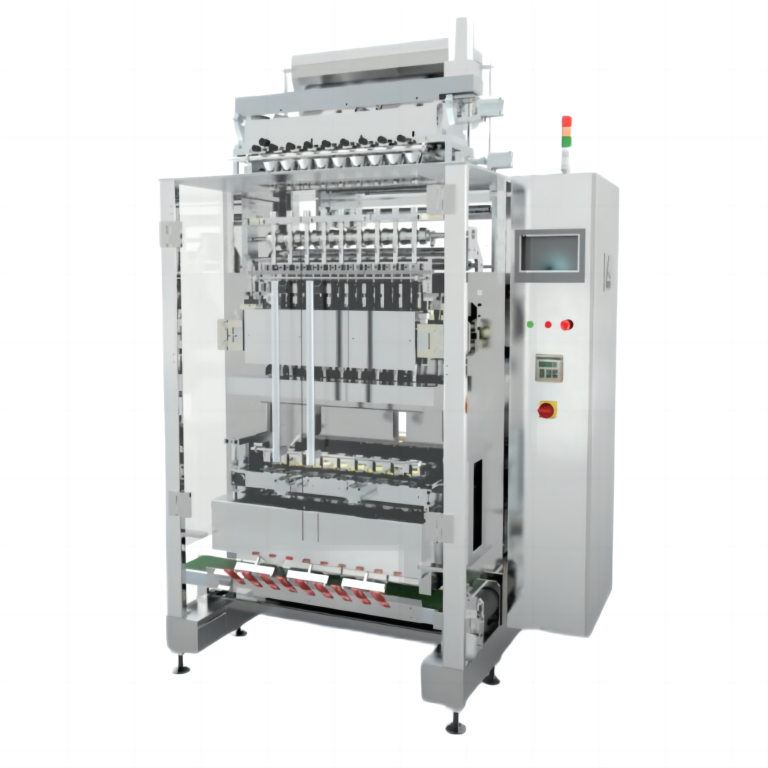
Tabletop Sachet and Stick Pack Machines
Small-format machines that produce single-serve packets from roll stock film. Think sugar packets, seasoning sachets, sample-size protein powder sticks.
- Tốc độ: 30–60 packets per minute (single lane)
- Price: $10,000–$20,000
- Best for: Single-serve powders, spice blends, sample packets, pharmaceutical sachets
- Limitation: Very specific use case. Not useful if you’re packaging anything other than single-serve portions.
If single-serve is exactly what you need, our stick packing machine page covers both tabletop and floor-standing models.
The Honest Take on Tabletop Machines
They’re the right tool when your product specifically calls for them: liquids in pouches, single-serve packets, small-batch specialty items. They’re not the right tool when you just want “something cheap and small.” A semi-auto VFFS gives you more speed, more flexibility, and lower per-bag cost for the same or slightly more investment. Don’t buy a tabletop machine because it looks approachable. Buy it because your product needs what it specifically does.
Real Numbers: What Do Small Producers Actually Buy?
I pulled data from our own recommendations, customer conversations, and industry patterns. Here’s what small producers actually purchase, not what manufacturers advertise, but what ends up on production floors.
Most Common First Machine Purchases
| Loại máy | % of First Purchases | Typical Buyer Profile | Average Daily Volume |
|---|---|---|---|
| Band sealer + pre-made bags | 28% | Farmers market sellers, home-based food producers, first-time packagers | 200–1,000 units |
| Semi-automatic VFFS | 44% | Growing food brands, coffee roasters, spice companies, supplement producers | 1,000–8,000 units |
| Tabletop pouch machine | 12% | Sauce makers, nut butter producers, cosmetic brands | 500–3,000 units |
| Entry-level automatic VFFS | 11% | Brands scaling past semi-auto, contract packers taking on first clients | 5,000–15,000 units |
| Other (stick pack, sachet, liquid filler) | 5% | Specialized single-serve products, pharmaceutical samples | Thay đổi |
Notice the numbers. Nearly three-quarters of first purchases are band sealers or semi-auto VFFS machines. That’s not because those are the only options: it’s because they’re the right options for the volume and budget most small producers have.
Typical Upgrade Timeline
| Starting Point | Upgrade Trigger | Timeframe | Typical Upgrade |
|---|---|---|---|
| Hand-sealing | Can’t keep up with orders | 3–6 months | Band sealer |
| Band sealer | Volume exceeds 2,000 units/day or labor cost hurts | 6–12 months | Semi-auto VFFS |
| Semi-auto VFFS | Running 4+ hours/day, need more throughput | 12–24 months | Entry-level automatic VFFS |
| Entry-level automatic | Multiple production lines or high-speed demand | 24–36 months | Mid-range automatic VFFS line |
The pattern is consistent. Most small producers make their first packaging machine purchase within 3–12 months of launching. They start at the level that matches their volume and budget, then upgrade when the machine becomes the bottleneck.
What Small Producers Spend (All-In)
I’m not talking about just the machine price. I’m talking about everything: machine, shipping, installation, first film order, spare parts, and the random things nobody tells you about.
| Setup | Machine Cost | All-In Cost (First Year) |
|---|---|---|
| Band sealer + bags | $500–$3,000 | $2,000–$8,000 |
| Semi-auto VFFS | $8,000–$25,000 | $12,000–$35,000 |
| Tabletop pouch machine | $5,000–$15,000 | $8,000–$22,000 |
| Entry-level automatic VFFS | $25,000–$50,000 | $35,000–$70,000 |
The all-in cost is typically 40–60% higher than the machine sticker price. Budget for it. The last thing you want is to buy a machine and not have money left for film to run through it.
Common Mistakes Small Producers Make
I see the same mistakes over and over. Learn from them:
Buying too much machine. You don’t need a $40,000 fully automatic line to package 1,000 bags a day. A semi-auto VFFS at a quarter of the price does the job. Buy for your volume today plus 12 months of growth, not for a fantasy scenario.
Ignoring film cost. The machine is a one-time cost. Film is forever. A machine that uses pre-made bags at $0.15 each costs $3,750 per month in materials at 1,000 bags/day. A VFFS running roll stock at $0.02 per bag costs $500. That’s $39,000 per year in savings. Film cost matters more than machine cost.
Skipping the learning curve. Every packaging machine has a learning curve. Budget 2–4 weeks of reduced output while your team gets proficient. Don’t schedule a major order delivery during the first month of a new machine.
Not buying spare parts upfront. Sealing wire, Teflon tape, heating elements: these wear out. Order a spare parts kit with the machine. When a seal wire breaks at 2pm on a production day, you don’t want to wait two weeks for a shipment from overseas.
Câu hỏi thường gặp
What is the best packaging machine for a small business?
A semi-automatic VFFS (vertical form fill seal) machine. It’s the best packaging machine for small business because it handles the most common product types (powders, granules, snacks, coffee), runs at 20–60 bags per minute, costs $8,000–$25,000, and uses inexpensive roll-stock film. For producers with very low volume or tight budgets, a band sealer with pre-made bags is the most affordable starting point.
How much does a small packaging machine cost?
A small packaging machine costs between $500 and $50,000 depending on the type. Band sealers start at $500–$3,000. Semi-automatic VFFS machines run $8,000–$25,000. Tabletop pouch machines are $5,000–$15,000. Entry-level automatic VFFS machines are $25,000–$50,000. Your first-year all-in cost (including film, spare parts, shipping, and setup) runs 40–60% above the machine price.
Can a startup afford a packaging machine?
Yes. A band sealer with pre-made bags gets you professional packaging for under $3,000 total investment. Many food startups begin this way and upgrade to a semi-automatic VFFS within 6–12 months as volume grows. An entry level packaging machine like a band sealer produces consistent, retail-ready seals that look far more professional than hand-sealing, and it does it at speeds no human can match.
What’s the cheapest way to start packaging a product?
Buy a continuous band sealer ($500–$1,500) and pre-made bags from a converter. Fill bags by hand with a scoop, funnel, or manual dispenser, then feed them through the band sealer. This gives you a professional, consistent seal at 5–15 bags per minute. Total starting cost: $1,500–$5,000 including the sealer, a case of bags, and basic filling tools. It’s the most affordable packaging equipment that produces retail-quality results.
Do I need an automatic packaging machine?
Not unless you’re packaging more than 3,000–5,000 units per day. A semi-automatic VFFS handles up to 8,000 units per day with one operator. An entry-level automatic makes sense when you’re running 4+ hours of packaging per day, your volume is growing past semi-auto capacity, or you need to free up an operator for other tasks. Most small producers don’t need full automation in their first year or two.
What packaging machine do I need for my product?
Start with your product type. Powders (protein, spices, flour) need a VFFS with an auger filler. Granules (rice, nuts, seeds) need a VFFS with a volumetric cup or small weigher. Liquids and sauces in stand-up pouches need a tabletop pouch machine or band sealer with spouted pouches. Solid items (bars, cookies) need a band sealer with flat pouches or a small flow wrapper. Not sure? Tell us your product and volume on our contact page and we’ll recommend the right setup.
Ready to Find Your Machine?
The best packaging machine for small business isn’t the most expensive one or the one with the most features. It’s the one that matches your volume, your product, your space, and your budget: today, not two years from now.
Start with where you are:
- Under $3,000 and low volume: Band sealer + pre-made bags. Get product out the door.
- $8,000–$25,000 and growing: Semi-automatic VFFS. Real speed, low film cost, room to scale.
- $25,000–$50,000 and scaling fast: Entry-level automatic VFFS. Hands-free operation, integrated filling, higher throughput.
Running a small operation? Tell us your product and daily volume: we’ll recommend the most cost-effective setup. Contact us here and get a straight answer within 24 hours.
No sales pitch. No pressure. Just honest advice about which packaging machine for small producers actually makes sense for what you’re building.




 English
 Spanish
 German
 Korean
 Arabic
 French
 Italian
 Japanese
 Thai
 Vietnamese
 Portuguese
 Swedish