You’re shopping for a packaging machine and every supplier asks the same question: “Do you want semi-automatic or fully automatic?” You nod, say you’re thinking about it, and then realize you don’t actually know the full implications of either choice. The price gap is enormous. The speed difference is real. And the wrong pick means either overspending on capability you don’t need or boxing yourself into a machine you outgrow in six months.
I’ve walked hundreds of buyers through this exact decision. The answer isn’t “automatic is better” or “semi-auto saves money.” It depends on your volume, your labor situation, your product mix, and how fast you’re growing. This article lays out every factor that matters so you can make the call with confidence.
Key takeaways:
- Semi-automatic packaging machines cost $8,000–$25,000 and produce 20–60 bags per minute with one operator controlling the cycle
- Fully automatic machines cost $25,000–$150,000+ and run 60–300+ bags per minute with minimal operator involvement
- The break-even point for upgrading from semi-auto to automatic typically lands between 5,000 and 10,000 units per day
- Labor cost is the biggest hidden variable: a fully automatic machine eliminates one full-time operator, which saves $30,000–$55,000 per year
- Semi-auto wins when you have low volume, frequent changeovers, limited capital, or an operator who can multitask
- Full automation wins when you’re running high daily volume, multiple shifts, or when labor is hard to find and expensive
Why Does This Decision Trip Up So Many Buyers?
Because “semi-automatic” and “fully automatic” sound like simple categories, but the reality is a spectrum, and most buyers don’t realize how many variables beyond speed are affected by their choice.
Here’s what typically happens. A buyer sees a semi-automatic VFFS machine listed at $12,000 and a fully automatic model at $55,000. The semi-auto spec sheet says “up to 60 bags per minute.” The automatic says “up to 120 bags per minute.” So the buyer thinks: the automatic is twice as fast and costs four times as much. Semi-auto seems like the obvious value play.
That reasoning isn’t wrong, but it’s incomplete. The speed numbers on spec sheets are theoretical maximums. A semi-automatic machine at 60 bags per minute requires an operator standing there, triggering every cycle, for the entire production run. A fully automatic machine at 120 bags per minute runs by itself while one person monitors the line. The labor equation changes everything.
And that’s before you factor in consistency (machines don’t get tired), changeover time (automatic machines store recipes, semi-auto requires manual recalibration), waste rates (automatic machines hold tighter fill tolerances), and what your production looks like 18 months from now.
The buyers who get tripped up are the ones who only compare sticker price and maximum speed. The ones who make a confident decision compare total cost of ownership, daily output needs, labor availability, and growth trajectory.
What Does Semi-Automatic Actually Mean?
A semi-automatic packaging machine handles film pulling, bag forming, sealing, and cutting on its own, but relies on an operator to trigger each fill cycle, load product into the hopper, and manage changeovers. The machine does the repetitive mechanical work; the person handles the timing and material flow.
Let me break down exactly what happens during a production run on a semi-automatic packaging machine:
- You load a roll of film onto the machine and thread it through the forming collar
- You set the bag length, seal temperature, and fill weight on the control panel
- You pour your product into the hopper
- The machine pulls film down, forms a tube, and seals the bottom
- You press a foot pedal or button to trigger the fill cycle
- The filling system (auger, volumetric cup, or weigher) dispenses product into the bag
- The machine seals the top and cuts the bag free
- Repeat steps 5–7 for every bag
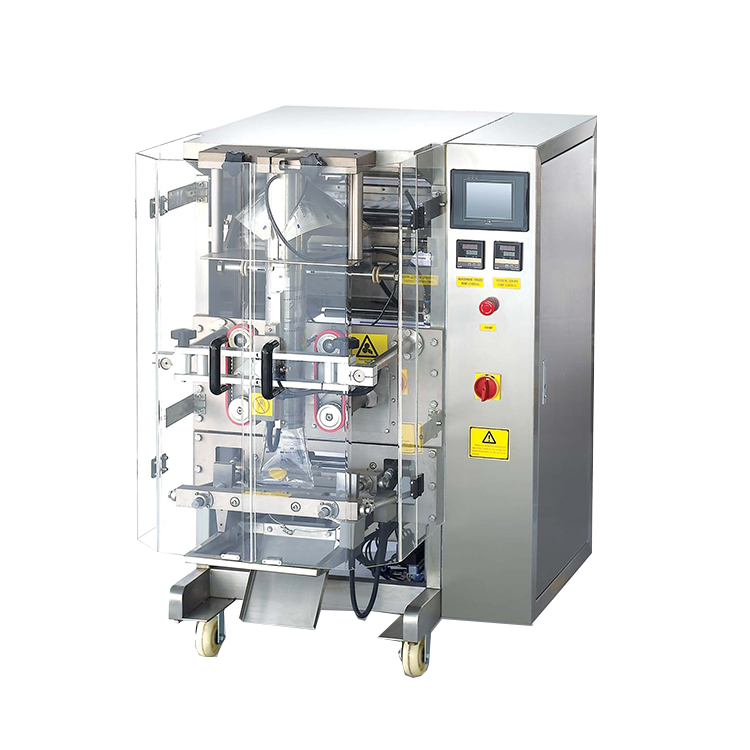
That foot pedal is the defining feature. It’s what makes the machine “semi” automatic. You control the rhythm. If you’re fast and consistent, you can push the machine close to its maximum rated speed. If you’re tired, distracted, or new to the machine, output drops.
What Semi-Auto Does Well
- Low entry cost. You’re getting a real production machine (one that forms bags from inexpensive roll stock film), for $8,000–$25,000. That’s a fraction of what a fully automatic line costs.
- Flexibility. Most semi-auto machines handle a wide range of bag sizes (60–250mm wide, 80–350mm long). Changing between sizes takes 15–30 minutes of manual adjustment. You can run multiple SKUs on the same machine without needing separate production lines.
- Simplicity. Fewer automated systems means fewer things that can break. Maintenance is straightforward. Most operators learn to run the machine confidently within a week.
- Low film cost. Like automatic machines, semi-auto VFFS units form bags from roll stock film at $0.005–$0.04 per bag. That’s dramatically cheaper than pre-made pouches.
Where Semi-Auto Shows Its Limits
- Operator dependency. The machine stops when the operator stops. Bathroom break, phone call, fatigue: production pauses. You’re also tying up one person for the entire packaging run.
- Speed ceiling. Even with an experienced operator, 40–50 bags per minute is the realistic sustained rate on most semi-auto machines. Theoretical maximums of 60+ are hard to maintain over multi-hour runs.
- Fill consistency. Operator timing affects fill accuracy, especially with auger systems. An operator who triggers the cycle a half-second late or early can introduce weight variation.
- Changeover time. Switching bag sizes or products requires manual mechanical adjustments: changing forming tubes, resetting fill parameters, adjusting seal temperatures. Expect 15–45 minutes per changeover depending on the complexity.
Who Semi-Auto Fits Best
A semi automatic packaging machine is the right fit when you’re producing 500–8,000 units per day, running one shift, managing 2–6 SKUs, and have an operator who can dedicate their time to the packaging line during production runs. It’s the most common starting point for growing food brands, coffee roasters, spice companies, and supplement producers.
What Does Fully Automatic Give You?
A fully automatic packaging machine runs the entire forming-filling-sealing cycle continuously without operator intervention. You load product into the hopper and film onto the roll stand; the machine handles everything else: including fill timing, bag length control, seal temperature management, film tracking, and batch counting.
Here’s what changes when you step up to full automation:
The machine runs on its own cycle. No foot pedal. No operator triggering each bag. You set the parameters (bag dimensions, fill weight, speed, seal temperature), on the PLC touchscreen, press start, and the machine produces bags at a steady rate until the hopper runs low or the film roll needs changing.
An operator’s role shifts from “running the machine” to “monitoring the line.” They keep the hopper filled, watch for jams or seal issues, replenish film rolls, and perform quality checks. One person can often monitor two or three automatic machines simultaneously.
What You Gain with Full Automation
- Sustained high speed. Fully automatic machines run 60–300+ bags per minute and hold that rate for entire shifts. There’s no operator fatigue factor. The machine runs at the same pace in hour six as it did in hour one.
- Consistent fill accuracy. Integrated filling systems (auger fillers with servo-driven dosing, multihead weighers with computer-controlled combination weighing), hold fill weights to tight tolerances (often +/-0.5–1.5g). No operator timing variation.
- Recipe storage and fast changeover. Touchscreen controls store parameter sets for different products and bag sizes. Switching from SKU A to SKU B takes 2–10 minutes: recall the recipe, swap the forming tube if needed, verify the first few bags. Compare that to 15–45 minutes of manual adjustment on a semi-auto machine.
- Lower waste. Tighter fill control and consistent seal quality mean fewer rejected bags. Automatic machines typically run at 1–3% waste rates versus 3–7% on semi-auto with an average operator.
- Data collection. Modern automatic machines track production counts, uptime, fill weights, and fault codes. You get real production data instead of estimates.
- Labor reallocation. The operator who was dedicated to the packaging line can now manage multiple machines or handle other production tasks.
What You Trade Away
- Capital cost. Entry-level automatic machines start around $25,000–$50,000. High-speed industrial systems run $65,000–$150,000+. That’s a significant investment compared to a $12,000 semi-auto.
- Complexity. More automated systems means more components that can fail. Servo motors, photocell sensors, PLC controllers, pneumatic actuators: these require trained troubleshooting. Your maintenance requirements go up.
- Setup time. Getting an automatic machine dialed in takes longer on day one. Initial parameter tuning, filling system calibration, and film tracking setup can take a full day. Semi-auto machines are often running production within a few hours of uncrating.
- Overkill at low volume. If you’re packaging 1,000 bags a day, a machine capable of 150 bags per minute spends most of its time idle. You’ve paid for capacity you don’t use.
Who Full Automation Fits Best
Fully automatic packaging machines make sense when you’re producing 5,000–50,000+ units per day, running multiple shifts or long single shifts, managing several SKUs with frequent changeovers, and need to minimize per-unit labor cost. Large food producers, contract packagers, and established brands with stable demand profiles fit this category.
Head-to-Head Comparison Table
Here’s how semi-automatic and fully automatic packaging machines stack up across the factors that actually affect your buying decision.
| Faktor | Halvautomatisk | Helautomatisk |
|---|---|---|
| Price range | $8,000–$25,000 | $25,000–$150,000+ |
| Speed range | 20–60 bags/min (operator-dependent) | 60–300+ bags/min (machine-driven) |
| Realistic sustained speed | 30–45 bags/min over a full shift | Matches rated speed for full shifts |
| Operator requirement | One dedicated operator | One operator monitoring 1–3 machines |
| Daily output (single shift) | 2,000–15,000 bags | 15,000–100,000+ bags |
| Fill accuracy | +/-1–3% (operator-dependent) | +/-0.5–1.5% (machine-controlled) |
| Changeover time | 15–45 minutes (manual) | 2–10 minutes (recipe recall) |
| Waste rate | 3–7% | 1–3% |
| Film cost per bag | $0.005–$0.04 (roll stock) | $0.005–$0.04 (roll stock) |
| Maintenance complexity | Låg | Moderate to high |
| Learning curve | 1–2 weeks | 2–4 weeks |
| Floor space | Compact (0.5–1.0 sq m) | Larger (1.5–4.0 sq m + auxiliaries) |
| Best daily volume | 500–8,000 units | 5,000–50,000+ units |
| Power requirement | 220V single phase | 220V/380V three phase |
| Auxiliary integration | Begränsad | Full (conveyors, check weighers, metal detectors) |
Both categories form bags from roll stock film, so your material cost per bag is the same. The differences are all about speed, labor, consistency, and capital.
All prices in this guide are indicative estimates for budgeting, based on market observation. Confirm current pricing with suppliers for your specific configuration.
When Does Semi-Automatic Make More Sense?
Semi-automatic makes more sense when your daily volume is under 8,000 units, you have reliable labor available, your budget is under $30,000, or you’re running frequent small-batch jobs that require regular changeovers.
Let me give you specific scenarios where I’d steer a buyer toward a semi-automatic packaging machine every time.
Scenario 1: The Growing Startup
You launched six months ago. You’re packaging 2,000–4,000 units per day. You have one or two people in production, and one of them handles packaging for a few hours each morning. Your product line has 3–4 SKUs and you change over the machine once or twice per day.
A semi-auto VFFS at $12,000–$18,000 is your sweet spot. You don’t have the volume to justify a $50,000 automatic machine, and your operator is already there doing other production tasks. The packaging machine runs for 2–4 hours and then they move on to something else.
If you buy a fully automatic machine at this stage, you’re spending $30,000–$40,000 more than you need to for capacity that sits idle most of the day. That money is better spent on marketing, inventory, or product development.
Scenario 2: The Multi-SKU Artisan Producer
You run a specialty spice company with 12 SKUs. Each SKU runs 500–2,000 units per production day. You change over the machine 4–6 times per shift.
Semi-auto wins here because changeover flexibility matters more than raw speed. On a semi-automatic machine, you swap the forming tube, adjust the fill system, tweak the seal temperature, and you’re running again in 20 minutes. The total daily output might be 8,000–10,000 units across all SKUs (well within semi-auto capacity), but the machine needs to be nimble.
Fully automatic machines handle changeovers faster when they’re recipe-driven, but the initial setup for 12 different SKUs takes time, and some of your small-batch runs don’t last long enough for the automatic machine to hit its stride.
Scenario 3: The Budget-Conscious Buyer
You have $15,000 to spend. That’s it. You need a machine that works, produces professional results, and doesn’t require financing.
Semi-automatic gets you a quality machine with change parts and spare parts for under $20,000 all-in. Fully automatic at this price point means buying the cheapest import available, and that brings reliability risks that eat your savings in downtime and frustration.
Scenario 4: The Operator-Multitasker
Your production floor has three people. One handles mixing and prep. One handles packaging. One handles shipping and cleanup. The person on packaging runs the machine for 4 hours and then helps with other tasks for the rest of the day.
In this setup, a semi-auto machine fits naturally. The operator is already there. They’re not exclusively a “packaging machine operator”: they’re a production team member who runs the packaging machine part of the day. You don’t gain much from a fully automatic machine in this labor model because the person is there regardless.
When Should You Go Fully Automatic?
Go fully automatic when your daily volume exceeds 8,000–10,000 units, you’re running the packaging line more than 4 hours per day, labor is scarce or expensive, or you need tight fill consistency for regulatory or cost reasons.
Here are the specific situations where full packaging machine automation pays for itself.
Scenario 1: The Volume Crossover
You’re producing 12,000–15,000 units per day on a semi-auto machine. Your operator is running the machine 6–8 hours per day, every day. They’re good at it, but they’re tired by hour five. Output drops. Waste creeps up. You’re considering hiring a second operator to split the shift.
This is the classic crossover point. At 12,000+ units per day, the labor savings from a fully automatic machine (eliminating one full-time operator position), pays for the machine price difference within 12–18 months. And you get higher sustained speed, better fill consistency, and lower waste on top of the labor savings.
Scenario 2: The Multi-Shift Operation
You’re running two or three shifts. Your semi-auto machine needs a dedicated operator on each shift. That’s two or three people whose primary job is pressing a foot pedal and keeping the hopper full.
A fully automatic machine runs all three shifts with one person monitoring the line across all shifts (or one per shift with time for other tasks). The labor savings multiply fast in multi-shift operations. Three operators at $35,000/year each is $105,000 in annual labor. If automation cuts that to one monitoring role at $40,000/year, you’ve saved $65,000 per year. The machine pays for itself in under a year.
Scenario 3: The Consistency-Critical Product
You’re packaging pharmaceutical supplements, medical products, or food items with strict net weight regulations. Fill accuracy of +/-1% isn’t good enough. You need +/-0.5% or tighter, and you need documentation proving every batch met spec.
Fully automatic machines with servo-driven auger fillers or multihead weighers hit these tolerances consistently and log the data. A semi-auto machine with an operator-controlled fill cycle introduces human variation that’s difficult to eliminate entirely.
Scenario 4: The Expanding Brand
Your brand is growing fast. You were at 3,000 units per day a year ago. Now you’re at 8,000. Your projections say 15,000–20,000 within 12 months. You’re adding SKUs, entering new retail channels, and potentially taking on contract packaging work.
Buying a semi-auto machine now means buying again in 12 months when you outgrow it. Buying a fully automatic machine now means you have headroom to grow into. The higher upfront cost is an investment in not having to upgrade, and not having to sell a used semi-auto machine at a loss.
For this scenario, I’d also look at whether a pouch filling machine fits your product format. If you’re moving into premade stand-up pouches with zippers, a fully automatic pouch machine handles the format that VFFS machines can’t.
What’s the Break-Even Point for Upgrading?
The break-even point for upgrading from a semi-automatic to a fully automatic packaging machine typically falls between 5,000 and 10,000 units per day, with a payback period of 8–18 months depending on your labor costs and the specific machines you’re comparing.
Let me run the numbers so you can see exactly where the crossover happens for your situation.
The Cost Comparison Framework
I’m going to compare two realistic setups:
- Setup A: Semi-automatic VFFS at $15,000, running 35 bags per minute sustained, one dedicated operator
- Setup B: Entry-level automatic VFFS at $40,000, running 80 bags per minute sustained, one operator monitoring (shared with other tasks)
Annual Operating Cost Comparison
| Cost Factor | Semi-Automatic (Setup A) | Fully Automatic (Setup B) |
|---|---|---|
| Machine price (one-time) | $15,000 | $40,000 |
| Operator labor (annual) | $35,000 (dedicated) | $0 (operator shared with other tasks) |
| Film cost (same for both) | $0.02/bag | $0.02/bag |
| Maintenance (annual) | $800–$1,500 | $2,000–$4,000 |
| Waste (annual, at $0.02/bag) | 5% waste rate | 2% waste rate |
| Electricity (annual) | $600–$1,000 | $1,200–$2,000 |
Break-Even at Different Daily Volumes
Let’s look at the total annual cost (machine amortized over 5 years + operating costs) at three volume levels:
At 3,000 units per day (750,000 units/year):
- Semi-auto: $3,000 (amortized) + $35,000 (labor) + $1,200 (maintenance) + $750 (waste) + $800 (power) = $40,750/year
- Automatic: $8,000 (amortized) + $0 (labor shared) + $3,000 (maintenance) + $300 (waste) + $1,600 (power) = $12,900/year, but you still have the operator on payroll doing other things, so real labor savings may be $15,000–$20,000 (partial reallocation), making it roughly $28,000–$33,000/year
At this volume, the automatic machine costs more per year than it saves. Semi-auto wins.
At 8,000 units per day (2,000,000 units/year):
- Semi-auto: $3,000 + $35,000 + $1,200 + $2,000 (waste) + $800 = $42,000/year
- Automatic: $8,000 + $0 (labor fully reallocated) + $3,000 + $800 (waste) + $1,600 = $13,400/year
At 8,000 units per day, the automatic machine saves roughly $28,600 per year. The $25,000 price premium pays for itself in under 12 months.
At 15,000 units per day (3,750,000 units/year):
- Semi-auto: $3,000 + $35,000 (likely 1.5–2 operators at this volume) + $1,500 + $3,750 + $1,000 = $44,250–$51,750/year
- Automatic: $8,000 + $0 + $3,500 + $1,500 + $1,800 = $14,800/year
At 15,000 units per day, you’re potentially running the semi-auto machine 7+ hours per day with an operator who can barely keep up. The automatic machine runs 3–4 hours and frees the rest of the day. Savings are $30,000–$37,000 per year.
The Quick Rule of Thumb
You don’t need to build a spreadsheet to make this call. Use these benchmarks:
| Daily Volume | Recommendation | Why |
|---|---|---|
| Under 3,000 units | Halvautomatisk | Not enough volume to justify the price difference |
| 3,000–5,000 units | Semi-automatic (plan to upgrade) | Semi-auto handles it, but start budgeting for automatic |
| 5,000–10,000 units | Either (depends on labor costs) | Break-even zone: labor cost is the tiebreaker |
| 10,000–20,000 units | Helautomatisk | Labor savings alone justify the upgrade |
| 20,000+ units | Fully automatic (industrial tier) | Semi-auto can’t physically keep up |
Your local labor rate matters. If operators cost $20/hour ($42,000/year), the break-even point shifts lower. If labor costs $12/hour ($25,000/year), semi-auto stays competitive at higher volumes. Adjust the numbers for your market.
Don’t Forget the Upgrade Path
One thing buyers often miss: you don’t have to start over. Many manufacturers offer trade-in programs or buyback guarantees when you upgrade from semi-auto to automatic within their product line. If you buy a semi-auto VFFS from a reputable manufacturer and outgrow it in 18 months, you might get 50–70% of your purchase price back as a trade-in credit toward an automatic model.
This means the risk of “buying wrong” is lower than it feels. Start with semi-auto if that matches your current volume. Upgrade when the numbers tell you to. The trade-in softens the financial impact.
Vanliga frågor
Is a semi-automatic packaging machine good enough for a growing business?
Yes, for most growing businesses a semi-automatic packaging machine is the right starting point. It handles 20–60 bags per minute, costs $8,000–$25,000, and uses inexpensive roll stock film. Most growing brands start with semi-auto and upgrade to fully automatic within 18–24 months when their daily volume crosses the 5,000–10,000 unit threshold. The upgrade path is well-established: many manufacturers offer trade-in programs when you move up.
How much faster is a fully automatic packaging machine?
A fully automatic packaging machine is typically 2–5 times faster than a semi-automatic in sustained real-world output. Semi-auto machines run 30–45 bags per minute over a full shift (operator fatigue reduces the theoretical maximum). Fully automatic machines maintain their rated speed (60–300+ bags per minute), for entire shifts without variation. At the entry level, an automatic VFFS at 80 bags per minute versus a semi-auto at 35 bags per minute is a realistic 2.3x speed advantage.
Can I upgrade a semi-automatic machine to fully automatic later?
Some semi-automatic machines can be upgraded with automatic filling systems, auto-cycle timers, and conveyor integration. However, the cost of upgrading individual components often approaches the price of a new automatic machine, and you still won’t match the performance of a purpose-built automatic unit. In most cases, upgrading means selling or trading in your semi-auto machine and purchasing a fully automatic one. Check with your manufacturer about trade-in programs before buying.
What’s the main difference between manual vs automatic packaging?
Manual vs automatic packaging comes down to who controls the cycle. In manual or semi-automatic packaging, an operator triggers each bag cycle, loads product, and manages timing. In fully automatic packaging, the machine runs the entire cycle on its own (forming bags, filling, sealing, cutting, and counting), with an operator monitoring rather than driving. The jump from manual to automatic packaging eliminates operator fatigue as a variable, increases sustained output, and reduces per-unit labor cost.
Does packaging machine automation save money?
Packaging machine automation saves money when your daily volume is high enough to offset the higher equipment cost with labor savings. At 8,000+ units per day, a fully automatic machine typically saves $20,000–$35,000 per year in operator labor, waste reduction, and throughput gains. At lower volumes (under 3,000–5,000 units per day), the equipment cost premium isn’t recovered fast enough to make automation the cheaper option. Run the break-even calculation for your specific volume and labor rate.
What packaging machine automation level do I need for my product?
Start with your daily volume. Under 3,000 units per day: semi-automatic or a band sealer with pre-made bags. 3,000–10,000 units: semi-automatic if you have reliable labor; fully automatic if labor is expensive or scarce. Over 10,000 units: fully automatic. Then factor in your product type (powder, liquid, granule, solid), your SKU count, and your changeover frequency. Products requiring tight fill tolerances or regulatory documentation benefit from full automation regardless of volume. If you’re not sure, tell us your product and volume: we’ll give you a specific recommendation.
Ready to Make the Call?
The automatic vs semi-automatic packaging machine decision isn’t about which technology is “better.” It’s about which one matches your operation right now and for the next 18–24 months.
Here’s the short version:
- Under $25,000 budget, under 5,000 units/day: go semi-automatic. It gets the job done and leaves capital for other parts of your business.
- Growing past 8,000 units/day, running long shifts: go fully automatic. The labor savings and throughput gains pay for the difference within a year.
- Somewhere in between: the break-even zone. Your labor cost and growth rate are the tiebreakers.
For a fuller picture of what machines cost at each automation level, see our packaging machine cost guide.
Not sure which level of automation fits your operation? Tell us your daily volume and labor situation: we’ll run the numbers. Contact us here and get a straight answer with real ROI math, no guesswork required.



 English
 Spanish
 German
 Korean
 Arabic
 French
 Italian
 Japanese
 Thai
 Vietnamese
 Portuguese
 Swedish