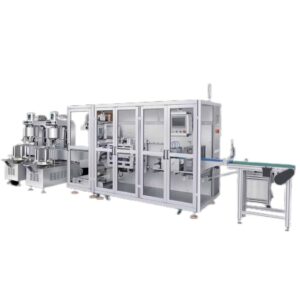
A sachet packing machine with 4-side seal pulls film from a roll, folds it flat, heat-seals the sides, fills several sachets at once in parallel lanes, then seals and cuts them into individual finished packs. The format is the workhorse of single-serve: sugar and coffee sticks, sauce and shampoo sachets, medicine powder packs, water sachets. One machine with four, six, or ten lanes multiplies output by the lane count at a fraction of the machine count, which is why almost every emerging-market sachet producer standardizes on this design.
Key takeaways:
- 4-side seal = flat web, sealed on all four edges. One film reel feeds all lanes; each lane is a miniature vertical form-fill-seal channel in parallel.
- Lanes multiply output. A 4-lane machine at 40 cycles per minute makes 160 sachets per minute; the same frame with 10 lanes makes 400.
- Filling system follows product state. Liquids use volumetric piston or gravity fillers; powders use auger or volumetric cup dosers; granules use vibration-fed cups.
- Sachet width fixes lane count. Narrow lanes fit more side by side; wide sachets cap the count on a given machine width.
- Seal quality is a temperature, pressure, and dwell problem. Sachet films are thin laminates; sealing windows are tighter than on pouch machines.
- Indicative pricing: entry multi-lane sachet machines run roughly $15,000-$40,000; servo, high-lane-count models reach $60,000-$150,000+.
How the Machine Works, Lane by Lane
Follow one film roll through the machine:
- Unwind and treat. The reel unwinds under tension control; a heater or corona treater prepares the sealing surface where the film chemistry needs it.
- Forming. The flat web passes folding plows that channel it into parallel vertical tubes, one per lane. Unlike a round bagger, there is no tube former spinning a cylinder: sachets stay flat.
- Vertical (back) seal. For a true flat sachet, the horizontal edges are sealed crosswise and the film is pre-creased into lanes; depending on design, lane dividers seal lengthwise between lanes.
- Fill. All lanes dose simultaneously: each lane has its own filling head fed from a common hopper or manifold. One machine cycle fills every lane once.
- Horizontal seal and cut. Cross-seal jaws close across all lanes, sealing the top of one sachet and the bottom of the next, and a cutter (or the jaws themselves) separates finished sachets downstream.
Because every lane does the same thing every cycle, the machine’s output in sachets per minute is simply lanes multiplied by cycles per minute. That multiplication is the entire economic argument for the format.
Lane Economics: Sizing the Machine
| Lanes | Cycles/min | Sachets/min | Typical sachet width | Indicative price range |
|---|---|---|---|---|
| 2-4 | 30-50 | 60-200 | 40-120 mm | $15,000-$35,000 |
| 5-8 | 30-50 | 150-400 | 25-80 mm | $30,000-$70,000 |
| 10-14 | 25-45 | 250-600 | 15-50 mm | $60,000-$150,000 |
| 16+ (high speed) | 30-60 | 500-1,000+ | 15-40 mm | $100,000-$250,000+ |
All prices in this guide are indicative estimates for budgeting, based on market observation. Confirm current pricing with suppliers for your specific configuration.
Three sizing rules from installed lines:
- Compute from sachet width, not ambition. Machine width caps total web width; wider sachets mean fewer lanes. A 100 mm sauce sachet on a mid-width frame realistically runs 4-6 lanes.
- Cycles per minute decline with fill size. Big doses (50 ml and up) take longer to dose and settle; tiny doses fly. Do not assume a machine’s fastest cycle rating applies to your largest sachet.
- Buy lanes for the peak SKU. If one product drives your season, size lanes for it and accept overcapacity elsewhere, rather than buying a second machine later.
Filling Systems by Product
The filling station is where sachet machines differentiate most, because dose accuracy and product behavior drive the choice:
| Product | Filling system | Watch for |
|---|---|---|
| Free-flowing liquid (water, sanitizer) | Gravity or timed-flow | Drip cut-off at high speed |
| Viscous liquid (sauce, shampoo, honey) | Piston (volumetric) | Suck-back nozzles for stringy product |
| Powder (coffee, milk powder, pharma) | Auger with servo | Flush with inert gas if needed; dust extraction |
| Granules (sugar, salt, grains) | Volumetric cup or vibration feed | Friable granules and dust |
| Tablets / capsules | Counting or strip systems | Breakage; often a different machine class |
Accuracy expectations: volumetric liquid systems hold roughly plus or minus 1-2% of dose; auger powder systems similar or better on consistent product; granule cup systems vary with granule density and are the loosest of the three. Pharma-grade sachets add checkweighers or 100% weight control, which is a separate investment on the discharge conveyor.
Sachet vs Stick Pack vs Single-Lane Machines
Stick packs are sachets’ narrow cousins: the same multi-lane principle with long, slender tubes (typically 12-30 mm wide) for coffee, sugar, and powder drinks. The machines look similar; the forming sets differ. If your product is a single-serve powder drink, compare both formats on consumer appeal before committing; the equipment class is nearly the same, as shown in our stick pack machine overview.
Single-lane 4-side seal machines make one sachet per cycle. They suit pharma small-batch, lab work, and very wide sachets, but at production volume the multi-lane design wins on cost per sachet by a wide margin.
Pre-made sachet machines fill already-formed sachets from a magazine: highest presentation quality (printed premade sachets look better than formed-on-machine), lowest speed, highest pack cost. They fill a premium niche the roll-fed multi-lane machine does not try to fill. To see the multi-lane roll-fed configuration as we build it, our sachet packing machine product page is a working example of the layout described above.
Films, Sealing, and the Defects That Matter
Sachet laminate choices (PET/PE, PET/AL/PE, paper/AL/PE, and mono-material recyclables) decide shelf life, but the machine’s job is the same: deliver heat, pressure, and dwell time inside the film’s sealing window.
A worked lane example. A contract packer must produce 250,000 sachets of 5 g chili powder per day on a single 8-hour shift. That is roughly 520 sachets per minute of running rate, which with 85% uptime reality means a nominal capacity near 620 per minute. On the table above, that lands on a 12-14 lane machine at 45+ cycles per minute with an auger filling system, or two smaller 8-lane machines run in parallel. The two-machine route costs more but survives one machine’s maintenance day; the single wide machine is cheaper per sachet but makes the whole daily volume hostage to one frame. Plants with seasonal peaks routinely choose the pair for exactly that reason.
Dust management on powder lanes. Powder sachet lines generate airborne fines at the fill point, and fines landing on the horizontal seal area are the top cause of leak rejects. A production-grade powder line includes dust extraction hoods at the filling manifold, suck-back or drip-cut nozzles, and a wipe-down or brush station ahead of the cross-seal jaws. On multi-lane frames, also check how the hopper agitator is sealed; powder packing is one of the few applications where machine hygiene and machine output are the same subject.
Static and film tracking. Thin sachet films carry static charge that pulls the web toward machine frames and misregisters lanes. Anti-static bars at unwind and just before the cross-seal are inexpensive and widely effective. Watch the film path during any factory test for tracking drift: a web that wanders a few millimeters over an hour will produce lane-to-lane seal differences that show up later as customer complaints rather than machine faults.
Common defects and their usual causes:
- Leaking seals: temperature drift, worn jaw cushioning, or product contamination in the seal zone (a fill-nozzle drip landing on the seal area).
- Wrinkled seals: uneven jaw pressure, misaligned lane dividers, or film path drag.
- Bursting at the fill point: filling too fast into a closed headspace, or sealing before product settles.
- Weight variation: product density changes (humidity in powder), worn auger flights, or air entrapment in viscous product.
Operators who log seal temperature curves and dose samples by shift catch these early. For the wider maintenance discipline, the packaging machine maintenance checklist applies to sachet lines directly, especially jaw cleaning and film-path inspection.
Frequently Asked Questions
How fast are sachet packing machines?
Entry 4-lane machines make roughly 120-200 sachets per minute; mid-range 8-lane designs reach 300-400; high-speed 12+ lane machines pass 500-600. Above that, lines run twin machines rather than ever-wider frames.
Can one machine run different sachet sizes?
Yes, by changing lane kits and filling heads: a machine set for six wide lanes might reconfigure to eight narrow ones. Changes are a real project (forming set, seal jaws, cutters, filling heads), typically hours not minutes, so plants batch production by format.
What products cannot run on 4-side seal sachet machines?
Highly foaming carbonated liquids, chunky sauces with large pieces (particle size vs nozzle bore), and products needing sterile filling in premade sterilized sachets. Each needs either a different machine class or significant customization.
How accurate is the fill?
Volumetric systems typically achieve plus or minus 1-2% under stable conditions. Trade-metrology rules in many markets require weight compliance checks; a checkweigher or statistical sampling plan closes that requirement.
What happens downstream of the cutter?
Finished sachets drop onto a discharge conveyor where the standard additions are a date coder (inkjet or thermal transfer over the seal area), a checkweigher or reject gate for weight outliers, and collection into buckets or counted cartons. Multi-lane output is fast, so the collection point needs buffering (a rotary table or accumulating conveyor) or operators get buried at every machine stoppage.
Where do I buy sachet film, and does it matter?
Film is the largest cost per sachet and the most common source of seal problems, so qualify a converter early: supply them your machine’s seal-curve data, run their laminate on your machine before committing volume, and keep a second qualified source. Print registration tolerance and consistent coating weight matter as much as barrier rating.
What utilities does a sachet line need?
Three-phase power, clean dry compressed air, and potable-grade product supply plumbing. Powder lines benefit from dust extraction at the filling area. Steam is only needed for sterilizable designs. Film storage climate control (stable temperature and humidity) quietly prevents more seal problems than any machine setting.
Is the water sachet business different?
Yes: very high volumes, thin mono-film, aggressive price competition, and hygiene regulation specific to drinking water. The machine class is the same multi-lane 4-side seal design at the large-dose end; see our water sachet packaging machine page for that application. If you are sizing a first sachet line and want a lane-count and filling recommendation for your product, contact us with the dose size, product type, and target output.