You’ve decided that a stand-up pouch is the right package for your product. Good call: doypack pouches give you shelf impact that flat bags can’t match, and consumers pick them up faster on retail shelves. But now you’re staring at machine spec sheets, trying to figure out whether you need a rotary turret system or a linear indexing unit, whether your zipper pouch requires a dedicated applicator station, and what “60 pouches per minute” actually means in real-world production.
I’ve helped buyers navigate these decisions across every application: coffee, pet food, baby food, protein powder, sauces, you name it. This guide maps every stand up pouch packaging machine option to the application it serves best. You won’t get generic advice here. You’ll get specific machine-to-product matching so you can buy with confidence.
Key takeaways:
- Stand-up pouches now account for a large share of new flexible packaging launches in food and beverage; the format has moved from niche to mainstream
- Rotary pouch machines handle 30–80+ pouches/minute across 6–12 stations; linear pouch machines run 10–40 pouches/minute at a lower entry price
- Zipper, spout, and valve features each add dedicated stations to the machine cycle, and not every machine can accommodate them
- Food, pet food, and personal care are the three largest application segments for premade pouch filling machines
- Machine speed claims on spec sheets often reflect ideal conditions: real-world sustained output is typically 70–85% of the quoted maximum
Why Is Stand-Up Pouch Packaging Taking Over Retail Shelves?
Because stand-up pouches combine three things that no other flexible format delivers simultaneously: vertical shelf presence, reclosability, and premium brand perception, and that combination directly lifts retail sell-through rates.
Walk through any grocery store and count the stand-up pouches. Coffee. Pet treats. Baby food. Snack nuts. Protein powder. Liquid soups. Dried fruit. You’ll find doypack packaging in nearly every aisle. Ten years ago, these products sat in tin-tie bags, cans, jars, or flat pillow pouches. Today the stand-up pouch owns the premium position.
The numbers tell the story. The stand-up pouch market has grown steadily in recent years. That growth isn’t coming from one industry. It’s coming from food, beverage, pet care, personal care, pharmaceuticals, and household products all shifting away from rigid packaging.
Why? Three reasons matter for your machine decision:
- Consumer preference. Shoppers associate the stand-up pouch with freshness and quality. The format lets them see the product through a clear window, reseal it with a zipper, and store it upright in the pantry. Convenience drives repeat purchase.
- Material efficiency. A stand-up pouch uses 60–70% less material by weight than a rigid container holding the same volume. Lower material weight means lower shipping cost per unit and a sustainability story that brand owners want to tell.
- Shelf differentiation. In a category where ten brands compete on the same shelf, the pouch that stands up wins. The upright format gives you a larger printable front face. You can add matte finishes, metallic accents, and clear windows: all of which are difficult or impossible on a pillow bag formed by a vertical form-fill-seal machine.
For you, the machine buyer, this retail shift means one thing clearly: if you’re launching or relaunching a consumer product, your brand team will probably ask for a stand-up pouch. And that means you need a premade pouch filling machine, not a VFFS line. A VFFS machine forms bags from roll stock. It can make gusset bags and pillow bags. It cannot run pre-made stand-up pouches with bottom gussets. That’s a different machine entirely, and that’s what this guide covers.
What Machine Types Handle Stand-Up Pouches?
Two machine architectures dominate premade pouch packaging: rotary turret machines and linear indexing machines. Both pick up a pre-made empty pouch, open it, fill it, seal it, and discharge it, but they do it in fundamentally different ways, and that difference drives your speed, cost, and flexibility.
Let me break them down before we get into application matching.
Rotary Turret Premade Pouch Machines
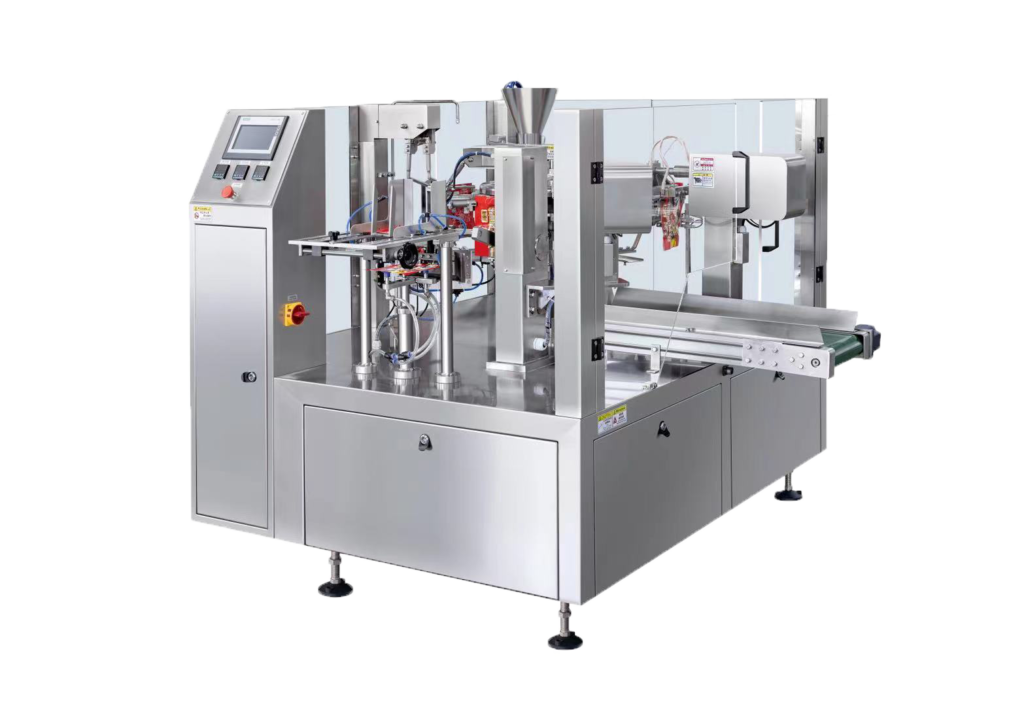
A rotary pouch machine holds pouches in a rotating carousel with 6, 8, 10, or 12 stations. The turret indexes station to station, and at each stop, one operation happens: pouch pickup, printing, pouch opening, filling (sometimes two fill stations), sealing, cooling, and discharge. Each station does one thing, and the carousel keeps moving.
Because every station runs simultaneously on different pouches, a rotary machine with 8 stations might complete 8 operations per revolution. That’s where the speed comes from. Rotary machines with servo-driven turrets and high-speed filling systems can sustain 50–80+ pouches per minute depending on pouch complexity and product type.
Rotary machines are the workhorse of the stand up pouch machine category. If you’re running a medium-to-high volume operation (5,000+ pouches per shift), a rotary unit is probably your starting point. Look for models with SS304 stainless steel construction on contact surfaces, servo-driven indexing for precision, and enough stations to handle your pouch features (zipper, spout, or valve).
Linear Indexing Premade Pouch Machines
A linear pouch machine moves pouches along a straight conveyor track, stopping at sequential stations. Same operations as the rotary (pickup, open, fill, seal, discharge), but laid out in a line instead of a circle.
Linear machines run slower. Typical output is 10–40 pouches per minute. They have fewer simultaneous operations because each station waits for the previous one to finish. But they have two real advantages:
- Lower cost. Entry-level linear machines start around $15,000–$30,000, compared to $35,000–$80,000+ for rotary units.
- Flexibility. Adding or removing stations is easier on a linear track. If you need a second fill station for a mixed product, or an extra seal station for thick film, a linear machine can often accommodate it without a major rebuild.
Linear machines make sense for small-to-medium producers, contract packagers running short campaigns, and companies packaging multiple SKU formats on one machine.
Which One Do You Start With?
Here’s my rule of thumb. If your daily output is under 5,000 pouches and you’re running 3–5 SKU changeovers per week, start with a linear machine. You’ll save money and gain flexibility. If your daily output is over 10,000 pouches and you’re running long campaigns with minimal changeover, go rotary. The speed difference pays for itself fast.
For a broader look at how premade pouch machines compare to other formats, see our pouch filling machine guide.
How Do You Choose Between Rotary and Linear Premade Pouch Machines?
You choose based on four variables: your daily volume, your number of SKUs, your pouch feature requirements, and your budget: in that order.
Let me walk through each one because this is the decision that locks in your production capability for the next 5–10 years.
Daily Volume
This is the first filter. It determines whether you need the speed of a rotary system or can get by with a linear unit.
| Daily Output (8-hour shift) | Recommended Machine Type | Typical Speed |
|---|---|---|
| Under 3,000 pouches | Semi-automatic or linear | 10–25 ppm |
| 3,000–10,000 pouches | Linear (multi-station) | 25–40 ppm |
| 10,000–30,000 pouches | Rotary (8–10 station) | 40–60 ppm |
| 30,000+ pouches | Rotary (10–12 station, dual-lane possible) | 60–80+ ppm |
That “ppm” stands for pouches per minute. When a manufacturer quotes speed, ask them two questions: “Is that sustained speed over a full shift?” and “Is that with or without zipper/spout stations active?” The answers will differ, sometimes by a lot.
SKU Count and Changeover Frequency
If you run one product in one pouch size all day, every day, any machine works fine. But if you’re a contract packager running 8 SKUs a week (different pouch sizes, different products, different closure types), changeover time becomes critical.
Linear machines generally offer faster changeover. Pouch format changes on a linear unit take 15–30 minutes with adjustable guide rails and quick-change filling funnels. Rotary machines require more involved change parts: the pouch grippers, opening suction cups, and fill funnels all need to match the new pouch dimensions. Plan 30–60 minutes for a full changeover on a rotary turret.
Some rotary machines now offer servo-adjustable stations that reduce changeover to recipe selection on the HMI. These cost more upfront but save significant production time if you’re changing formats daily.
Pouch Feature Stations
Here’s where the rotary vs. linear decision gets interesting. Every pouch feature (zipper, spout, degassing valve), requires a dedicated station on the machine. A basic pouch with no closure needs: pickup, coding, opening, filling, sealing, discharge: that’s 6 stations. Add a zipper and you need an extra zipper detection and sealing station. Add a spout and you need a spout screwing or capping station. Add a one-way valve for coffee and you need a valve applicator.
Rotary machines with 10–12 stations can accommodate most feature combinations. Linear machines are more limited: each added station extends the machine footprint and adds cost. If your pouch has two or more features (say, zipper plus spout), a rotary machine is usually the better platform.
Budget Reality
Let me give you real price ranges. These are FOB prices from manufacturers I’ve worked with, not list prices from a brochure.
| Tipo de máquina | Entry Price | Mid-Range | High-End |
|---|---|---|---|
| Linear premade pouch machine | $15,000–$30,000 | $30,000–$55,000 | $55,000–$80,000 |
| Rotary premade pouch machine (8-station) | $35,000–$55,000 | $55,000–$90,000 | $90,000–$150,000 |
| Rotary premade pouch machine (10–12 station) | $55,000–$80,000 | $80,000–$130,000 | $130,000–$200,000+ |
These are base machine prices. Your filling system (auger filler, piston filler, multihead weigher) is typically quoted separately and adds $5,000–$40,000 depending on the type and accuracy requirements.
All prices in this guide are indicative estimates for budgeting, based on market observation. Confirm current pricing with suppliers for your specific configuration.
What Pouch Features Affect Machine Selection? (Zipper, Spout, Valve)
Every closure feature you add to a stand-up pouch requires a dedicated processing station on your machine, and not every machine has room for all of them. You need to specify your pouch design before you finalize your machine configuration, not after.
This is the mistake I see most often. A buyer purchases a standard 8-station rotary pouch machine, then their marketing team decides the pouch needs a zipper closure and a degassing valve. The machine doesn’t have enough stations. Now they’re upgrading to a 12-station unit or adding a secondary offline valve applicator: both expensive fixes that could have been avoided.
Here’s what each feature demands from your stand up pouch packaging machine.
Zipper (Press-to-Close Reclosable)
Zippers are the most common closure feature on stand-up pouches. They’re standard on coffee pouches, snack bags, pet food, and dried fruit.
On the machine side, a zipper pouch needs:
- Zipper detection: a sensor that confirms the zipper is present and oriented correctly before filling begins. Running product into a pouch with a missing or misaligned zipper wastes material and creates mess.
- Zipper sealing station: a heated sealing jaw that seals the top of the pouch above the zipper track. This seal must not melt the zipper itself, so temperature control and jaw profile matter. Poor zipper sealing is one of the top quality complaints I see on premade pouch lines.
- Opening assist: some machines use a mechanical prong or air blast to open the zipper area before the filling station drops product. This prevents product from getting trapped in the zipper track during filling.
Most rotary machines handle zipper pouches without issue. Linear machines can too, but verify that the unit you’re evaluating has a dedicated zipper sealing station: don’t assume it’s standard.
Spout (Fitment for Liquid and Semi-Liquid)
Spouted stand-up pouches are everywhere in baby food, sauces, liquid supplements, and household cleaning products. The spout (usually a plastic fitment with a screw cap), is pre-installed on the premade pouch by the pouch manufacturer. Your machine fills through the spout opening.
A spout filler station includes:
- Spout gripping and alignment: the machine clamps the spout to hold the pouch steady during filling. Alignment is critical. If the fill nozzle misses the spout opening, you get product on the outside of the pouch and a mess on your conveyor.
- Filling through the spout: typically a piston filler or peristaltic pump that meters product through a nozzle inserted into the spout. The fill nozzle diameter must match the spout inner diameter, and you need a clean cutoff to prevent drips.
- Spout capping: if the cap is not pre-installed, the machine needs a screw capping station. Some pouches arrive pre-capped (you fill, then the machine re-caps), others arrive open (you fill and cap in one operation).
Spout filling adds complexity. The fill system must handle your product’s viscosity: thin liquids fill faster than thick pastes. If you’re filling a thick baby food puree at 25 pouches per minute, that’s different from filling a thin juice at 50 pouches per minute. Match your spout filler to the thickest product you’ll run.
One-Way Degassing Valve (Coffee)
Fresh roasted coffee releases carbon dioxide for days after roasting. A one-way degassing valve lets CO2 escape without letting oxygen in. It’s the feature that makes stand-up pouches the dominant format for specialty coffee.
Valve application on a premade pouch machine requires:
- Valve feeding and placement: the machine picks a valve from a vibratory bowl or tape feeder and positions it on the pouch interior before sealing. Placement accuracy matters (the valve must align with a pre-scored hole in the pouch film.
- Valve sealing), a heat-sealing station bonds the valve to the inner film layer. Temperature and dwell time are specific to the valve and film combination.
Not every premade pouch filling machine supports valve application. Many coffee producers apply valves offline with a dedicated valve applicator, then run the pouches through their stand up pouch machine for filling and sealing. If you’re a coffee roaster, ask your machine supplier whether valve application is integrated or needs a separate unit. (And if your coffee product line also includes single-serve stick packs, see our stick packing machine guide for that format.)
Gusset and Bottom Configuration
The bottom gusset is what makes the pouch stand up. But there are variations that affect machine handling:
- Standard doypack (W-fold gusset): the most common, folds inward from both sides at the bottom. Nearly every stand up pouch machine handles this.
- Quad seal bag: four separate side seals create a box-like bottom. Requires wider seal jaws and sometimes a bottom pre-opening device on the machine.
- Flat bottom pouch (box pouch): five panels for a rigid, rectangular base. These are stiffer and may need stronger pouch-opening suction cups on the machine.
When you specify your pouch, tell your machine supplier the exact bottom gusset type. “Stand-up pouch” isn’t specific enough. A machine that runs doypack pouches smoothly may struggle with quad seal bags if it’s not configured for them.
Which Industries Use Stand-Up Pouches Most?
Food and beverage, pet food, and personal care/household products are the three biggest application segments for stand-up pouch packaging machines, and each segment has different filling requirements, pouch features, and speed expectations.
Let me walk through the major applications so you can see where your product fits and what other buyers in your category are specifying.
Coffee and Tea
Coffee is probably the single most common application for premade pouch filling machines. Roasters love the stand-up pouch for its shelf presence, the one-way valve for freshness, and the zipper for reclosability. A typical specialty coffee pouch is a matte-finish doypack with a degassing valve and press-to-close zipper, holding 250g–1kg of whole beans or ground coffee.
- Filling system: Auger filler for ground coffee (±1–2% accuracy), multihead weigher or volumetric cup filler for whole beans
- Pouch size range: 100mm–200mm wide, 150g–1,000g fill weight
- Typical speed: 20–40 pouches/minute (medium roasters), 40–60 pouches/minute (high-volume operations)
- Critical feature: Degassing valve and zipper
Pet Food and Pet Treats
Pet food was one of the first categories to shift aggressively to stand-up pouches. The format works for both dry kibble (weighed and filled) and semi-moist treats (often filled with a multihead weigher). Premium pet food brands use quad seal bags and flat bottom pouches for maximum shelf stability and visual impact.
- Filling system: Multihead weigher for dry kibble and treats, auger filler for powdered supplements
- Pouch size range: 150mm–300mm wide, 100g–3,000g fill weight
- Typical speed: 25–50 pouches/minute
- Critical features: Zipper (nearly universal), tear notch, large format handling
Snack Foods
Nuts, dried fruit, trail mix, popcorn, jerky: snacks were early adopters of the stand-up pouch because the format lets consumers see the product through a clear window and reseal the bag. Snack pouches tend to be smaller than pet food pouches but run at higher speeds.
- Filling system: Multihead weigher (standard for snack applications)
- Pouch size range: 100mm–180mm wide, 30g–500g fill weight
- Typical speed: 30–60 pouches/minute
- Critical features: Zipper, clear window, gas flush for modified atmosphere packaging (MAP)
Baby Food and Infant Nutrition
Baby food has shifted dramatically from glass jars to spouted stand-up pouches. The spout lets parents squeeze puree directly onto a spoon. Powder infant formula also uses stand-up pouches, though without spouts.
- Filling system: Piston filler or peristaltic pump for purees, auger filler for powdered formula
- Pouch size range: 90mm–140mm wide, 60g–250g fill weight
- Typical speed: 20–40 pouches/minute
- Critical features: Spout (for purees), hygienic SS304 construction, cleanroom-compatible design
Sauces, Soups, and Liquid Products
Liquid and semi-liquid products in stand-up pouches are growing fast. Think pasta sauce, curry paste, soup, cooking oil, liquid egg whites, and protein shakes. Spouted pouches are standard for pourable products.
- Filling system: Piston filler for viscous products, gravity or flow-meter filler for thin liquids
- Pouch size range: 120mm–200mm wide, 100g–1,000g fill weight
- Typical speed: 15–35 pouches/minute (thicker products run slower due to fill time)
- Critical features: Spout with screw cap, leak-proof sealing, drip-free nozzle cutoff
Personal Care and Household Products
Shampoo, body wash, laundry detergent pods, dish soap refills: personal care and household brands are using stand-up pouches as refill formats and travel-size containers. These products often require chemical-resistant construction on the machine.
- Filling system: Piston filler or flow-meter filler
- Pouch size range: 80mm–180mm wide, 30ml–1,000ml fill volume
- Typical speed: 20–45 pouches/minute
- Critical features: Chemical-resistant seals, drip-free filling, cap or spout closure
Nutraceuticals and Protein Powder
Protein powder, pre-workout supplements, collagen, and meal replacement products are heavy users of stand-up pouches. The zipper is essential: consumers open and close these pouches daily. Accuracy is critical because supplements are sold by weight and subject to regulatory requirements.
- Filling system: Auger filler (±0.5–1% accuracy for premium products)
- Pouch size range: 120mm–200mm wide, 200g–2,000g fill weight
- Typical speed: 20–40 pouches/minute
- Critical features: Zipper, high-accuracy auger dosing, dust extraction at fill station
What Speed Can You Expect from a Stand-Up Pouch Line?
Real-world output from a stand up pouch packaging machine is typically 70–85% of the manufacturer’s quoted maximum speed, and it drops further with zipper, spout, or valve features active. Plan your capacity around sustained speed, not peak speed.
This is where buyers get caught. A spec sheet says “60 pouches per minute.” You plan your production around that number. Then you install the machine, run your first shift, and discover you’re getting 42 pouches per minute. What happened?
Why Real Speed Is Lower Than Quoted Speed
Several factors eat into your theoretical maximum:
- Pouch opening time. A stand-up pouch with a bottom gusset takes longer to open than a flat pouch. The suction cups need to pull the front and back apart, then the bottom gusset needs to unfold. Add a zipper and the opening sequence takes even longer because the zipper track resists separation.
- Fill time. This is the single biggest speed limiter. A multihead weigher can dump 200g of nuts in under a second. A piston filler dosing 500ml of thick sauce might need 3–4 seconds per pouch. Your fill system, not your machine’s indexing speed, usually determines your actual throughput.
- Seal dwell time. Thick laminated films need more heat and more dwell time to create a reliable seal. If your pouch uses a 120-micron PET/AL/PE laminate (common in coffee), the seal station needs 0.3–0.5 seconds per cycle. A thinner 80-micron OPP/PE film seals faster.
- Changeover losses. Every time you switch pouch sizes or products, you lose 15–60 minutes of production. If you’re running five SKUs per shift, that’s 1–4 hours of lost output.
- Operator efficiency. Hopper refills, pouch magazine reloads, minor adjustments: these micro-stoppages add up. An experienced operator on a well-maintained machine will outperform a new operator on the same equipment by 15–25%.
Speed Expectations by Application
Here’s what I’d consider realistic sustained output for common applications:
| Aplicativo | Tipo de máquina | Quoted Speed | Realistic Sustained Speed |
|---|---|---|---|
| Coffee (250g, zipper + valve) | Rotary 10-station | 50–60 ppm | 35–45 ppm |
| Pet treats (200g, zipper) | Rotary 8-station | 45–55 ppm | 32–42 ppm |
| Snack nuts (150g, zipper) | Rotary 8-station | 50–60 ppm | 38–48 ppm |
| Baby food puree (120g, spout) | Rotary 8-station | 35–45 ppm | 22–32 ppm |
| Protein powder (500g, zipper) | Linear multi-station | 25–35 ppm | 18–26 ppm |
| Sauce (350ml, spout) | Rotary 10-station | 30–40 ppm | 20–30 ppm |
| Laundry detergent refill (500ml) | Linear | 20–30 ppm | 14–22 ppm |
Use the “realistic sustained speed” column for your production planning. If that number meets your daily output requirements, you’re in good shape. If you’re close to the limit, move up to a faster machine or plan for a second shift.
How to Maximize Real Output
You can close the gap between theoretical and actual speed with a few practical steps:
- Invest in quick-change tooling. Adjustable pouch guides and toolless fill funnel changes cut changeover time in half. The upfront cost pays back fast if you run multiple SKUs.
- Keep your sealing surfaces clean. Film residue on seal jaws builds up over a shift and causes weak seals. Weak seals trigger rework and rejected pouches, which tanks your effective output. Clean seal jaws every 2–4 hours.
- Match your fill system to your product. An undersized auger or a piston filler running at its maximum stroke length will bottleneck your line. Size your filling system for the heaviest fill weight and thickest product you’ll run.
- Pre-open and pre-load pouches. Some operations have a dedicated operator pre-loading pouch magazines while the machine runs. This eliminates the most common micro-stoppage on stand-up pouch lines.
- Use a larger pouch magazine. A standard magazine holds 100–200 pouches. Upgrading to a 400-pouch magazine or adding an automatic pouch feeder reduces reload frequency and keeps the machine running.
Perguntas frequentes
Can one stand up pouch packaging machine handle different pouch sizes?
Yes, but within a range. Most rotary and linear premade pouch machines handle pouch widths from 80mm to 250mm and heights from 100mm to 350mm. To switch sizes, you adjust guide rails, change fill funnels, and update the recipe on the HMI. Going outside the rated range requires new change parts: pouch grippers, forming sets, and seal jaws. Tell your machine supplier your full size range upfront so they configure the machine for both your smallest and largest pouch from day one.
What’s the difference between a premade pouch machine and a VFFS machine?
A VFFS machine forms bags from a flat roll of film: it creates the bag, fills it, and seals it in one continuous process. A premade pouch filling machine takes pre-made, pre-printed pouches (manufactured by a separate pouch converter), opens them, fills them, and seals them. VFFS is faster and cheaper per bag but limited to simpler formats. Premade pouch machines produce the premium stand-up pouches with zippers, spouts, and valves that VFFS cannot match. For a full comparison, see our VFFS vs premade pouch vs flow wrapper guide.
How much floor space does a stand-up pouch line require?
A basic rotary pouch machine measures roughly 1.5m x 1.5m (5ft x 5ft). Add the filling system, product hopper, conveyor, and operator access, and you need approximately 3m x 3m (10ft x 10ft) for the complete line. Linear machines are longer but narrower: plan for 3m–5m x 1.2m (10ft–16ft x 4ft). Don’t forget ceiling clearance for the product hopper, which can sit 2–3 meters above the machine deck.
Do I need compressed air for a premade pouch machine?
Yes. Pneumatic systems drive the pouch-opening suction cups, the sealing jaws on many models, and various actuators throughout the machine. You’ll need a compressed air supply at 0.5–0.7 MPa (5–7 bar) with clean, dry air. Most machines consume 200–500 liters per minute depending on the number of pneumatic stations. Budget for an air compressor and dryer if you don’t already have a shop air system.
Can I run liquid products on the same machine as dry products?
Technically yes, with changeover. But I’d caution against it for most operations. Liquid filling requires a piston or pump system with sanitary fittings, drip trays, and washdown-compatible construction. Dry product filling uses an auger or multihead weigher that needs to stay dry. Swapping between these fill systems isn’t a 30-minute changeover: it’s a half-day project. If you run both liquid and dry products regularly, consider dedicating separate machines rather than converting one machine back and forth.
What maintenance does a stand-up pouch machine need?
Daily: clean seal jaws, check pouch opening suction cups for wear, inspect film path for debris. Weekly: lubricate linear bearings and guide rails, check pneumatic connections for leaks, calibrate fill system accuracy. Monthly: inspect seal jaw Teflon coating, check belt tension on pouch conveyor, verify sensor alignment, clean optical registration sensors. Quarterly: replace worn suction cups, check servo motor alignment, inspect electrical connections for looseness, run a full calibration cycle on all fill stations. Machines with SS304 construction in food plants should follow your facility’s sanitation schedule for washdown.
Ready to Find the Right Stand-Up Pouch Machine?
You came here looking for a stand-up pouch packaging machine. Now you know the machine type that matches your product, the features your pouch requires, the speed you can realistically expect, and the price range you should budget for.
The next step is matching your specific requirements to a machine. That’s where we come in.
Tell us your pouch size, product type, and target speed: we’ll match you with the right machine. Reach out through our contact page and we’ll get back to you with specific recommendations tailored to your application, your volume, and your budget. No generic quotes. No upselling. Just the right premade pouch filling machine for your product.
Whether you’re packaging coffee with a degassing valve, baby food through a spout, or protein powder with a zipper seal, we’ve helped buyers in your exact situation find the right equipment. Let’s talk.








 English
 Spanish
 German
 Korean
 Arabic
 French
 Italian
 Japanese
 Thai
 Vietnamese
 Portuguese
 Swedish