Quick Answer: Flat bottom bags and quad seal bags are the two premium formats in flexible packaging, and they look similar on the shelf, but they demand very different things from your packaging machine. A flat bottom bag packaging machine needs a multi-panel forming collar, a bottom folding unit, and four longitudinal sealing stations working in precise alignment. A quad seal bag machine needs four corner seal stations too, but skips the bottom fold, which makes it faster, simpler, and cheaper to tool. I’ve configured both formats for producers across coffee, pet food, snacks, and organic products, and the single biggest mistake I see is buyers choosing the format based on aesthetics alone, then discovering their machine can’t run it, or that the per-bag cost blows past their budget. This article breaks down exactly how these two formats differ in structure, what each one demands from your equipment, and how to decide which one fits your product and your production line.
重要なポイント
- Flat bottom bags and quad seal bags both use four corner seals, but flat bottom adds a dedicated base panel that’s folded and sealed during forming. That extra step is what gives flat bottom bags their signature box-like stability, and it’s what makes them slower to produce and more demanding on equipment.
- A flat bottom bag packaging machine requires a multi-panel forming collar, a bottom folding unit, four longitudinal seal stations, and precision servo-controlled film registration. This is the most complex VFFS configuration outside of multi-lane stick packing.
- A quad seal bag machine needs four corner seal stations but no bottom folding mechanism. Production speeds run 30-80 bags per minute for quad seal versus 25-60 bags per minute for flat bottom: a meaningful throughput gap at scale.
- Film cost runs 40-60% higher for flat bottom bags compared to a pillow bag of the same face dimensions. Quad seal bags use 30-50% more film. Over a million-unit production run, that difference adds up to tens of thousands of dollars.
- Both formats command premium retail pricing and deliver superior shelf presence. Consumer perception research generally suggests that block-shaped packages signal higher quality compared to pillow bags and gusset bags.
- Many modern VFFS platforms support both formats with tooling changes, but you must specify the machine for the more demanding format (flat bottom), from the start. You can always downshift to quad seal or gusset on a flat bottom machine. You cannot upgrade a quad seal machine to run flat bottom without major hardware additions.
Why Are Premium Bag Formats Growing So Fast?
Flat bottom and quad seal bags are capturing share from traditional pillow bags and side gusset bags because brands need shelf differentiation, consumers associate block-shaped packages with premium quality, and retailers are allocating more shelf space to products that stand upright and display face-forward.
Walk through any specialty grocery store, pet food aisle, or coffee section and count the bags that look like small boxes. Five years ago, those shelves were dominated by side gusset bags lying on their sides or hanging from clips. Today, the premium segment runs almost exclusively on flat bottom and quad seal formats.
I’ve watched this shift happen project by project. A specialty coffee roaster switches from side gusset to flat bottom and sees a 15% increase in retail price acceptance for the same beans. A pet food brand moves from gusset to quad seal and reports better pallet utilization, fewer damaged bags in transit, and stronger repeat purchase rates. The data isn’t anecdotal: multiple packaging industry surveys in 2024 and 2025 reported that consumers perceive block-shaped packages as higher in quality compared to round or pillow-shaped packages holding the same product.
But here’s what those surveys don’t cover: the machine side of the equation. Moving from a pillow bag or side gusset bag to a flat bottom or quad seal format isn’t just a design decision. It’s a capital equipment decision. The forming tube changes. The sealing stations multiply. The film width jumps. The cycle time drops. If you’re evaluating a vertical form fill seal machine purchase and you know you want a premium format, you need to understand exactly what each format requires before you sign off on a machine configuration.
That’s what this article delivers.
What Is a Flat Bottom Bag (and Why Do Premium Brands Love It)?
A flat bottom bag (also called a box pouch or block bottom bag), is a flexible package with four corner seals and a dedicated flat base panel that folds and seals during forming, creating a perfectly rectangular footprint that stands upright without support.
If you’ve picked up a bag of specialty coffee from a roaster like Blue Bottle, Stumptown, or Intelligentsia, you’ve handled a flat bottom bag. It looks like a miniature cereal box made from flexible film. The front and back panels are flat. The side gussets expand to hold product. The bottom is a single flat panel that the machine folds and seals into place during the forming sequence.
Flat Bottom Bag Anatomy
The format has six structural elements:
- Front panel (the main branding surface
- Back panel), secondary branding, regulatory text, barcodes
- Two side gusset panels (expand outward when filled, printable with secondary graphics
- Flat base panel), the defining feature. This is a separate film panel folded underneath and sealed to create the standing surface
- Four corner seals (longitudinal seals running the full height of the bag at each corner
- Top seal), horizontal seal closing the bag after filling, sometimes with a zipper or tin tie
That base panel is what separates flat bottom from every other VFFS format. In a quad seal bag, the bottom is formed by the gusset panels folding underneath: it opens when filled but it isn’t a dedicated flat surface. In a flat bottom bag, the base is engineered as an independent structural element.
Flat Bottom Bag Specifications
| パラメータ | Typical Range |
|---|---|
| Face width | 80 mm to 250 mm |
| Side depth | 40 mm to 120 mm |
| Base panel width | Equals side depth |
| Bag length | 120 mm to 400 mm |
| Fill weight range | 100 g to 3,000 g |
| Film width required | Widest of all VFFS formats: 40-60% more than equivalent pillow bag |
| Production speed | 25 to 60 bags per minute |
| Machine requirement | Flat bottom VFFS with multi-panel former, bottom fold unit, 4 corner seal stations |
| Common applications | Specialty coffee, premium pet food, organic grains, protein powder, artisan snacks, superfoods |
Why Premium Brands Choose Flat Bottom
The format offers five printable faces (front, back, both sides, and the base). That’s more branding real estate than any other VFFS bag type. The rectangular footprint stacks neatly on retail shelves and pallets. And the standing stability is excellent: a properly filled flat bottom bag doesn’t lean, tip, or slump.
The trade-off is production complexity and cost. The bottom folding step adds time to each cycle. The forming collar is more intricate than any other format. And film consumption is the highest of any VFFS bag style because of the base panel, corner seal overlaps, and side gusset panels.
What Is a Quad Seal Bag?
A quad seal bag is a flexible package with four vertical corner seals that create a blocky, rectangular shape: structurally rigid, capable of holding heavy fills without bulging, and offering five printable faces, but without the dedicated flat base panel that defines a flat bottom bag.
Quad seal bags are what you see on premium pet food shelves, bulk rice displays, and flour packaging. They share the flat front, flat back, and side gusset panels of a flat bottom bag. They share the four corner seals. What they don’t have is that extra base panel. Instead, the bottom is formed by the gusset panels folding inward underneath the bag when it’s filled. The bag stands up (most of the time), but the base isn’t perfectly flat.
Quad Seal Bag Anatomy
- Front panel (primary branding
- Back panel), secondary graphics and compliance text
- Two side gusset panels (expandable, printable
- Four corner seals), the defining structural element
- Folded bottom (gusset panels tuck underneath to create a standing surface (not a dedicated base panel)
- Top seal), horizontal closure, optionally with zipper
Quad Seal Bag Specifications
| パラメータ | Typical Range |
|---|---|
| Face width | 80 mm to 300 mm |
| Side depth | 40 mm to 150 mm |
| Bag length | 100 mm to 450 mm |
| Fill weight range | 250 g to 5,000 g |
| Film width required | 30-50% more than equivalent pillow bag |
| Production speed | 30 to 80 bags per minute |
| Machine requirement | Quad seal VFFS with multi-panel former and 4 corner seal stations |
| Common applications | Premium pet food, rice, flour, frozen food, specialty coffee, organic products |
Where Quad Seal Wins
Quad seal handles heavier fills than flat bottom: up to 5 kg versus 3 kg. The blocky shape resists bulging under weight, which makes it ideal for dense products like pet food kibble, rice, and flour. Production speeds are 20-30% faster than flat bottom because the machine skips the bottom folding step. And the tooling is less complex, which means lower capital cost and faster changeovers.
The standing stability is good but not perfect. Without a dedicated base panel, quad seal bags can lean slightly when filled with uneven product. They also don’t present as crisp a rectangular footprint on the shelf as flat bottom bags do. For many applications, that difference is minor. For brands where shelf presentation is the primary selling point, it matters.
How Do the Production Requirements Differ?
Flat bottom and quad seal bags share the four-corner-seal structure, but flat bottom adds a bottom folding and sealing step that changes the forming collar design, the machine sequence, the cycle time, and the film registration tolerance. Here’s the component-by-component breakdown.
This is the section that matters most if you’re evaluating equipment. The structural difference between these two formats (one has a flat base panel, one doesn’t), cascades into meaningful differences in nearly every part of the packaging machine.
Forming Collar Comparison
| 成分 | Quad Seal | Flat Bottom |
|---|---|---|
| Collar type | Multi-panel forming collar that creates a rectangular tube | Multi-panel forming collar + bottom folding plow |
| Complexity | Moderate (4 panels formed simultaneously | High) 4 panels + base panel fold in one pass |
| 料金 | 40-60% more than standard pillow bag collar | 80-120% more than standard pillow bag collar |
| Changeover time | 30-60 minutes | 45-90 minutes |
The forming collar is the heart of any VFFS machine. It’s the metal shaper that takes flat film from a roll and bends it into the cross-section of your bag. A quad seal forming collar creates a rectangular tube with four panels. A flat bottom forming collar does the same thing but also incorporates a folding plow that tucks the base panel underneath before the film enters the sealing zone.
That folding plow is precision hardware. If the fold is off by even 2 mm, the finished bag leans to one side on the shelf. I’ve seen production runs wasted because the bottom fold wasn’t calibrated correctly after a changeover. Servo-controlled film registration (where the machine uses optical sensors to track printed marks on the film and adjust the fold position in real time), is essential for flat bottom production. Quad seal is more forgiving because there’s no fold to align.
Sealing Stations
Both formats require four longitudinal sealing stations for the corner seals. But flat bottom adds at least one more sealing step:
| Seal Operation | Quad Seal | Flat Bottom |
|---|---|---|
| Corner seals (4x) | Required | Required |
| Bottom panel seal | Not applicable | Required |
| Top/bottom horizontal seal | Required | Required |
| Total seal stations | 4 longitudinal + 1 horizontal | 4 longitudinal + 1 horizontal + 1 bottom |
| Seal temperature precision | ±5°C acceptable | ±3°C recommended |
More seal stations mean more heat, more pressure calibration, and more potential failure points. Flat bottom production demands tighter seal temperature control because the bottom panel seal has to bond cleanly while the corner seals are simultaneously forming. If any one of the five longitudinal seals is weak, the bag fails.
Film Width and Material Consumption
This is where the cost difference between the two formats shows up in your material budget.
| Film Parameter | Quad Seal | Flat Bottom |
|---|---|---|
| Film width vs pillow bag | +30 to 50% | +40 to 60% |
| Extra film for bottom panel | None | 1× side depth per bag |
| Corner seal overlap | 4 × 10-15 mm | 4 × 10-15 mm |
| Waste percentage | 3-5% trim waste | 5-8% trim waste |
For a 200 mm face × 80 mm side × 300 mm length bag, a flat bottom format typically consumes 15-20% more film per bag than a quad seal format of the same dimensions. At $2.50 per square meter for a decent PET/PE laminate, that’s roughly $0.01 to $0.02 more per bag. Over a million units, you’re looking at $10,000-$20,000 in additional film cost for flat bottom.
Speed and Throughput
| Speed Factor | Quad Seal | Flat Bottom |
|---|---|---|
| Typical speed range | 30-80 bpm | 25-60 bpm |
| Speed limitation | Corner seal dwell time | Bottom fold alignment + corner seal dwell time |
| Maximum realistic speed | 70-80 bpm on well-tuned servo machine | 50-60 bpm on well-tuned servo machine |
| Changeover between sizes | 30-60 minutes | 45-90 minutes |
The speed gap comes from the bottom folding step. Every flat bottom bag cycle includes a pause for the folding plow to execute the base fold, the film to register, and the bottom seal to fire. Quad seal skips all of that. On a high-speed line running 16 hours a day, that speed difference translates to thousands of fewer bags per shift from a flat bottom machine.
What Machine Do You Need for Each Format?
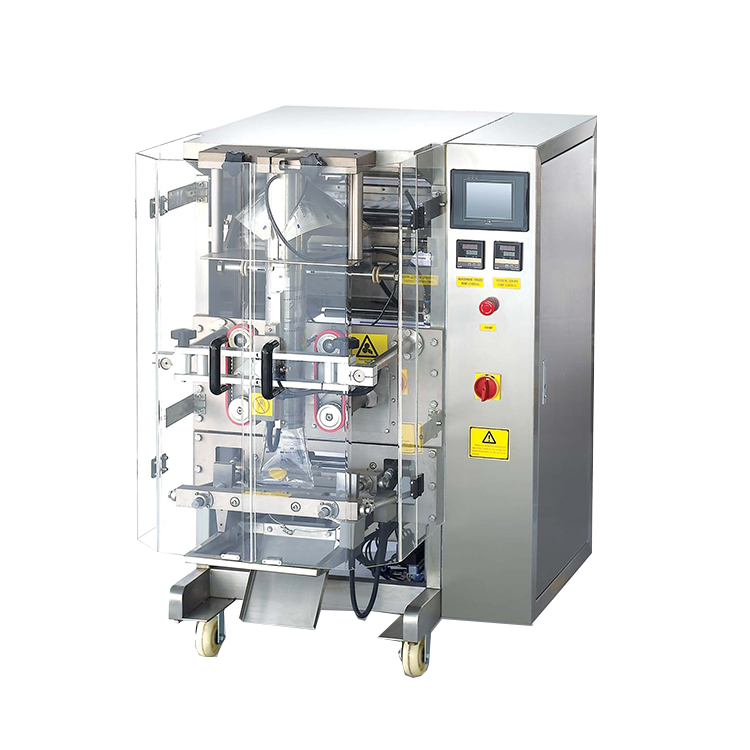
You need a flat bottom bag packaging machine for flat bottom bags: a VFFS configured with a multi-panel forming collar, a bottom folding unit, four longitudinal sealing stations, and servo-controlled film registration. For quad seal bags, you need a quad seal VFFS with a multi-panel former and four corner seal stations, but no bottom fold mechanism. Some machines can do both.
Let’s get specific about what you’re buying in each case.
Flat Bottom Bag Packaging Machine: What to Look For
A flat bottom bag packaging machine is the most complex single-lane VFFS configuration you can buy. Here’s the equipment checklist:
- Multi-panel forming collar with integrated bottom folding plow. This is custom-tooled to your bag dimensions. You can’t use a quad seal forming collar and add a bottom fold later: the collar has to be designed for flat bottom from the start.
- Four longitudinal sealing stations. These fire simultaneously to create the four corner seals. Each station has independently controlled temperature and pressure. Look for machines where each seal jaw has its own temperature controller: if one seal runs hot, you need to adjust that station alone, not all four.
- Bottom sealing station. A dedicated heat seal bar that bonds the folded base panel. This station fires on every cycle, synchronized with the film pull and corner seal timing.
- Servo-driven film pull system. Not optional for flat bottom. The bottom fold alignment requires precision film indexing that mechanical cam systems can’t deliver consistently. Full servo control on the pull belts gives you ±1 mm registration accuracy.
- PLC with recipe storage. Flat bottom production has more parameters to manage: fold position, bottom seal timing, corner seal temperatures, film tension. A recipe-based control system stores all of these for each SKU so changeover is a selection, not a recalibration session.
- Automatic film splicing (recommended). Flat bottom machines run slower than other VFFS formats, so every minute of downtime for roll changes hurts proportionally more. Auto-splicing keeps the line running during roll changes.
Expect to pay $50,000-$150,000+ for a flat bottom bag packaging machine depending on speed tier, servo configuration, and integrated features. Chinese-manufactured flat bottom VFFS machines start around $35,000-$55,000. European models from suppliers like ROVEMA, Bosch, or IMA run $80,000-$200,000+.
All prices in this guide are indicative estimates for budgeting, based on market observation. Confirm current pricing with suppliers for your specific configuration.
Quad Seal Bag Machine: What to Look For
A quad seal bag machine shares most of the flat bottom architecture minus the bottom fold:
- Multi-panel forming collar. Creates the rectangular cross-section. Simpler than flat bottom because there’s no folding plow integration.
- Four longitudinal sealing stations. Same as flat bottom. Each corner seal needs independent temperature and pressure control.
- Servo-driven film pull system (recommended but not always required). Quad seal bags are more forgiving on film registration than flat bottom because there’s no bottom fold to align. A well-tuned servo-assisted machine can handle quad seal reliably. Full servo is better for high-speed production.
- PLC with recipe storage. Still important for managing multiple SKUs, but with fewer parameters than flat bottom.
Quad seal bag machines typically cost 15-25% less than flat bottom machines of equivalent speed and build quality. Entry-level quad seal VFFS machines start around $30,000-$45,000. High-speed industrial models run $60,000-$150,000.
Can One Machine Run Both Formats?
Yes, with caveats. Many modular VFFS platforms support both flat bottom and quad seal production through tooling changes. The key principle: spec the machine for flat bottom, and it can always run quad seal. Flat bottom requires all the hardware that quad seal needs, plus the bottom folding unit. Disable the bottom fold, swap the forming collar, and your flat bottom machine runs quad seal bags.
The reverse is not true. You can’t add a bottom folding unit to a quad seal machine as an afterthought. The forming collar, frame, and film path all need to accommodate the folding mechanism from the design stage.
If you think there’s any chance you’ll run flat bottom bags in the future, buy the machine that supports it. The upfront premium is 15-25%, but it saves you from buying a second machine later.
Still mapping bag formats to machine types? Our VFFS vs premade pouch vs flow wrapper comparison breaks down how each core machine type handles the main bag formats.
For products that need upright presentation but don’t require the rectangular footprint of flat bottom or quad seal, a パウチ充填機 running premade stand-up pouches is an alternative worth considering: especially for liquid and semi-liquid products.
Cost Comparison: Flat Bottom vs Quad Seal vs Pillow
Flat bottom is the most expensive VFFS bag format to produce, followed by quad seal, with pillow bags as the low-cost baseline. The cost gap comes from film consumption, machine capital, tooling, and production speed.
Here’s a side-by-side comparison for a typical 200 g specialty coffee bag (180 mm face × 70 mm side × 250 mm length):
| Cost Factor | ピローバッグ | クアッドシールバッグ | Flat Bottom Bag |
|---|---|---|---|
| Film cost per bag | $0.015-0.025 | $0.022-0.035 | $0.025-0.042 |
| Machine cost (entry) | $8,000-25,000 | $30,000-45,000 | $35,000-55,000 |
| Machine cost (industrial) | $65,000-150,000 | $60,000-130,000 | $80,000-200,000 |
| Forming collar/tooling | $500-2,000 | $2,000-5,000 | $3,000-8,000 |
| Production speed | 80-160 bpm | 40-80 bpm | 25-60 bpm |
| Bags per 8-hour shift | 38,000-76,000 | 19,000-38,000 | 12,000-28,000 |
| Labor cost per bag | Lowest | 適度 | Highest |
| Retail shelf impact | 低い | 高い | Highest |
| Consumer price premium | Baseline | +10-15% | +15-25% |
The production speed difference is the hidden cost that catches people off guard. If you’re currently running 80 bags per minute on a pillow bag line and you switch to flat bottom at 45 bags per minute, you need either a second machine or longer shifts to maintain the same daily output. That’s a significant operational change.
Five-Year Total Cost of Ownership Estimate
For a mid-size producer running 5,000 bags per day, 250 days per year (1.25 million bags annually):
| TCO Component | Pillow Bag Line | Quad Seal Line | Flat Bottom Line |
|---|---|---|---|
| Machine purchase | $35,000 | $45,000 | $60,000 |
| Tooling (2 sizes) | $3,000 | $8,000 | $12,000 |
| Film cost (5 years) | $125,000-156,000 | $138,000-219,000 | $156,000-263,000 |
| Maintenance (5 years) | $10,000 | $15,000 | $20,000 |
| Energy (5 years) | $12,000 | $15,000 | $18,000 |
| Estimated 5-year TCO | $185,000-216,000 | $221,000-302,000 | $266,000-373,000 |
The 5-year TCO gap between quad seal and flat bottom runs roughly $45,000-$70,000. Whether that’s justified depends entirely on your retail strategy. If the flat bottom format lets you command $0.50 more per bag at retail, that’s $625,000 in additional revenue over five years: far exceeding the cost difference.
Which Format Should You Actually Choose?
Choose flat bottom when shelf presence is your primary competitive advantage and your product sells at a premium price point. Choose quad seal when you need heavy-fill capability, good shelf presence, and better production economics. Choose neither if your product is a commodity sold on price.
Here’s my decision framework after configuring these formats for dozens of production lines.
Go with Flat Bottom If:
- You’re packaging specialty coffee, artisan snacks, superfoods, or organic products where the bag itself is part of the brand experience
- Your retail price is in the top quartile for your category and you need packaging that justifies that premium
- Your fill weight is under 2-3 kg and the product is relatively consistent in shape (whole beans, granules, powder)
- You need five printable faces for branding, origin stories, brew instructions, or regulatory compliance in multiple languages
- Your production volume is moderate (under 30,000 bags per day) and speed isn’t the bottleneck in your operation
- Your retail channels include specialty grocery, direct-to-consumer, or online subscription where visual differentiation drives trial and repeat
Go with Quad Seal If:
- You’re packaging pet food, rice, flour, or frozen products at weights from 500 g to 5 kg
- You need heavy-fill structural integrity (the bag must hold its shape and stack cleanly at 3-5 kg
- Production speed matters), you’re running 20,000+ bags per day and every bag per minute counts
- You want premium shelf presence but can’t justify the flat bottom price premium in your category
- Your product line includes both premium and value SKUs and you want one machine that handles both (quad seal for premium, gusset or pillow for value with tooling changes)
- Pallet stacking and logistics efficiency are important: quad seal bags stack like blocks
Go with Neither If:
- Your product is a commodity sold on price, not presentation. Pillow bags and gusset bags handle these applications at much lower cost.
- Your fill weight is under 100 g: you’re in sachet or stick pack territory, not premium bag territory.
- You need spouted pouches, zipper reclosure, or clear windows in custom shapes: these features are better served by premade pouches on a pouch filling machine.
- Your production volume exceeds 100,000 bags per day: at that scale, the speed penalty of flat bottom and quad seal becomes a serious constraint. You may need multiple lines.
The Hybrid Strategy
I’ve worked with several producers who run both formats on the same machine line. Here’s how: they buy a flat bottom-capable VFFS machine and run flat bottom for their premium SKU (specialty coffee, $18 per bag retail) and switch to quad seal for their mid-tier SKU (everyday coffee, $10 per bag retail). The forming collar swap takes about an hour. They schedule long runs of each format to minimize changeovers: flat bottom on Monday and Tuesday, quad seal Wednesday through Friday.
This approach maximizes machine utilization and capital efficiency. The flat bottom machine costs more upfront, but the ability to serve both market segments on one line pays for the premium within 18-24 months.
よくある質問
Can I run flat bottom bags on a quad seal machine?
No, not without major modifications. A quad seal VFFS machine lacks the bottom folding unit and the specialized forming collar integration that flat bottom bags require. Adding these components typically costs $8,000-$20,000 in parts and engineering, and some machine frames simply don’t have the physical space or mounting points. If you think you might need flat bottom in the future, buy the flat bottom machine from the start. It can always run quad seal by disabling the bottom fold.
What’s the speed difference between flat bottom and quad seal in real production?
Flat bottom runs 25-60 bags per minute. Quad seal runs 30-80 bags per minute. In practice, most producers settle into 40-50 bpm for flat bottom and 55-70 bpm for quad seal on well-tuned servo machines. The gap comes from the bottom folding step: every flat bottom cycle includes a fold-and-register pause that quad seal doesn’t need. If you’re running 16-hour shifts, that difference can be 3,000-5,000 fewer bags per day on the flat bottom line.
How much more does flat bottom film cost compared to quad seal?
For bags with the same face dimensions, flat bottom typically uses 10-20% more film per bag than quad seal. The extra material goes into the dedicated base panel. At typical laminate film prices ($2.00-$3.50 per square meter), that’s roughly $0.008-$0.02 more per bag. Over a million-unit annual run, you’re looking at $8,000-$20,000 in additional film cost for flat bottom versus quad seal. Factor this into your per-unit economics when choosing a format.
Do I need a different filling system for flat bottom versus quad seal?
The filling system (whether it’s a multihead weigher, auger filler, volumetric cup, or piston filler), is independent of the bag format. Both flat bottom and quad seal bags are filled through the top of the forming tube on a VFFS machine. The filling system you choose depends on your product type (granule, powder, liquid, piece count), not the bag shape. That said, flat bottom bags sometimes require a slightly longer dwell time between fill and seal because the bottom fold needs to set before the bag is cut free. Your filler’s discharge timing may need adjustment.
Can I add a zipper or degassing valve to flat bottom and quad seal bags?
Yes. Both formats support in-line zipper application and one-way degassing valve insertion on the VFFS machine. A zipper applicator mounts above the forming collar and bonds a zip strip to the inner film surface. Degassing valves heat-seal into the face or gusset panel. Both options add cost ($3,000-$8,000 for the applicator unit) and reduce maximum speed by 5-15%. Specialty coffee roasters routinely run flat bottom bags with both a zipper and a degassing valve (it’s a proven configuration.
Which format is better for block bottom bag packaging), flat bottom or quad seal?
“Block bottom bag” is a term that’s used for both formats, which creates confusion. Technically, a flat bottom bag is a true block bottom bag because the base panel creates a flat, rectangular (block-shaped) standing surface. A quad seal bag has a blocky shape from the corner seals, but the bottom is a folded gusset, not a flat panel. If you need the block bottom bag packaging format for its precise rectangular footprint and superior standing stability, flat bottom is the right choice. If “block bottom” in your market refers to any blocky, four-corner-sealed bag, either format works: choose based on fill weight, speed, and cost considerations.
Bottom Line
Flat bottom bags and quad seal bags are the two premium formats in flexible packaging, and the choice between them comes down to three things: how perfect your shelf presence needs to be, how heavy your fill is, and how much you’re willing to invest in production complexity.
Flat bottom delivers the most premium presentation: a perfect rectangular box that stands rock-solid on the shelf, five printable faces, and consumer perception that justifies higher retail pricing. It demands the most from your equipment: a dedicated flat bottom bag packaging machine with bottom folding, precision servo control, and tight seal management.
Quad seal gives you 85-90% of the shelf impact at lower cost and higher speed. It handles heavier fills, runs faster, and requires less specialized tooling. For pet food, rice, flour, and mid-premium products, it’s often the smarter operational choice.
Both formats beat pillow bags and gusset bags on shelf presence. Both require significantly more machine and material investment. The right answer depends on your product, your retail strategy, and your production economics, not on which format looks better in a product catalog.
Not sure which premium bag format fits your product? お問い合わせ with your product details and retail requirements: we’ll recommend the right format and machine.









 English
 Spanish
 German
 Korean
 Arabic
 French
 Italian
 Japanese
 Thai
 Vietnamese
 Portuguese
 Swedish