A palletizing machine stacks filled cases, bags, or pails onto a pallet in a programmed pattern so a person does not have to. Two architectures dominate the market: conventional (layer) palletizers, which form a complete row-and-layer matrix and place it onto the pallet in one motion, and robotic palletizers, which pick products with a robot arm in groups or one by one. The short version: conventional wins on raw speed for one high-volume product, robotic wins when your product mix, case sizes, or pallet patterns change often.
Points clés à retenir :
- Conventional means layer-forming. Products are queued into a full layer, then swept or gripped onto the pallet in one move: fast and gentle on uniform products.
- Robotic means pick-and-place. An arm with a gripper builds the pattern case by case: slower per case, but it absorbs size changes and mixed pallets with a program change, not a mechanical rework.
- Bags and cases behave differently. Valve and open-mouth bags want a conventional bagger-style palletizer with squaring and layer pads; cases and pails run on either architecture.
- Speed math beats brochure math. Size the machine from cases per minute times shift hours, layer counts, and planned changeover frequency, not from the rated maximum.
- Upstream feeding decides success. An infeed conveyor with product turning and squaring does half the palletizing work.
- Floor space is a real constraint. A robotic cell can fit in roughly a 3 x 3 m footprint; conventional machines are taller and longer.
What a Palletizing Machine Actually Does
Every palletizer, regardless of architecture, runs the same sequence:
- Infeed. Products arrive single file on a conveyor from the case packer or bagging line.
- Row forming. Products are grouped into rows: rollers stop and side belts push to build the row pattern.
- Layer forming. Rows accumulate until one complete layer is assembled, often with interlocked (brick) pattern for pallet stability.
- Placement. The layer moves onto the pallet: swept by an overhead carriage in conventional machines, or placed by the robot gripper in robotic cells.
- Layer pad and repeat. A sheet of cardboard or slip sheet drops between layers when the product needs it, then the sequence repeats.
- Discharge. The finished pallet rolls out to the stretch wrapper, and an empty pallet loads automatically.
The intelligence lives in step 2 and 3: pattern software decides how products interlock so the pallet does not lean or collapse in transit. That software quality is a bigger differentiator between suppliers than arm speed or motor power.
Conventional Layer Palletizers: How They Work
A conventional palletizer builds complete layers on a forming table, then transfers the whole layer onto the stack in one smooth motion. Two transfer styles are common: a sweep arm that pushes the layer off a roller table, and a gripper carriage that picks up the layer from above.
Where conventional machines win:
- Speed. Well beyond 100 cases per minute at the top end; bag palletizers commonly handle 20–40 bags per minute continuously.
- Product handling. One-shot layer placement disturbs bags less than repeated arm picks, which matters for soft or settling products like flour and feed.
- Duty cycle. Decades of factory uptime is the norm; the mechanics are simple and repairable.
Where they struggle:
- Mixed or frequent changeovers. Every new case size or pattern historically meant guide adjustments; modern servo machines store recipes, but mechanical rework is never zero.
- Footprint and height. Layer forming tables and overhead carriages need vertical room, often 4 m or more of machine height.
- Very low volumes. Below roughly 10 cases per minute, a conventional machine is capital sitting idle; semi-automatic palletizers or a robot make more sense.
You will also see the terms high-level et low-level. A high-level machine forms each layer on an elevated table and lowers it onto the stack from above while the pallet sits on the floor: gentler on bags and usually faster. A low-level machine forms layers at floor level and raises or lowers the pallet on a lift table as the load builds: it fits low ceilings and takes product straight from existing floor conveyors. Match the style to your building before you compare speeds, because ceiling height decides this for you.
Robotic Palletizer Cells: How They Work
A robotic palletizer uses an articulated arm (usually a 4-axis palletizing robot) with a gripper engineered for your product: vacuum cups for cases, clamshell or side-clamp grippers for bags, magnetic layers for pails. The cell includes the robot, infeed conveyor, pallet stations, and safety fencing.
The robot builds pallets case by case or in small groups, following a pattern program. Change the case size, load a new recipe, and the same hardware runs the new pattern.
Where robotic cells win:
- Flexibility. Multiple case sizes, multiple pallet patterns, mixed pallets: all handled in software.
- Footprint. A compact single-arm cell can fit a 3 x 3 m corner and even sit inline with low-clearance ceilings.
- Scalability. Start with one arm, add a second in the same cell when volume grows.
- Future rerating. Re-grip and re-program for a new product family instead of re-engineering the machine.
Where they struggle:
- Raw throughput. A single arm tops out around 20–30 cases per minute depending on pick weight and distances; conventional machines pass that easily.
- Gripper dedication. The gripper is designed for your product range. Very different products (bags plus pails) may need quick-change grippers.
- Soft bag handling. Air-filled bags can deform in a clamp gripper; bag work needs a supplier with real bag references.
Conventional vs Robotic: The Decision Table
| Facteur | Conventional layer | Robotic cell |
|---|---|---|
| Typical throughput | 40–120+ cases/min | 15–30 cases/min per arm |
| Ceiling height needed | High (4 m+) | Low (2.5–3 m workable) |
| Floor footprint | Larger, linear layout | Compact, ~3 x 3 m per cell |
| Pattern change | Recipe recall, some mechanical adjust | Pure software recall |
| Mixed SKU pallets | Difficult | Straightforward |
| Bag handling | Excellent (squaring, layer pads) | Good with the right gripper |
| Indicative capex | $80,000–$300,000 | $60,000–$250,000 per cell |
| Maintenance profile | Mechanical wear parts (chains, rollers) | Robot has long service intervals; spare parts pricier |
Read the capex numbers as budgeting ranges, not quotes; integration, conveyors, and pallet dispensers move the total substantially.
Bags, Cases, Pails: Matching Architecture to Product
Bags (25–50 kg open-mouth or valve bags) almost always palletize conventionally or on a bag-specialist robot. Bags of flour, cement, feed, and grain settle after filling; a conventional machine squares each layer against a backstop and often inserts layer pads, which produces square, stable, transport-safe stacks. Robots can do it with clamshell grippers and pre-squaring conveyors, but references matter.
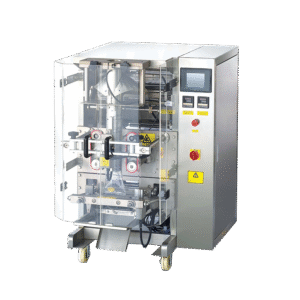
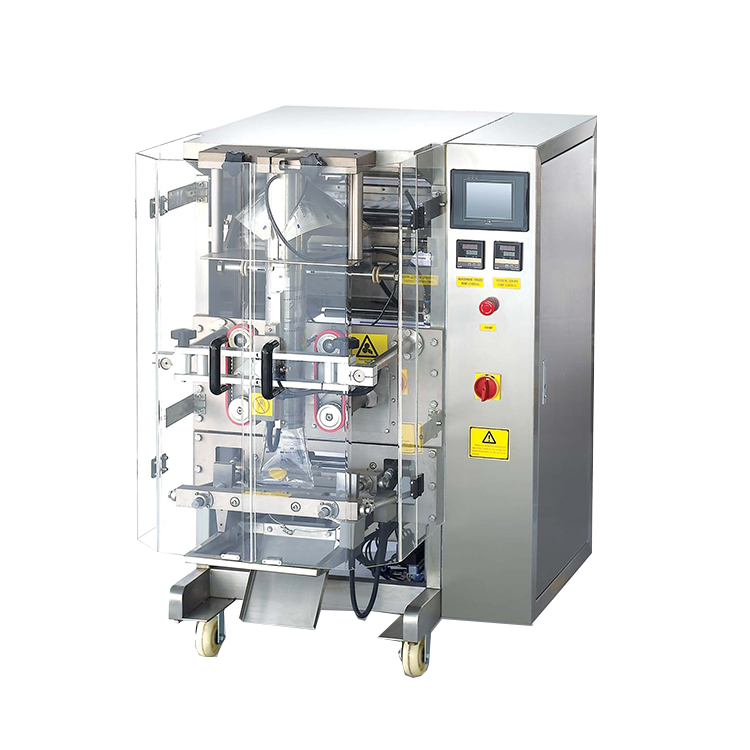
The photo below shows the machine that feeds most bag palletizing lines: a vertical form fill seal bagger producing filled bags ready for squaring and stacking.
Cases (RSC cartons, trays) run on either architecture. One or two case sizes at high speed points conventional; many sizes and mixed retail pallets point robotic.
Pails, drums, and bottles in reshippers usually palletize robotically with specialized grippers, because the products are heavy for their footprint and pattern precision matters for containment.
For the conveyors, elevators, and product-turning devices that feed all of this, see our guide to feeding and vacuum devices in packaging machines and the auxiliary equipment category: the infeed section is where most palletizing projects are actually won or lost.
Sizing a Palletizer: The Speed Math
Work the numbers before you shop:
- Cases per minute at the source. Not the case packer peak: the sustained rate after micro-stops.
- Pallets per hour. Cases per minute x 60 / units per layer / layers per pallet.
- Pallet change time. Empty pallet dispensing and full pallet discharge run 15–30 seconds; subtract that from each cycle.
- Shift reality. One shift at 20 cases per minute is about 8,400 cases; two palletizing robots or one conventional machine handle it depending on mix.
Example: 25 cases per minute, 12 cases per layer, 8 layers = one pallet every 23 minutes. That is one relaxed robot or one small conventional machine. The same rate with six case formats on mixed pallets is a different project entirely, and the flexibility requirement drives the architecture choice more than the speed does.
Palletizer Prices: What to Budget
Indicative ranges for complete systems, including basic infeed integration:
| System | Fourchette de prix indicative |
|---|---|
| Semi-automatic palletizer (operator assists) | $15,000–$40,000 |
| Robotic cell, single arm, cased goods | $60,000–$150,000 |
| Robotic cell, bag handling with squaring conveyor | $100,000–$250,000 |
| Conventional layer palletizer, cases | $80,000–$200,000 |
| Conventional high-level bag palletizer | $150,000–$300,000+ |
Tous les prix indiqués dans ce guide sont des estimations à titre indicatif destinées à vous aider à établir votre budget, et sont basés sur l'observation du marché. Veuillez vérifier les prix actuels auprès des fournisseurs pour votre configuration spécifique.
The machine is usually 50–60% of project cost; conveyors, guarding, pallet dispensers, controls integration, and shipping fill the rest. Budget the project, not the box.
Questions fréquemment posées
Can a robotic palletizer handle bags as well as cases?
Yes, with the right gripper and infeed. Bag applications need a squaring conveyor (bags are squared before picking) and a clamshell or side-clamp gripper sized to your bag weight and dimensions. Ask any supplier you talk to for bag references at your weight class, because bag behavior varies more than case behavior.
How much floor space does a palletizing cell need?
Plan roughly 3 x 3 m for a compact single-robot cell plus 1 m clearance for maintenance access, and about double that for the infeed conveyor run. Conventional machines trade footprint for height: expect a 4 m machine height for a high-level sweep machine.
Do I need layer pads or slip sheets between layers?
For stable, interlocking cases, usually no. For bags, pails, and anything that can shift in transit, layer pads (cardboard or plastic sheets) significantly improve pallet squareness and transport safety. Bag palletizers dispense pads automatically as part of the layer cycle.
How does a palletizer integrate with my existing packaging line?
Through the infeed conveyor and signals. The palletizer takes products from your case packer or bagging line output conveyor, so match conveyor width, height, and speed, and agree the handshake signals (product ready, pallet full, fault) during specification, not after delivery.
What maintenance does a palletizing machine need?
Robots: scheduled grease and battery checks every 12–24 months and gripper wear parts. Conventional: chain and roller lubrication, wear strip replacement, and photo-eye cleaning on a monthly-to-quarterly rhythm. Both reward the same preventive discipline as the rest of your line.
Is palletizing automation worth it at low volume?
Below roughly 8–10 cases per minute, full automation rarely pays back quickly. Semi-automatic palletizers (the machine lifts and places, the operator forms rows) remove the lifting injuries at a fraction of the cost, and can be a stepping stone to a full cell later. Contactez-nous with your rates and product mix and we can sanity-check which tier fits.