You just ran a batch of protein powder through your packaging line and half the bags are underfilled. The other half are covered in fine white dust that’s seeping through the seals. Your auger keeps bridging, the hopper keeps caking, and your fill weights bounce around like a roulette wheel. Sound familiar?
Powder is one of the hardest products you’ll ever package. It doesn’t flow like a liquid. It doesn’t pour like granules. It dusts, it compacts, it bridges, it cakes, and it gets absolutely everywhere. If you don’t have the right powder packaging machine (specifically, the right auger filler machine configured for your exact powder), you’ll fight it every single day.
I’ve spent years working with auger filling equipment across protein powder, flour, spices, milk powder, coffee, chemical powders, and pharmaceutical blends. This guide covers everything I’ve learned: how auger fillers work, servo vs mechanical systems, auger geometry by powder type, and how to solve the three big problems (dust, caking, bridging) that make powder packaging a nightmare.
Key takeaways:
- Powder demands a dedicated auger filler machine: you can’t use volumetric cups, multihead weighers, or liquid fillers and expect good results
- Servo auger fillers deliver +/- 0.5% accuracy and handle a wider range of powder types than mechanical augers, but they cost 40-60% more upfront
- Auger flight geometry, tooling diameter, and agitator design must match your specific powder’s bulk density, particle size, and flow characteristics: there is no universal auger
- Dust, caking, and bridging account for a large share of powder packaging downtime; each problem has a specific mechanical solution (dust extraction, hopper agitation, vibration)
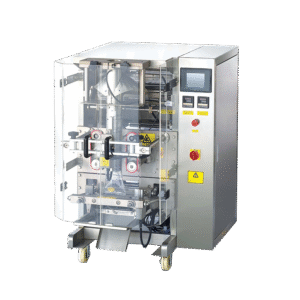
- A complete powder packaging line (auger filler + VFFS machine أو آلة تعبئة الأكياس) runs $25,000 to $180,000+ depending on speed, format, and dust control requirements
- Getting the auger setup wrong doesn’t just cost you in giveaway and rejects: it can create explosion hazards with fine organic dusts
Why Is Powder One of the Hardest Products to Package?
Powder doesn’t behave. It doesn’t flow consistently, it doesn’t fill predictably, and it creates problems that no other product category does: dust clouds, bridge formation in hoppers, caking from moisture absorption, and static cling that makes product stick to every surface it touches. You can’t muscle through these problems with a generic filling system. You need an auger filler machine designed for powder, configured for your specific powder, and tuned to your target fill weight.
Let me explain why powder is so difficult compared to other products you might package.
Powders Don’t Have a Single Flow Behavior
Liquids fill by volume (pour 500 mL of water into a container and you get 500 mL every time. Granules and pellets flow freely), they pour like sand through an hourglass. Powders? They sit somewhere between a solid and a liquid, and their behavior depends on particle size, shape, moisture content, fat content, and how long they’ve been sitting still.
Free-flowing powders like salt and granulated sugar pour reasonably well. Semi-free-flowing powders like flour and protein powder tend to bridge: they arch over the opening of a hopper and refuse to fall through, even though there’s powder sitting right above the gap. Non-free-flowing powders like cocoa powder, starch, and some chemical blends cake and compact under their own weight, turning into a solid block inside your hopper.
If you try to fill any of these with a volumetric cup filler (the type used for granules and seeds), you’ll get wild weight variation. The powder doesn’t level off consistently in the cup, so each dose is a different volume, and because the bulk density changes with settling, the same volume gives you a different weight. That’s why powder packaging equipment needs an auger filler. The auger screw meters powder volumetrically but with positive displacement: every revolution moves a fixed volume of powder through the flights, giving you consistent doses.
Dust Is Not Just a Mess: It’s a Hazard
Most powders generate dust during filling. That dust gets into seals (causing leakers), coats machine surfaces (creating contamination risks between SKUs), and in sufficient concentration with the right particle size, becomes a combustible dust explosion hazard.
The Occupational Safety and Health Administration (OSHA) and the National Fire Protection Association (NFPA) have specific standards for combustible dust (NFPA 652). Organic powders (flour, sugar, starch, protein powder, milk powder, cocoa), are all classified as combustible dusts. If your packaging line generates visible dust clouds around the filling point, you have both a quality problem and a safety problem.
A proper powder packaging machine addresses dust at the source with enclosed filling systems, dust extraction ports, and anti-dust tooling designs. We’ll get into the specifics later, but understand this: dust control isn’t an optional upgrade for powder packaging. It’s a core requirement.
Bulk Density Changes Everything
Bulk density (the weight of powder per unit volume), varies dramatically between powder types. Milk powder sits around 0.3 to 0.5 g/cm³. Flour runs 0.4 to 0.6 g/cm³. Protein powder ranges from 0.3 to 0.6 g/cm³ depending on formulation. Heavy mineral powders can hit 1.5 g/cm³ or higher.
Why does this matter? Because your auger filler doses by volume. If your powder’s bulk density changes (from batch to batch, from humidity changes, from aeration during transport), your fill weight changes even though the auger turned the same number of revolutions. Servo auger fillers compensate for this by allowing precise, repeatable rotation counts and integrating with check weighers for real-time adjustment. But you still need to know your powder’s bulk density to size the auger correctly in the first place.
What Are Your Options for Filling Powder?
You have three filling technologies for powder: auger fillers (positive-displacement screw dosing), volumetric cup fillers (gravity-fed cup measurement), and net weigh fillers (static weighing before discharge). For almost every powder packaging application, the auger filler is the right answer. Cup fillers work for a narrow range of free-flowing powders at low accuracy requirements. Net weigh fillers handle large fill weights but run slow.
Auger Filler Machines
The auger filler machine is the workhorse of powder packaging. It uses a helical screw (the auger) rotating inside a tube to meter a precise volume of powder with each revolution. It’s positive displacement: the auger physically moves powder from the hopper through the tube and out the discharge point. Every revolution pushes a fixed volume, and by controlling the number of revolutions (or fractions of a revolution), you control the dose.
Auger fillers handle fill weights from 1 gram to 5,000+ grams. They work with free-flowing, semi-free-flowing, and non-free-flowing powders. They can be configured for speeds from 20 to 150+ fills per minute. And they’re compatible with every packaging format: VFFS, premade pouch, rigid container, jar, bottle, and can.
Volumetric Cup Fillers
Cup fillers use a rotating dial with adjustable-volume cups. The cup fills with powder by gravity, rotates to the discharge point, and dumps into the package. They’re simple, inexpensive, and fast. But they only work well with powders that flow freely and level off consistently in the cup: think granulated salt, coarse sugar, or large-crystal powders.
For flour, protein powder, cocoa, starch, or any semi-free-flowing powder, cup fillers produce unacceptable weight variation. I’ve seen +/- 10% accuracy on cup fillers running flour. That’s a non-starter for most commercial applications.
Net Weigh Fillers
Net weigh fillers weigh the product in a static weigh hopper before discharging it into the package. They’re highly accurate (typically +/- 0.1% to 0.25%), because they measure weight directly rather than relying on volumetric consistency.
The downside is speed. Net weigh fillers max out around 20 to 40 fills per minute because each cycle requires a full weighing settle time. They’re best for large fill weights (1 kg and above) where the absolute weight variance in dollars justifies the slower speed. For small packages (think 50 g to 500 g sachets and pouches), auger fillers are faster and more practical.
How Does an Auger Filler Work?
An auger filler meters powder by rotating a helical screw inside a cylindrical tube. Each full rotation of the auger pushes a fixed volume of powder through the tube and out the discharge spout. By controlling the number of rotations (or fractions of a rotation), the machine delivers a consistent dose every cycle. An agitator blade in the hopper keeps powder flowing into the auger flights, and a gate or shutter at the discharge prevents drip and stringing between fills.
Let me break down each component and what it does.
The Hopper
The hopper holds your powder supply above the auger. It’s typically a conical or cylindrical stainless steel container with a capacity of 20 to 100+ liters depending on your line’s runtime between refills. The hopper needs to be sized so that the powder level doesn’t drop below the auger inlet during operation: if the auger runs dry, your fill weight tanks.
For powders that bridge, the hopper needs mechanical agitation. This can be a paddle agitator mounted on a separate shaft that rotates inside the hopper, breaking up bridges and keeping powder flowing into the auger. For powders that cake, the hopper may need vibration pads or flex-wall designs that gently flex the hopper walls to break up compacted material.
Some hoppers include a low-level sensor that triggers an alarm or auto-refill system when the powder level drops too low. This is a worthwhile feature: running the auger dry is one of the most common causes of underfill complaints.
The Auger Screw (Flight)
The auger screw is the heart of the machine. It’s a helical flight (imagine a screw or a drill bit), machined to tight tolerances and mounted inside a cylindrical tube called the auger housing or tooling. The clearance between the auger flights and the inside wall of the tube is typically 0.1 to 0.5 mm. Tighter clearance means less powder slips back past the flights (called backflow), which means better dosing accuracy.
Auger screws come in different diameters, pitches, and flight counts:
- Single-flight auger: One continuous helix. Standard for most powders. Simple, reliable, easy to clean.
- Double-flight auger: Two interleaved helices. Delivers more uniform flow for fine powders that tend to channel or core (flow down the center while powder at the walls stays put).
- Variable-pitch auger: The distance between flights changes along the length. Used for powders that compress easily: the wider pitch at the inlet draws powder in, and the tighter pitch near the discharge compresses it into a solid column that cuts cleanly without dripping.
- Open-center auger: Flights attached to a central shaft with space between them. Used for powders that tend to pack tightly and need the extra clearance to prevent jamming.
The auger diameter you need depends on your fill weight and powder bulk density. Small fill weights (1 to 50 g) use small-diameter augers (30 to 50 mm). Medium fill weights (50 to 500 g) use medium augers (50 to 80 mm). Large fill weights (500 to 5,000 g) use large augers (80 to 120 mm+). Your auger filler manufacturer should size the tooling based on your specific powder and target weight.
The Agitator
Mounted inside the hopper on its own shaft, the agitator is a blade or paddle assembly that rotates continuously during operation. Its job is to keep powder moving into the auger inlet. Without agitation, many powders form a “rat hole”: a channel directly above the auger inlet where powder flows out, while the surrounding powder in the hopper stays put because it’s bridged or caked.
The agitator doesn’t need to be aggressive. It just needs to keep the powder surface moving gently. For most powders, a simple paddle blade rotating at 20 to 60 RPM does the job. For very cohesive powders, you might need a more aggressive agitator with multiple blades or a spiral design.
The Discharge Gate (Shutter)
At the bottom of the auger tube, where powder exits into the package, there’s a gate or shutter mechanism. This is critical for clean fills. When the auger stops rotating after a dose, any powder left in the tube wants to continue falling: either from gravity or from residual momentum. The gate closes immediately when the auger stops, cutting off the powder column and preventing drip.
There are two main gate types:
- Rotary gate (butterfly valve): A disc that rotates 90 degrees to open and close. Fast, reliable, and standard on most auger fillers. Works well for most powders.
- Linear gate (slide valve): A plate that slides horizontally to close the discharge. Better for very fine powders that can seep past a rotary gate’s edge seals.
For powders that string (meaning they form a continuous strand between the discharge point and the package as the package moves away), you need a gate that closes fast and cuts clean. Protein powder and some fine chemical powders are notorious stringers. A good rotary gate with a positive seal solves this.
The Drive System
The drive system is what rotates the auger. This is where the biggest difference between auger filler types shows up (servo-driven vs mechanically-driven), and I’ll cover that comparison in the next section.
Servo Auger vs Mechanical: What’s the Real Difference?
A servo auger filler uses a servo motor with encoder feedback to control auger rotation to within fractions of a degree, delivering +/- 0.3% to 0.5% fill accuracy and enabling real-time weight adjustment from a check weigher. A mechanical auger filler uses a clutch-and-brake system with a fixed mechanical stroke, delivering +/- 1% to 2% accuracy at a lower purchase price. For most commercial powder packaging operations running today, servo is the better investment.
I’ve installed both types. Here’s what the real-world comparison looks like.
Servo Auger Fillers
A servo auger filler uses a servo motor connected to the auger through a gearbox. The servo motor has a built-in encoder that reports its exact rotational position: typically to within 0.01 degrees. The machine’s PLC tells the servo to rotate an exact number of revolutions to three decimal places, and the servo does it. Every time. Without drift.
The advantages are significant:
- دقة: +/- 0.3% to 0.5% of target weight, compared to +/- 1% to 2% for mechanical. On a 500 g fill, that’s the difference between +/- 2.5 g and +/- 10 g. If you’re running 5,000 bags a day at $4/kg product cost, that accuracy difference saves you $50 to $150 per day in giveaway.
- Recipe storage: You can store dozens of product recipes (fill weights, auger speeds, agitation speeds) in the PLC and recall them instantly. Changeover between SKUs takes seconds instead of the 15 to 30 minutes a mechanical system needs for physical adjustment.
- Check weigher integration: The servo system can receive feedback from a downstream check weigher and automatically adjust the auger rotation to compensate for drift. If fill weights start trending heavy, the servo reduces the rotation fraction. This closed-loop control keeps weights within tolerance all day without operator intervention.
- Speed flexibility: The servo can run the auger at variable speeds: fast for the bulk of the fill, slow for the final top-off. This “dual-speed” filling reduces dust generation (the slow final dose doesn’t blast powder into the package) and improves accuracy on light fills.
- صيانة: No clutch or brake to adjust or replace. Servo systems are basically maintenance-free on the drive side. The mechanical components that wear out are the same as any auger filler: the auger screw, the tube, and the gate seals.
Servo auger fillers cost $8,000 to $30,000+ depending on configuration, number of filling heads, and dust control features.
Mechanical Auger Fillers
A mechanical auger filler uses an electric motor connected to the auger through a clutch-and-brake assembly. When it’s time to fill, the clutch engages, the auger rotates, and after a set number of revolutions (controlled by a mechanical counter or cam), the clutch disengages and the brake stops the auger.
The advantages are simplicity and cost:
- Lower price: Mechanical auger fillers run $4,000 to $15,000. That’s 40% to 60% less than a comparable servo system.
- Simpler controls: No servo amplifier, no encoder, no complex PLC programming. If something breaks, it’s usually a mechanical component that any competent technician can diagnose and replace.
- Proven reliability: Clutch-and-brake systems have been around for decades. They work. They’re well understood. Parts are available from multiple suppliers.
The disadvantages are why most new installations go servo:
- Lower accuracy: The clutch-and-brake mechanism has inherent mechanical slop. The brake doesn’t stop the auger at exactly the same position every cycle, so you get +/- 1% to 2% fill weight variation.
- No closed-loop correction: If your bulk density drifts during a run (and it will: from aeration, humidity, or settling), your fill weights drift with it and there’s no automatic correction. An operator has to notice and manually adjust the stroke.
- Changeover time: Switching to a different fill weight or product requires mechanical adjustment of the stroke counter, clutch timing, and sometimes auger speed. Expect 15 to 30 minutes per changeover versus 30 seconds for a servo system with recipe recall.
My Recommendation
If you’re running a single product at a single fill weight and your accuracy requirement is +/- 2% or worse, a mechanical auger filler will do the job at a lower price. If you’re running multiple SKUs, need +/- 1% accuracy or better, or want to integrate with a check weigher for closed-loop control, go servo. The servo system can pay for itself in reduced giveaway, often within 6 to 18 months at higher volumes.
Weighing semi-automatic against full automation for your whole line? Our automatic vs semi-automatic packaging machine guide walks through the break-even math.
What Powder Types Need Which Auger Configuration?
Different powders need different auger screw geometries, agitator styles, and discharge setups. A flour auger won’t work for protein powder. A spice auger won’t work for milk powder. Getting the tooling right for your specific powder is the single most important factor in auger filler performance.
Here’s what I’ve learned from configuring auger fillers across different powder categories.
Flour and Fine Powders (0.3-0.6 g/cm³)
Flour is semi-free-flowing. It tends to bridge in hoppers and pack tightly in auger tubes. It generates moderate dust. It’s also a combustible dust, so enclosed filling and dust extraction are mandatory.
Recommended configuration:
- Auger: Single-flight, medium pitch (25 to 40 mm), 50 to 65 mm diameter for typical 500 g to 2 kg fills
- Agitator: Paddle agitator, continuous operation, 30 to 50 RPM
- Gate: Rotary gate with positive seal
- Hopper: Conical with flex-wall option for bridging prevention
- Dust control: Enclosed tooling with dust extraction port connected to a central dust collection system
Protein Powder and Sports Nutrition (0.3-0.6 g/cm³)
Protein powder is one of the trickiest powders to fill consistently. It’s light, fluffy, aerated, and it strings: meaning it forms a continuous thread between the discharge and the package. It’s also hydrophilic, so it clumps in humid environments.
Recommended configuration:
- Auger: Variable-pitch auger, 50 to 65 mm diameter. The variable pitch compresses the aerated powder into a dense column that cuts cleanly without stringing.
- Agitator: Dual-blade paddle, 40 to 60 RPM. You need good agitation because protein powder bridges aggressively.
- Gate: Rotary gate with fast-acting closure. Speed matters: the gate needs to snap shut before the powder string has time to stretch and drip.
- Dust control: Enclosed tooling with dust boot or funnel that extends into the package opening, directing powder straight down and capturing fugitive dust.
- Special consideration: If you’re running whey protein, expect static buildup on the auger tube. A grounded tube or anti-static coating helps.
Spices and Seasonings (0.4-0.8 g/cm³)
Spices vary wildly. Fine spice powders like paprika and turmeric act like flour: they bridge and dust. Coarse spice blends with visible particles (pepper flakes, dried herbs) flow more freely but can jam between tight auger clearances.
Recommended configuration:
- Auger: Single-flight, medium to coarse pitch, 40 to 55 mm diameter for typical 20 g to 200 g fills. For coarse blends, use an open-center auger with wider flight clearance (0.3 to 0.5 mm) to prevent particle jamming.
- Agitator: Gentle paddle agitation. Spices don’t bridge as aggressively as flour, but fine spice powders still need help flowing into the auger.
- Gate: Rotary gate. Standard works fine.
- Dust control: Enclosed tooling essential: spice dust is pungent, gets everywhere, and cross-contamination between flavors is a real quality issue. Dedicate auger tooling sets to flavor families if possible.
- Special consideration: Spice dust can be irritating. Good dust extraction isn’t just a quality concern: it’s an operator comfort and safety concern.
Milk Powder and Dairy Powders (0.3-0.5 g/cm³)
Milk powder (whole milk powder and skim milk powder) is free-flowing but dusts heavily. It’s also hygroscopic: it absorbs moisture from the air and cakes rapidly. Fat content in whole milk powder (26-28%) makes it slightly sticky.
Recommended configuration:
- Auger: Single-flight, medium pitch, 50 to 70 mm diameter. Milk powder flows well enough that you don’t need variable-pitch tooling.
- Agitator: Moderate agitation, 20 to 40 RPM. Don’t over-agitate: excess agitation aerates milk powder and changes its bulk density, which throws off fill weights.
- Gate: Rotary gate with heated option for whole milk powder (the fat content can cause powder to stick to cold gate surfaces).
- Dust control: Full enclosure with dust extraction is mandatory. Milk powder dust is a serious combustible dust hazard and a food safety contamination risk.
- Special consideration: Keep the filling area climate-controlled (low humidity, moderate temperature). Milk powder exposed to humid air will cake in the hopper mid-run.
Chemical and Pharmaceutical Powders
Chemical powders span the entire range of behaviors: from free-flowing granular powders to extremely cohesive fine powders. The common thread is that they need high accuracy and, often, containment to prevent operator exposure.
Recommended configuration:
- Auger: Depends on the specific powder. Fine pharmaceutical powders often use double-flight or variable-pitch augers for uniform dosing. Granular chemical powders may use simple single-flight tooling.
- Agitator: Matched to the powder’s flow characteristics. Many pharmaceutical operations use gentle agitation to avoid degrading the powder’s particle structure.
- Gate: Linear gate for fine powders that can seep past rotary seals. Containment gate designs that prevent any powder from escaping the discharge path.
- Dust control: Full containment: glove box enclosures, HEPA-filtered dust extraction, closed-transfer systems. Regulatory requirements (FDA, GMP) drive the containment level.
- Special consideration: Clean-in-place (CIP) or washdown capability is often required. All contact surfaces must be 316L stainless steel or equivalent, with no dead zones where powder can accumulate.
Dust, Caking, and Bridging: How to Solve the Big Three Problems
Three problems cause the majority of powder packaging downtime: dust (fugitive powder escaping the fill point), caking (powder compacting into solid masses in the hopper or auger), and bridging (powder arching over the hopper outlet and refusing to flow into the auger). Each problem has a specific mechanical solution, and if you address all three when you spec your auger filler, your line will run clean and consistent.
Let me walk through each one.
Dust
Dust is the most visible powder packaging problem. It gets into seals and causes leaks. It coats your machine and creates cross-contamination risk between SKUs. It settles on sensors and obscures photo eyes. And in sufficient concentration, it’s an explosion hazard.
Solutions that actually work:
- Enclosed tooling: The auger tube should be fully enclosed from the hopper to the discharge. Open auger designs where the screw is visible are fine for granular products but terrible for powder: dust escapes from every gap.
- Dust extraction port: A port on the tooling housing connected to a vacuum system pulls fugitive dust out of the filling zone before it escapes. This is standard on any serious powder packaging machine and should be non-negotiable on your spec sheet.
- Dust boot or filling funnel: A flexible sleeve or rigid funnel that extends from the auger discharge into the package opening. It creates a physical barrier between the dust zone and the rest of the machine. For VFFS applications, the funnel extends into the forming tube.
- Down-draft table: For container filling (jars, bottles, cans), a down-draft table pulls air downward away from the fill point, capturing dust before it rises into the operator’s breathing zone.
- Anti-dust auger design: Some auger tooling designs include a secondary “dust return” flight that captures powder that escapes the main flights and channels it back into the filling zone rather than letting it escape upward.
Caking
Caking happens when powder absorbs moisture from the air and the individual particles fuse together into a solid mass. It’s most common with hygroscopic powders: milk powder, protein powder, some spices, and many chemical powders.
Solutions:
- Climate control: The most effective anti-caking measure is controlling the environment. If your filling room is at 60% relative humidity and your powder cakes above 50%, you have two choices: dehumidify the room or accept that your powder will cake. Climate control is almost always cheaper than fighting caking mechanically.
- Hopper vibration: Small vibration pads mounted on the hopper walls break up early-stage caking before it becomes a solid block. The vibration should be gentle: you’re trying to keep powder moving, not shake the machine apart.
- Flex-wall hopper: Instead of rigid stainless walls, a flex-wall hopper has flexible panels that are periodically flexed by external agitator arms. This breaks up cakes without introducing vibration into the rest of the machine.
- Anti-caking additives: Some powders benefit from flow agents mixed in during production: silicon dioxide, tricalcium phosphate, or sodium aluminosilicate. These coat individual particles and prevent them from fusing. This is a product formulation decision, not a machine decision, but it’s worth knowing about.
Bridging
Bridging is when powder forms an arch over the outlet of the hopper. The powder above the bridge sits there, while the auger below runs dry. Your fill weights drop to zero, and the operator has to poke the powder with a stick to break the bridge. It’s frustrating, it’s inconsistent, and it’s completely solvable.
Solutions:
- Agitator blade: A properly designed agitator blade in the hopper is the primary defense against bridging. The blade sweeps the hopper walls and the outlet area, physically breaking bridges as they form. For most powders, continuous agitation at 30 to 50 RPM eliminates bridging entirely.
- Hopper geometry: A steep-walled conical hopper (60 degrees or steeper) resists bridging better than a shallow-walled hopper. The powder is less likely to find a stable arch configuration on steep walls.
- Vibration: Unlike caking, where gentle vibration helps, bridging responds well to more aggressive vibration. A pneumatic or electric vibrator mounted on the hopper wall can be triggered on a timer: pulsing every few seconds to keep powder moving.
- Larger outlet diameter: If your hopper outlet is too small relative to the powder’s bridging tendency, no amount of agitation will solve it. The outlet needs to be at least 3 to 5 times the powder’s maximum particle size, and for cohesive powders, significantly larger.
Selection Table: Auger Specs by Powder Type
Here’s a quick-reference table mapping common powder types to their recommended auger filler configurations. Use this as a starting point: your auger filler manufacturer should verify and refine these specs based on your actual product samples.
| Powder Type | Bulk Density (g/cm³) | Flow Behavior | Auger Type | Auger Diameter | Agitator | Gate Type | Dust Control | Typical Fill Weight Range |
|---|---|---|---|---|---|---|---|---|
| Wheat flour | 0.4–0.6 | Semi-free, bridges | Single-flight, medium pitch | 50–65 mm | Paddle, 30–50 RPM | Rotary | Enclosed + extraction | 250 g – 5 kg |
| Protein powder (whey) | 0.3–0.5 | Semi-free, strings, bridges | Variable-pitch | 50–65 mm | Dual-blade, 40–60 RPM | Rotary, fast-acting | Enclosed + dust boot | 30 g – 2 kg |
| Protein powder (plant-based) | 0.3–0.5 | Semi-free, aerated | Variable-pitch | 50–65 mm | Dual-blade, 40–60 RPM | Rotary, fast-acting | Enclosed + dust boot | 30 g – 2 kg |
| Milk powder (skim) | 0.4–0.5 | Free-flowing, dusts | Single-flight, medium pitch | 50–70 mm | Gentle, 20–40 RPM | Rotary | Enclosed + extraction | 250 g – 25 kg |
| Milk powder (whole) | 0.3–0.45 | Free-flowing, slightly sticky | Single-flight, medium pitch | 50–70 mm | Gentle, 20–40 RPM | Rotary, heated option | Enclosed + extraction | 250 g – 25 kg |
| Instant coffee powder | 0.2–0.35 | Free-flowing, very dusty | Single-flight, coarse pitch | 50–65 mm | Gentle, 20–30 RPM | Rotary | Enclosed + extraction | 50 g – 500 g |
| Spice powder (fine) | 0.4–0.6 | Semi-free, bridges, dusts | Single-flight, medium pitch | 40–55 mm | Paddle, 30–50 RPM | Rotary | Enclosed + extraction | 10 g – 500 g |
| Spice blend (coarse) | 0.4–0.8 | Semi-free | Open-center, wider clearance | 40–55 mm | Gentle paddle | Rotary | Enclosed | 20 g – 500 g |
| Cocoa powder | 0.3–0.5 | Non-free, cakes heavily | Double-flight | 50–65 mm | Aggressive, 40–60 RPM | Rotary | Enclosed + extraction | 100 g – 2 kg |
| Starch | 0.4–0.7 | Non-free, cakes, bridges | Double-flight or variable-pitch | 50–70 mm | Aggressive paddle | Rotary | Enclosed + extraction | 250 g – 25 kg |
| Sugar (powdered/icing) | 0.5–0.8 | Semi-free, dusts heavily | Single-flight, medium pitch | 50–65 mm | Moderate paddle | Rotary | Enclosed + extraction | 100 g – 5 kg |
| Chemical powder (general) | 0.5–1.5+ | Varies widely | Depends on product | 40–80 mm | Matched to flow | Linear gate preferred | Full containment | 50 g – 50 kg |
| Pharmaceutical powder | 0.2–0.8 | Varies, often cohesive | Double-flight or variable-pitch | 30–55 mm | Matched to product | Linear, containment | HEPA containment | 1 g – 500 g |
This table gives you a baseline. When you contact an auger filler supplier, send them your powder samples. Any reputable manufacturer will test your product on their tooling and recommend the exact auger geometry, speed, and agitation settings. This testing process (usually called a “product trial” or “fill trial”), takes a few hours and is the single best way to avoid buying the wrong tooling.
All prices in this guide are indicative estimates for budgeting, based on market observation. Confirm current pricing with suppliers for your specific configuration.
الأسئلة الشائعة
What is the most accurate filling method for powder products?
A servo-driven auger filler is the most accurate volumetric filling method for powders, delivering +/- 0.3% to 0.5% fill accuracy. For applications requiring even tighter tolerance, a net weigh filler (gravimetric) achieves +/- 0.1% to 0.25% but runs at much lower speeds: typically 20 to 40 fills per minute. For most commercial packaging operations, the servo auger filler hits the sweet spot between speed, accuracy, and cost. Closed-loop systems that connect the servo auger to a downstream check weigher maintain that accuracy over long production runs by auto-adjusting for bulk density drift.
Can one auger filler handle different powder types?
Yes, but you’ll need different auger tooling sets. The auger screw, tube (housing), and sometimes the agitator are matched to a specific powder’s flow characteristics. Switching from flour to protein powder, for example, requires changing the auger screw and tube assembly: a process that takes 15 to 30 minutes on most machines. Servo auger fillers make this easier by storing speed and rotation recipes for each product, so once the mechanical changeover is done, you select the recipe and the machine adjusts its parameters automatically. If you run many different powders, keep dedicated tooling sets for each product family.
How fast can an auger filler run with powder?
Typical auger filler speeds range from 30 to 120 fills per minute for powder products, depending on fill weight, powder characteristics, and packaging format. Light fills (5 to 50 g) on small sachets can hit 100 to 150+ fills per minute on a single head. Heavy fills (1 to 5 kg) on large bags typically run 15 to 40 fills per minute. You can increase throughput by using a dual-head or multi-head auger filler: two or more filling stations operating in parallel on the same machine. A dual-head auger filler on a vertical form fill seal machine can reach 80 to 160+ bags per minute on medium-fill-weight powder products.
What causes inconsistent fill weights in powder packaging?
The four most common causes are: (1) bridging in the hopper that starves the auger of product, (2) bulk density changes from aeration, humidity, or batch-to-batch variation, (3) mechanical wear on the auger flights or tube that increases backflow past the flights, and (4) inconsistent auger stopping position on mechanical clutch-and-brake systems. Diagnosing which one is causing your issue starts with watching the hopper: if the powder level above the auger inlet is dropping or showing bridging, fix the agitation. If the hopper is full but weights drift, check bulk density and auger wear. If weights are consistent within each short run but shift between runs, your bulk density is varying between batches and you need check-weigher feedback to compensate.
Do I need a dust collection system for powder packaging?
Yes, for almost every powder packaging application. Dust collection isn’t optional: it protects seal integrity (dust in the seal area causes leaks), prevents cross-contamination between SKUs, keeps sensors and machine surfaces clean, and addresses combustible dust safety requirements for organic powders. Most auger filler machines include a dust extraction port on the tooling housing as standard. You connect this to a central dust collection system or a standalone dust extractor. For fine, dusty powders like flour, milk powder, and cocoa, budget $2,000 to $8,000 for a dust collection system sized to your filling speed and powder type.
How much does a complete powder packaging line cost?
A complete powder packaging line: including product feeding (bucket elevator or conveyor), auger filler, packaging machine (VFFS or premade pouch), check weigher, metal detector, and dust collection: runs $25,000 to $180,000+ depending on speed, bag format, automation level, and dust control requirements. A basic single-lane VFFS line with a mechanical auger filler for a free-flowing powder at 30 to 50 BPM starts around $25,000 to $45,000. A servo auger filler on a high-speed VFFS machine with check-weigher feedback, nitrogen flush, and full dust extraction runs $80,000 to $180,000+. Premade pouch lines with auger fillers are typically $40,000 to $120,000 for a single-lane system. Contact us for a quote specific to your product and speed requirements at our contact page.
Get the Right Auger Setup for Your Powder
You wouldn’t use the same size shoe for every foot. Don’t use the same auger for every powder.
The difference between a powder packaging line that runs smooth and one that fights you every day comes down to three things: the right auger geometry for your specific powder, the right drive system for your accuracy needs, and the right dust and flow management for your operating environment. Get those three right and powder packaging becomes predictable. Get them wrong and you’ll spend your days poking hoppers, wiping dust off seals, and explaining to your customer why half their bags are underweight.
Tell us your powder type, bulk density, and fill weight: we’ll recommend the right auger setup.



 English
 Spanish
 German
 Korean
 Arabic
 French
 Italian
 Japanese
 Thai
 Vietnamese
 Portuguese
 Swedish