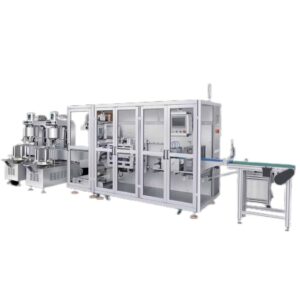
A bottle labeling machine applies labels to round containers: water and juice bottles, cosmetics jars, chemical jugs, wine bottles. Because a cylinder has no flat face, every machine that labels a bottle well must do two jobs at once: hold the container stable, and rotate it under the label at a matched speed. Five machine types solve this in different ways, and the right choice depends less on the bottle and more on your output, label material, and changeover needs.
主なポイント:
- Round containers rotate; the machine controls the rotation. Wrap-around and roll-fed machines spin the bottle; pressure-sensitive machines feed label at the same surface speed.
- Five types cover the market: pressure-sensitive linear, pressure-sensitive rotary, roll-fed BOPP wrap-around, shrink sleeve, and pre-glued cut-and-stack.
- Speed sets the tier. Entry wrap machines reach roughly 20-40 bottles per minute; rotary pressure-sensitive systems run 150-300+.
- Label material decides the machine. Adhesive labels need pressure-sensitive equipment; BOPP film roll-fed needs hot-melt systems; full-body designs need shrink sleeve lines.
- Changeover cost is the hidden cost. Frequent format changes favor servo recipe machines over mechanical adjustment machines.
- Match the labeler to the filler speed. A labeler starved or flooded by upstream output never reaches its rated speed.
How Labeling a Round Bottle Works
A flat container can take a label from a simple press. A round container cannot: the label must wrap around the curve, which means the bottle has to turn through a controlled arc while the label applies.
Three coordinated elements make this happen:
- Container handling. An infeed screw (a rotating shaft with helical flights) spaces bottles to an exact pitch, then a belt or roller chain grips them from the side so they cannot drift.
- Rotation control. A wrap belt or driven roller presses against the bottle side and spins it. The surface speed of that rotation is matched to the label feed speed, so the label lays down without wrinkles or stretching.
- Label application. Depending on the type, the machine either peels a self-adhesive label from its backing web, glues a paper or BOPP label on the fly, or passes the bottle into a sleeve that is later shrunk in a tunnel.
Any bottle labeling problem you will ever debug (wrinkles, bubbles, crooked labels, label lift on the seam) traces back to one of these three elements: bottle spacing, speed matching, or application method. For a wider view that includes flat containers and case labeling, start with our guide to choosing a labeling machine.
The 5 Types at a Glance
| Type | Label material | 標準速度 | Best for | 目安となる価格帯 |
|---|---|---|---|---|
| Pressure-sensitive linear | Self-adhesive paper/film on roll | 20-150 bpm | Short runs, many SKUs, precise placement | $8,000-$60,000 |
| Pressure-sensitive rotary | Self-adhesive on roll | 100-300+ bpm | High-speed beverage and personal care | $60,000-$250,000 |
| Roll-fed wrap-around | BOPP or PP film, hot-melt glued | 80-600 bpm | High-volume water, CSD, juice in round PET | $50,000-$300,000 |
| Shrink sleeve | Printed PET sleeve, no adhesive | 40-300 bpm (plus tunnel) | Full-body 360 designs, contoured shapes | $30,000-$150,000 |
| Pre-glued cut-and-stack | Paper labels pre-coated with glue | 60-200 bpm | Glass bottles, beer, spirits, food jars | $25,000-$120,000 |
本ガイドに記載されている価格はすべて、市場動向を基に算出した、予算策定のための目安となる概算価格です。具体的な構成については、サプライヤーに現在の価格を確認してください。
Pressure-Sensitive Machines: The Default Choice
A pressure-sensitive machine (often called self-adhesive or sticker labeling) peels pre-gummed labels off a siliconized backing web. The label emerges from a peel plate already free on its leading edge; the moving bottle picks it up and rotates it onto the web.
Why it dominates mid-range lines:
- No glue system to heat, meter, or clean. Changeover is a label roll swap.
- Placement accuracy suits front-and-back pairs, neck labels, and tamper bands.
- The same machine runs paper, PP, PE, and clear film labels with minor setting changes.
Linear vs rotary within the type: a linear machine carries bottles past one application station on a conveyor; a rotary machine carries them in pockets around a carousel with multiple applicators, multiplying speed at a much higher price and footprint. Below roughly 100 bottles per minute, linear almost always wins on cost per unit.
The practical limits are label cost (self-adhesive labels cost more than plain BOPP) and web waste: the spent backing liner is scrap. At very high volumes, that cost difference pushes buyers toward roll-fed.
One technical detail separates good pressure-sensitive machines from cheap ones: label detection. Standard photoelectric sensors see a printed label’s mark, but clear film labels on a clear liner are invisible to them; quality machines carry ultrasonic or capacitive web sensors that detect the label edge by thickness instead. If your roadmap includes no-label-look clear labels, confirm the sensor type before purchase, because retrofitting web sensing means rebuilding the applicator head timing. The same inquiry should cover the registration mark standard your printer will use, since machine and print house must agree on it.
Roll-Fed Wrap-Around: The Volume Play
A roll-fed machine cuts a straight label from a continuous web of BOPP film, applies hot-melt glue stripes to its leading and trailing edges, and wraps it around the rotating bottle with a series of brushing belts. There is no backing liner and no pre-cut label: the container defines the label length.
This is the machine behind nearly every round bottle of water and soft drink produced at scale, because:
- BOPP film is the cheapest label material per bottle at volume.
- Cutting label length on the fly means one film roll covers several bottle sizes.
- Speeds run into the hundreds of bottles per minute on beverage lines.
The trade-offs are real: you need a hot-melt glue unit (maintenance item), the container must be reasonably rigid and round, and label graphics are limited to wrap-around formats (no separate front and back panels). Container quality matters too, since roll-fed exposes every bottle’s ovality as a label wrinkle.
Shrink Sleeve and Pre-Glued: The Specialty Plays
Shrink sleeve lines slip a printed PET tube over the bottle, then pass it through a steam or electric tunnel that shrinks the sleeve to the container. Sleeves cover the full body including the neck and cap area, print 360 degrees, and follow contoured shapes no other method can decorate. They also hide nothing: container defects show through, and the sleeve plus tunnel adds cost and floor space per bottle. Tamper-evidence bands and combination designs (sleeve over a glued label) are common mid-solutions.
Pre-glued cut-and-stack machines take labels that are pre-cut, stacked in a magazine, and pre-coated with a cold or reactivated glue. This is the traditional method for glass beer, wine, and spirits bottles and for many food jars. Running cost per label is low, the look is classic paper-on-glass, but the method demands consistent label storage conditions (humidity warps stacked labels) and slower changeovers than roll swaps.
Match the Machine to Container and Line
Before comparing quotations, write down these five facts about your own product; every serious supplier will ask for all five:
| Your fact | Why the machine cares |
|---|---|
| Container shape and diameter range | Sets wrap belt geometry, infeed screw pitch, and change parts |
| Container material (PET, HDPE, glass) | Rigidity drives the choice: film wrap needs stiff walls; glass suits pre-glued |
| Label size and placement (wrap, front+back, neck) | Decides applicator count and type |
| Required output in bottles per minute | Selects linear vs rotary tier |
| Number of SKU changes per week | Servo recipe changeover vs manual adjustment |
One integration point buyers under-spec: the transfer between filler and labeler. Bottles leaving a rotary filler arrive spaced and timed; a labeler infeed screw must accept that timing without jamming. State your filler’s discharge method in every inquiry, and if the line includes a liquid packaging solution with capping and filling upstream, ask the labeler supplier to confirm the interfacing responsibility in writing. Supporting equipment like conveyors and accumulators, not the labeler itself, is where most line-speed losses appear; see our overview of auxiliary equipment for the full picture.
Four Buying Mistakes to Avoid
- Sizing the labeler at exactly filler speed. Add 10-20% headroom, or every micro-stop upstream becomes a label backlog.
- Buying rotary when linear would do. Below the speed crossover, rotary adds capital, floor space, and skilled-maintenance burden for zero gain.
- Ignoring label specification. A machine runs on a narrow range of label materials, adhesives (permanent vs removable, cold-storage rated), and roll dimensions. Lock the label spec with the machine, or pay for trials later.
- Forgetting validation of the container itself. Oval PET bottles and thin-wall containers label badly on wrap equipment. Send real production bottles, not golden samples, for supplier tests.
よくある質問
What speed bottle labeling machine do I need?
Take your filler’s sustainable output in bottles per minute, add 10-20% headroom, and buy that tier. A labeler rated far above your line idles wastefully; one rated at line speed drowns at every upstream hiccup.
Can one machine label different bottle sizes?
Yes, within its format envelope. Servo machines recall stored recipes (diameter, label length, speed matching) in minutes; mechanical machines need manual adjustment per change, and both need change parts such as infeed screws and guide rails beyond a diameter step.
Pressure-sensitive or roll-fed for a water line?
Below roughly 15,000-20,000 bottles per day, pressure-sensitive linear machines usually win on simplicity and changeover. Above that, roll-fed BOPP wins on label cost per bottle. The exact crossover depends on your label pricing and SKU count.
How accurate is label placement on a round bottle?
Modern servo machines hold placement within about plus or minus 1 mm at the label edge on rigid round containers. Oval bottles, flexible walls, and label seams on molded PET ridges degrade that figure; specify your tolerance before ordering.
Do shrink sleeves need a separate machine plus a tunnel?
Yes: a sleeve applicator (which drops and positions the cut sleeve) and a shrink tunnel (steam or electric) work as a pair. Some compact systems combine both in one frame at lower speed, and the tunnel consumes steam or significant power, so budget utilities, not just the machine.
How much maintenance does a bottle labeler need?
Daily cleaning of glue systems (roll-fed and pre-glued), weekly belt and roller inspection, and periodic calibration of speed matching. Labelers reward scheduled care more than most machines; our 包装機のメンテナンスチェックリスト covers the weekly and monthly routines that keep placement accuracy stable. If you want a machine recommendation for your bottles and speeds, お問い合わせ with your container drawings and target output.