You’re staring at dozens of machine models, each one claiming to be the answer to your production problems. The specs blur together. The jargon piles up. And you still don’t know which packaging machine you actually need.
I’ve helped hundreds of buyers cut through that confusion. This guide walks you through every factor that matters (product type, machine format, speed requirements, bag style, budget, and sourcing) so you can make a confident buying decision without second-guessing yourself.
Points clés à retenir :
- Your product type (powder, liquid, solid, granule) determines the machine format: start there
- VFFS machines handle 20–300 bags/minute; premade pouch machines run 10–80 pouches/minute
- Total cost of ownership includes installation, training, spare parts, and downtime, not just the sticker price
- Used machines save 40–60% but carry risk; imports save money but require due diligence on support
- Answer five questions before you buy and you’ll eliminate 90% of wrong choices
Why Is Choosing a Packaging Machine So Overwhelming?
Because the market is fragmented across machine formats, bag types, product categories, and speed tiers, and most manufacturers only sell one or two formats, so they push what they have rather than what you need.
Let’s be honest. There’s no single “best packaging machine.” There’s only the right machine for your specific product, your volume, your bag format, and your budget. A VFFS machine that’s perfect for a snack producer running 200 bags per minute would be a disaster for a coffee company filling valve-sealed pouches.
The confusion gets worse when you start comparing specs. One manufacturer quotes “maximum theoretical speed.” Another quotes “real-world sustained speed.” A third doesn’t specify at all. Film widths, seal temperatures, fill systems: the variables multiply fast.
Here’s the thing: you don’t need to understand every machine ever built. You need a clear framework that narrows the field to two or three viable options. That’s exactly what this guide gives you.
What’s Your Product Type? (Start Here)
Your product’s physical form (powder, liquid, granule, or solid) is the single most important factor in machine selection. It dictates the filling system, the bag material, and often the machine format itself.
Everything flows from this. Before you look at a single machine spec, write down exactly what you’re packaging. Then use this breakdown.
Powders and Fine Particles
Products like protein powder, flour, spices, coffee grounds, and chemical additives fall into this category. Powders are tricky. They dust. They bridge in hoppers. They compact under vibration.
You need an remplisseur à vis sans fin: a screw-based dosing system that measures powder by volume or weight. Auger fillers handle fine powders at speeds of 20–120 cycles per minute with accuracy of ±1–2% by weight.
For free-flowing powders (like granulated sugar), a multihead weigher can also work, but auger filling remains the standard for dusty or cohesive powders.
Liquids and Pastes
Think sauces, oils, honey, shampoo, liquid detergent, and beverages. Liquids require piston fillers, peristaltic pumps, or gravity-fill systems depending on viscosity.
Thin liquids (water-like) are fast and easy. Thick pastes (like peanut butter) need heated hoppers and positive-displacement pumps. Plan your fill system around the thickest product you’ll run, not the thinnest.
Granules and Small Pieces
Products like rice, beans, nuts, seeds, pet food kibble, and frozen vegetables. These flow well and are relatively easy to handle.
UN peseuse multi-têtes is the go-to solution here. Multihead weighers use 10–24 individual weigh heads to combine portions fast, really fast. They can hit 50–200+ dumps per minute with ±0.5–1.5g accuracy. They’re the backbone of snack and produce packaging.
Solids and Irregular Items
Cookies, crackers, bars, trays, hardware, medical devices. These don’t “flow” at all. They need to be placed or stacked, not poured.
Flow wrappers handle individual solid items at high speed (50–400+ pieces/minute). For multipacks or trays, a horizontal form-fill-seal machine is the right call. For large or odd-shaped items, you’re looking at manual or semi-automatic solutions.
Product Type to Filling System Quick Reference
| Type de produit | Examples | Filling System | Typical Speed Range | Précision |
|---|---|---|---|---|
| Poudre | Protein, flour, spices | Auger filler | 20–120 cpm | ±1–2% |
| Liquid (thin) | Water, juice, oil | Gravity/piston fill | 30–200 cpm | ±0.5–1% |
| Liquid (thick) | Honey, paste, sauce | Piston/pump fill | 20–80 cpm | ±1–2% |
| Granule | Rice, nuts, seeds | Multihead weigher | 50–200+ cpm | ±0.5–1.5g |
| Solid | Bars, cookies, trays | Manual/loading | 30–400+ cpm | N/A (count/stack) |
Which Machine Format Matches Your Product?
The four main machine formats (VFFS, premade pouch, flow wrapper, and stick pack) each serve different product and bag combinations. Matching your product to the right format eliminates most of the guesswork.
Formage, remplissage et scellage verticaux (VFFS)
VFFS machines form bags from a roll of film, fill them vertically, and seal them, all in one continuous motion. They’re the workhorse of the packaging industry.
Best for: Snacks, granules, powders, frozen foods, produce, hardware. Anything you can pour or drop into a bag from above.
Speed range: 20–300 bags/minute depending on product and bag size.
Bag types: Pillow bags, gusseted bags, quad seal bags, flat bottom bags.
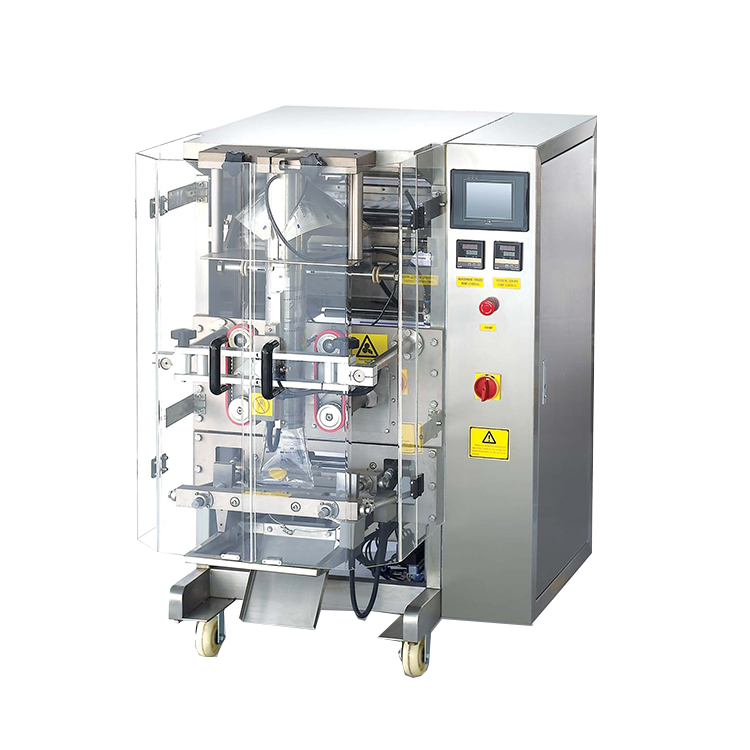
If you’re packaging a dry product at medium to high volume, a vertical form fill seal machine is probably your starting point. VFFS dominates food packaging for good reason: it’s fast, flexible, and cost-effective per bag.
Premade Pouch Machines
These machines take pre-formed pouches from a magazine, open them, fill them, and seal them. The pouches come already made from a converter, so the machine only fills and seals.
Best for: Stand-up pouches with zippers, spouts, clear windows, or premium graphics. Coffee, pet food, baby food, sauces, snacks in retail-ready pouches.
Speed range: 10–80 pouches/minute for single-lane; up to 200+ for multi-lane rotary systems.
Why choose premade pouch over VFFS: When your pouch has features that can’t be formed inline: zippers, spouts, shaped windows, matte/gloss varnish patterns. Premade pouches also deliver higher print quality and shelf impact.
For premium retail products, a machine de remplissage de sachets préfabriqués is often worth the higher per-unit pouch cost.
Enveloppeuses à flux continu
Flow wrappers form a tube of film around a product horizontally, then seal both ends. The product rides on a conveyor through the film.
Best for: Individual solid items: cookies, bars, crackers, rolls, medical devices, hardware items.
Speed range: 50–400+ pieces/minute. High-speed bakery wrappers can exceed 1,000 pieces/minute.
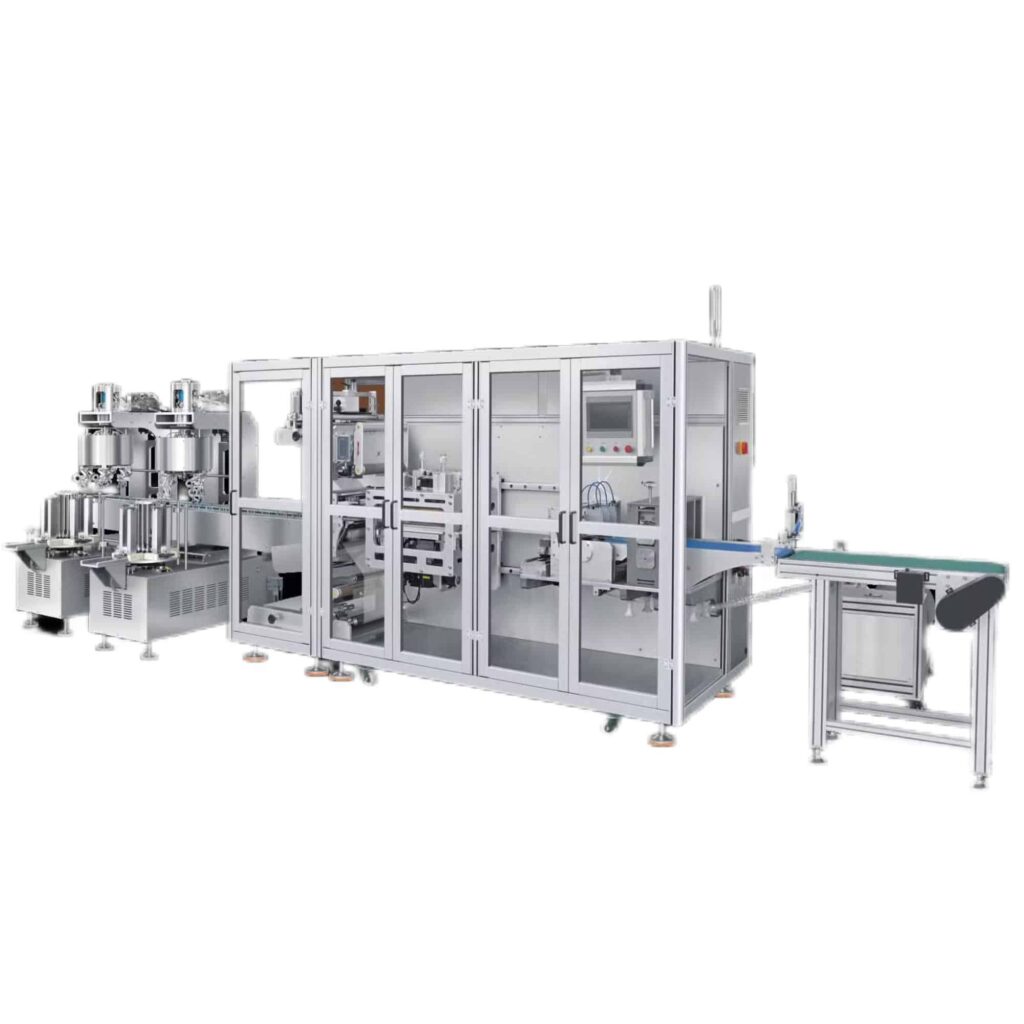
A flow wrapping machine is your answer when you’re wrapping discrete items at high speed. Nothing else comes close for that application.
Machines à stick pack
Stick packs are narrow, single-serve tubes formed from a roll of film. Think sugar packets, drink mix sticks, pharmaceutical sachets.
Best for: Single-serve powders and liquids. Coffee sticks, protein powder sticks, sugar, salt, pharmaceutical powders, liquid condiments.
Speed range: 40–200+ sticks/minute per lane. Multi-lane machines (4–16 lanes) can produce thousands of sticks per minute.
Other Formats
- Band sealers: For pre-made bags that just need a top seal. Simple, fast, affordable.
- Sachet machines: Similar to stick packs but wider and flatter. Ketchup packets, shampoo samples.
- Cartoners and case packers: For secondary packaging after the primary bag or pouch is sealed.
What Speed Do You Actually Need?
Most buyers overestimate their speed requirement by 2–3x. Calculate your actual throughput based on production hours, not theoretical maximums, and buy a machine that runs at 70–80% of its rated capacity.
Here’s how to figure out your real speed requirement:
- Annual volume: How many units do you package per year?
- Production days: How many days per year does the line run? (Typically 220–260 for single-shift operations.)
- Production hours per day: How many hours of actual packaging time? (Not shift length, subtract breaks, changeovers, and maintenance. 6–7 hours is realistic for an 8-hour shift.)
- Calculate:
“`
Required speed (bags/minute) = Annual volume ÷ (Production days × Production hours × 60)
“`
Exemple: 5,000,000 bags/year ÷ (240 days × 6.5 hours × 60 min) = 53 bags/minute
You’d want a machine rated for roughly 70–80 bags/minute to run comfortably at 53 with headroom for growth and variability.
Speed Tier Comparison
| Speed Tier | Bags/Minute | Typical Machine | Typical Investment | Idéal pour |
|---|---|---|---|---|
| Faible | 10–40 | Semi-auto, single-lane pouch | $5,000–$30,000 | Startups, small batches, specialty |
| Moyen | 40–120 | VFFS, single-lane pouch | $15,000–$80,000 | Growing brands, mid-volume co-packers |
| Haut | 120–300 | High-speed VFFS, multi-head weigher line | $50,000–$200,000 | Established brands, contract packaging |
| Very High | 300–1,000+ | Multi-lane stick/sachet, high-speed flow wrapper | $100,000–$500,000+ | Large-scale food, pharma, commodities |
Investment ranges are indicative estimates: confirm current pricing with suppliers.
Running a machine at full blast sounds efficient. It’s not. Machines at 100% capacity have no buffer for hiccups. Target 70–80% of rated speed for sustained, reliable production.
What Bag Format Are You Targeting?
Your bag format affects the machine type, the film cost, the shelf presence, and the consumer experience. Choose the bag first, then find the machine that makes it.
I see buyers do this backwards all the time. They pick a machine and then try to figure out what bags it can make. That’s how you end up with a machine that technically works but produces a bag your competitors outclass on the shelf.
Common Bag Formats and When to Use Them
| Bag Format | Description | Typical Products | Machine | Attrait des rayons |
|---|---|---|---|---|
| Sac à oreiller | Simple sealed pillow shape | Chips, frozen veg, hardware | VFFS | Low–Medium |
| Gusseted pillow | Side gussets for stability | Coffee, pet food | VFFS | Moyen |
| Quad seal bag | Four corner seals, block shape | Premium snacks, coffee | VFFS | Haut |
| Sac à fond plat | Flat base, stands upright | Coffee, pet food, tea | VFFS | Very High |
| Stand-up pouch | Pre-made, stands with gusset | Sauces, snacks, pet food | Premade pouch | Very High |
| Stick pack | Narrow single-serve tube | Sugar, drink mix, pharma | Stick pack | Moyen |
| Sachet | Small flat packet | Ketchup, samples, pharma | Sachet machine | Low–Medium |
| Flow wrap | Film wrapped around product | Cookies, bars, trays | Flow wrapper | Medium–High |
Decision Points
- Need a zipper reclosure? Go premade pouch. Zippers on VFFS-formed bags are possible but less reliable and limit speed.
- Need a spout or fitment? Premade pouch, no question.
- Need the lowest per-bag cost? VFFS forms bags from roll stock, which is significantly cheaper than pre-made pouches.
- Need maximum shelf impact? Flat bottom bags on a VFFS or premium premade stand-up pouches.
- Need single-serve convenience? Stick packs or sachets.
What’s Your Real Budget?
The machine price tag is 50–70% of your total cost. Factor in installation, training, tooling, spare parts, film trialing, and 12-month consumables to get your real number.
Nobody likes budget surprises. Here’s what the full picture looks like.
Cost Breakdown by Machine Type
| Cost Category | VFFS ($) | Premade Pouch ($) | Flow Wrapper ($) |
|---|---|---|---|
| Base machine | 15,000–150,000 | 20,000–120,000 | 25,000–200,000 |
| Filling system (auger, weigher, etc.) | 5,000–50,000 | 5,000–40,000 | Included |
| Conveyor/platform | 2,000–10,000 | 3,000–15,000 | 2,000–8,000 |
| Installation & commissioning | 2,000–10,000 | 2,000–10,000 | 2,000–10,000 |
| Training | 500–3,000 | 500–3,000 | 500–3,000 |
| Spare parts (year 1) | 1,000–5,000 | 1,000–5,000 | 1,000–5,000 |
| Film/tooling trials | 1,000–5,000 | 500–3,000 | 1,000–5,000 |
| Total range | $26,500–$233,000 | $32,000–$196,000 | $32,000–$231,000 |
All ranges are indicative estimates: confirm current pricing with suppliers.
Hidden Costs People Forget
- Electrical and air supply upgrades: Your facility may need new circuits, compressed air capacity, or three-phase power. Budget $2,000–$15,000.
- Film minimum orders: Roll stock suppliers have minimums. Premade pouch converters have even higher minimums. Your first film order could be $3,000–$15,000.
- Downtime during learning: Expect 2–4 weeks of reduced efficiency while your team gets comfortable with a new machine. That’s real production cost.
- Regulatory compliance: Food contact materials, CE marking, FDA compliance, if you’re in food or pharma, factor in audit and documentation costs.
Should You Buy New, Used, or Import?
New machines give you warranty and support. Used machines save 40–60% but carry mechanical and parts risks. Imports from Asia save money but require careful supplier vetting and patience with support time zones.
New Machines
Avantages : Full warranty (1–2 years), factory support, latest technology, custom-configured to your product, training included.
Inconvénients : Higher price, longer lead time (8–16 weeks typical), depreciation.
When to buy new: First machine purchase, complex product requirements, high-speed production where reliability is non-negotiable, regulated industries (food, pharma).
Used Machines
Avantages : 40–60% savings over new, available immediately, proven in production.
Inconvénients : No warranty (or limited), parts may be discontinued, unknown wear history, may need refurbishment ($5,000–$20,000), limited or no support.
When to buy used: Budget-constrained, simple product, experienced maintenance team on staff, non-critical production line or backup machine.
Red flags with used machines: Seller can’t demonstrate it running, no documentation or manuals, proprietary parts from a defunct manufacturer, heavy corrosion or film residue on sealing jaws.
Imported Machines
Avantages : 30–50% savings over domestic new machines, improving build quality year over year, wide selection.
Inconvénients : Support across time zones, shipping and customs logistics, spare parts may take weeks, documentation may be incomplete, warranty enforcement is difficult.
When to import: Budget is tight, you have technical staff who can maintain the machine, you’re comfortable with video-call support, the product application is straightforward.
Risk mitigation: Order spare parts kits with the machine. Request video of your product being run on the exact model. Use a freight forwarder experienced in machinery. Get everything in writing: specs, warranty terms, delivery timeline.
Quick Decision Framework: 5 Questions to Answer Before You Buy
Answer these five questions (honestly) and you’ll narrow the field from hundreds of machines to two or three real contenders.
1. What exactly am I packaging?
Not “snacks.” Be specific. “Salted potato chips, 150g, in a pillow bag with nitrogen flush.” The more specific you are, the faster suppliers can recommend the right setup.
Write down: product name, weight or volume range, number of SKU variations, and any special requirements (Modified atmosphere, nitrogen flush, product protection from crushing).
2. How many units do I need per hour/day/year?
Use the calculation from the speed section above. Come up with one number: bags per minute at sustained production speed. That number drives everything else.
3. What does the bag need to look like on the shelf?
Bring a physical sample of a competitor’s packaging you like, or a sketch of what you want. The bag format determines the machine type more than almost anything else.
4. What’s my total budget, not just machine budget?
Include installation, training, spare parts, first film order, and facility modifications. Add 15% contingency. That’s your real number.
5. Who will operate and maintain this machine?
A machine is only as good as the team running it. If you don’t have experienced packaging staff, prioritize machines with good local support, clear documentation, and accessible training. The cheapest machine with no support will cost more in downtime than a pricier machine with a technician on speed dial.
Decision Matrix
| Your Situation | Type de machine | Budget Range | Priority |
|---|---|---|---|
| Startup, 1 product, <50 bpm | Semi-auto VFFS or single-lane pouch | $10,000–$35,000 total | Ease of use, support |
| Growing brand, 2–5 SKUs, 50–100 bpm | Mid-range VFFS with auger or weigher | $30,000–$80,000 total | Flexibility, changeover speed |
| Established producer, high speed, 100–250 bpm | High-speed VFFS line with multihead weigher | $80,000–$250,000 total | Reliability, uptime, parts availability |
| Premium retail product, zipper pouch | Premade pouch machine | $35,000–$100,000 total | Pouch quality, seal integrity |
| Single-serve powder or liquid | Stick pack or sachet machine | $25,000–$150,000 total | Accuracy, speed per lane |
FAQ
How do I know what packaging machine I need?
Start with your product type (powder, liquid, granule, solid) and your desired bag format. These two factors eliminate 80% of machines on the market. Then layer in speed requirements and budget. If you’re unsure, contact us with your product details and we’ll point you in the right direction.
And if you want to see where packaging formats and regulations are heading before you commit, our flexible packaging trends for 2026 covers the six shifts that matter for machine buyers.
What is the most versatile packaging machine?
A VFFS machine with interchangeable forming tubes and a combination weigher or auger filler is the most versatile option for most buyers. One VFFS machine can handle dozens of product and bag-size combinations by swapping tooling. It won’t make premade pouches or flow wraps, but within the formed-bag category, nothing beats its flexibility.
How much does a packaging machine cost?
A complete packaging machine setup ranges from $15,000 for a basic semi-automatic unit to $250,000+ for a fully automated high-speed line. The machine itself is typically 50–70% of the total investment when you include filling systems, conveyors, installation, training, and initial spare parts.
Can one machine handle different products?
Yes, with changeover time. Most VFFS machines can switch between bag sizes in 15–45 minutes by changing the forming collar (forming tube assembly) and adjusting settings. Switching between product types (e.g., powder to granule) may also require changing the filling system. Premade pouch machines handle different pouch sizes with similar changeover times. Factor changeover frequency into your speed planning.
What’s the difference between VFFS and premade pouch machines?
VFFS machines form bags from roll stock film in real time: the bag is created, filled, and sealed in one continuous process. Premade pouch machines take ready-made pouches, open them, fill them, and seal only the top. VFFS has lower per-bag material cost and higher maximum speed. Premade pouch allows more complex pouch features (zippers, spouts, shaped windows) and higher print quality.
How do I choose a packaging machine for food products?
Food packaging has three extra requirements: food-grade contact surfaces (stainless steel, FDA-compliant materials), washdown capability for sanitation, and compliance with food safety standards (FSMA, HACCP, or local equivalents). Choose a machine built specifically for food applications: don’t try to adapt an industrial machine. Also consider Modified Atmosphere Packaging (MAP) if your product needs oxygen removal for shelf life.

Ready to Find Your Machine?
Choosing a packaging machine comes down to knowing your product, your volume, your bag format, and your real budget. Answer those five framework questions and you’re ahead of most buyers who spend months going in circles.
Not sure which machine fits? Tell us your product, target speed, and budget, we’ll narrow it down for you.
No sales pitch. No pressure. Just a straight answer about which machine makes sense for what you’re packaging.