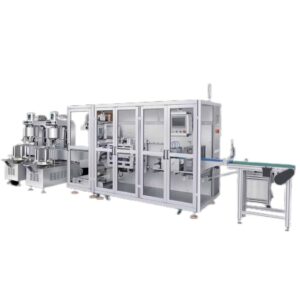
A robotic palletizer is a robot arm that picks cases, bags, or bundles and stacks them in programmed patterns on a pallet. That sentence is true and mostly useless for buying one, because the arm is roughly a third of the engineering. The cell around the arm (infeed conveyor, layer forming, pallet and slip-sheet handling, safety enclosure) decides whether the system hits its rate or becomes the most expensive bottleneck on your line. This guide walks through what each component does, how to size the robot honestly, and what the whole cell actually costs.
Puntos clave:
- The robot is a component, not the system. Infeed, pallet dispenser, slip-sheet placer, and fencing typically cost as much as the arm itself.
- Payload math is unforgiving. Rate the arm at case weight plus end-of-arm tool weight plus a dynamic margin, never at bare case weight.
- Conventional palletizers still win on single-SKU speed. Robots win on flexibility: multiple SKUs, multiple pallet patterns, tight floors.
- Layer forming is where rates live or die. How product arrives to the pick point determines cycles per minute more than robot speed does.
- Budget the safety cell from day one. Fencing, scanners, and interlocks are not optional add-ons; they are what makes the cell legal and usable.
- Precios orientativos: entry single-arm cells start near $80,000-$120,000; high-speed multi-line cells run well past $400,000.
For how conventional high-level and low-level palletizers work, and when they beat robots, see our palletizing machine guide first; this article assumes you have narrowed the choice to robotic.
What Is Actually in a Robotic Palletizing Cell
Walk any installed cell and you will find the same five blocks in some form:
- Infeed and product conditioning. Cases from the upstream line (often a case sealer) are metered, squared, and turned so they present a consistent face to the robot. Bag products need flattening and squaring devices, since a rounded bag cannot be stacked cleanly.
- Layer forming. A section of conveyor or a rotating table where groups of cases are arranged into one complete layer before the pick. Pre-forming layers lets the robot move one row or one layer per cycle instead of chasing individual cases.
- The robot and its end-of-arm tool (EOAT). Usually a four-axis articulated arm with a gripper: vacuum cups for smooth-walled cases, clamps or fork-style fingers for open trays and bags, magnetic tools for steel cans. The tool weighs on every cycle, and it is the part most often redesigned after install.
- Pallet handling. A dispenser that feeds empty pallets from a stack, conveyors that roll the finished pallet out, and a slip-sheet or tier-sheet placer between layers when the pattern needs the stability.
- Safety and controls. Fencing or light curtains around the envelope, door interlocks, area scanners where operators must pass, and the pattern-management controller your operators will actually touch.
Buying the arm and treating items 1, 2, 4, and 5 as extras is the classic first-timer structure, and it is why cells arrive and then sit unproductive for weeks while the missing conveyors are quoted as change orders.
Sizing the Robot: Payload and Speed Done Honestly
Two numbers, honestly calculated, eliminate most buying mistakes.
Payload. Everything the arm must lift at once: your heaviest product group (one case, a row, or a formed layer section) plus the full weight of the end-of-arm tool, plus a dynamic margin of at least 25-30% for acceleration. A 25 kg case moved by a 40 kg tool does not need a 65 kg robot; it needs a robot rated comfortably above 80 kg, and arms are sold in standard classes (roughly 60, 120, 180, 210 kg and up). Undersizing shows up as axis faults and gearbox wear, months after commissioning, when the warranty conversation is harder.
Speed. Robots are rated in cycles per minute, but your requirement is pallets per hour, and the conversion runs through pattern math:
| Your numbers | Example |
|---|---|
| Cases per layer | 8 |
| Layers per pallet | 5 |
| Cases per pallet | 40 |
| Line output | 40 cases per minute |
| Pallets needed per hour | 60 |
| Robot cycles needed | 40 picks per minute if single-case picking, 5 per minute if full-layer picking |
Single-case picking at 40 cycles per minute is aggressive for one arm; layer picking at 5 is easy. This is why layer forming upstream, not a faster robot, is the standard answer to a rate problem. Two-arm cells and gantry systems push further, at sharply higher cost.
Robotic vs Conventional: Where Each Wins
| Factor | Robotic cell | Conventional high-level palletizer |
|---|---|---|
| Typical rate | 1-40 cases per minute per arm | 40-120+ cases per minute |
| SKU and pattern flexibility | Software change, minutes | Mechanical changeover or fixed patterns |
| Floor footprint | Compact, flexible layout | Long, tall, fixed |
| Bag handling | Good with squaring conveyor | Excellent (bag-specific designs) |
| Gentle product placement | Excellent (controlled path) | Bien |
| Rango de precios orientativo | $80,000-$400,000+ | $150,000-$600,000+ |
| Skills to maintain | Robot-trained technicians | Conventional mechanics |
Todos los precios que figuran en esta guía son estimaciones orientativas para la elaboración de presupuestos, basadas en el análisis del mercado. Confirma los precios actuales con los proveedores para tu configuración específica.
The pattern that repeats across industries: single product, very high speed, one pattern, bags or uniform cases: conventional. Multiple SKUs, several lines to one cell, rate under roughly 30 cases per minute, pattern changes on demand: robotic. Many plants run both, with a robot cell serving the flexible lines and a conventional machine absorbing the volume line.
The gantry alternative. Between the two sits the gantry (overhead Cartesian) palletizer: a frame-mounted carriage running on X-Y rails above the pallet position, with a vertical lifting axis and the same gripper options as an arm. Gantry cells suit very heavy payloads (full layers of product, drums, kegs), very tall stable patterns, and clean-floor layouts where the machine occupies headroom instead of floor space. Their weakness is pattern flexibility: tool paths are more constrained than an articulated arm’s, and mixed-SKU patterns with frequent changes favor arms. Ask for a gantry quotation specifically when your loads pass roughly 100 kg per pick or your floor plan cannot give up the cell footprint; otherwise the articulated arm ecosystem is broader and better supported.
A worked example. Take a sauce plant sealing 1,200 cases per 8-hour shift: that is 150 cases per hour, or 2.5 per minute, palletizing to 48-case pallets, so one pallet every 19 minutes. A single small arm at 5 cycles per minute with a two-case gripper absorbs that rate with a 5x margin, and the plant spends the surplus on gentle placement and mixed-height patterns for warehouse stability. Contrast a snack line at 45 cases per minute: same math now demands 45 picks per minute single-case, which points to layer forming plus a bigger arm, or two arms, or conventional. Writing your own numbers into this paragraph before contacting suppliers is the single most useful preparation you can do.
The Five Mistakes That Kill Robot Projects
- Quoting the arm, installing the cell. Accept a quotation only if infeed conditioning, pallet dispensing, and safety are line items with prices, not “by others.”
- Sizing payload at product weight. Add tooling and dynamic margin, or buy the next arm class up; retrofitting a bigger arm costs more than ordering it.
- Assuming product arrives robot-ready. Sealed cases from a tape machine have a flap seam the gripper must bridge; bags arrive shapeless. Plan squaring and turning hardware early.
- Skipping the simulation. Every serious integrator simulates the cell against your pallet patterns and rate before build. The simulation is where interferences and short-cycle problems cost nothing to fix.
- No pattern management plan. Someone must create and edit pallet patterns after commissioning. Budget the training, and prefer controllers your staff can operate without the integrator on speed dial.
Integration, Safety, and the Real Budget
Three line items deserve their own paragraph because they are consistently underestimated.
Safety. A palletizing robot is a fast, heavy machine moving overhead loads in a space people need to enter (to clear jams, swap pallets, clear wrappers). Perimeter fencing with interlocked gates, light curtains at hand-off points, and safety-rated scanners where trucks or operators cross are baseline. In most jurisdictions the risk assessment is a legal deliverable, not a formality; ask your integrator for theirs as part of the quotation.
Utilities and installation. Cells need three-phase power, compressed air for tooling (vacuum generators are air-hungry; size the compressor), and a level slab rated for anchor loads. Foundation work found after delivery is a schedule killer.
Maintenance reality. Robot arms themselves need less daily care than the conveyors around them; gripper wear parts (vacuum cups, clamp pads), stretch wrapper coordination, and pallet dispenser jams are the recurring items. Slot the cell into your existing routines; our Lista de comprobación para el mantenimiento de la máquina de envasado gives the weekly-to-quarterly structure, and conveyors and elevators that feed the cell are covered in the auxiliary equipment overview.
Preguntas frecuentes
How many cases per minute can one robot palletize?
With layer forming upstream, a single mid-size arm typically sustains 15-30 cases per minute on cartons and somewhat less on bags. Individual-case picking without forming pushes the same arm’s practical ceiling down toward 10-15 cycles per minute. Above roughly 40 cases per minute, look at two-arm cells, gantries, or conventional machines.
Can a robotic palletizer handle bags?
Yes, with the right tooling and conditioning: clamp-style or fork-and-clamp grippers, plus bag flattening and squaring conveyors upstream, and often slip sheets between layers. Bag lines reward integrators with grain, feed, and cement experience specifically, so ask for bag-line references.
How much floor space does a cell need?
A single-arm cell with pallet dispensing and discharge typically fits in roughly 4 by 6 meters including fencing; the safety perimeter is often the largest single area item. Multi-line cells with more pallet positions grow from there. Layout simulation before purchase is the reliable answer.
Do I need slip sheets or tier sheets between layers?
Use them when layers would otherwise be unstable: bags, tall stacks of small cases, mixed patterns, and warehouse stacking beyond two pallets high. The sheet placer is a modest add-on at order time and an expensive retrofit later.
What is the lead time for a robotic palletizing cell?
Typically three to six months from order to commissioning for engineered cells, driven more by conveyor manufacturing and controls engineering than by the arm, which integrators usually stock or source quickly. Ask for the integration schedule, not just the robot delivery date.
Should I buy the robot from the arm maker or an integrator?
Arm makers sell arms; integrators sell working cells. Unless you have in-house robot engineering, buy the complete cell from an integrator (who takes system responsibility) and treat the arm brand as a component choice. Tell us your products, rates, and floor layout, and Contáctanos for a palletizing configuration matched to your line.