If you’re choosing a packaging machine and you’ve narrowed it down to VFFS, premade pouch, or flow wrapping, you’re asking the right question. This packaging machine comparison breaks down exactly where each format dominates (and where it falls flat), so you don’t spend six figures on the wrong machine.
I’ve watched buyers get this decision wrong more times than I can count. They pick the format they’ve seen most often, or they go with whatever their competitor uses, or they buy based on sticker price alone. Then they’re stuck with a machine that can’t run the bag style their brand needs, or one that costs twice as much per package as it should.
This article fixes that. You’ll get specific speed ranges, cost ranges, bag format capabilities, and head-to-head comparisons: the structured data that actually drives a smart decision.
Key takeaways:
- VFFS machines run the fastest (30–300+ bags/min) and have the lowest cost per package, but they’re limited to formed-in-place bag styles like pillow bags and gusset bags
- Premade pouch machines produce stand-up pouches, zipper pouches, and spouted pouches (the premium shelf presence formats), at 10–80 pouches/min
- Flow wrappers are the go-to for individual solid items (bars, cookies, trays) at 50–500+ pieces/min with fin seal and lap seal options
- Your product type, required bag style, and daily volume together determine the winning format: no single format wins everywhere
- A premade pouch can cost 3–8x more in film per package than a VFFS-formed bag, but the retail shelf impact may justify it
Why Can’t You Just Pick One Machine and Be Done?
Because your product type, your brand’s retail requirements, and your production volume don’t all point to the same format, and choosing based on any one factor while ignoring the others is how you end up with expensive regret.
Here’s the tension. A VFFS machine is fast and cheap to run. But it can’t produce a stand-up pouch with a zipper: the format that premium coffee, pet food, and snack brands use to stand out on shelf. A premade pouch machine makes that stand-up pouch beautifully, but it runs at a third of the speed and the pouches cost more. A flow wrapper screams through individual bars at 400 per minute, but it can’t make a bag at all: it wraps a solid item in film, period.
This packaging format comparison exists because these three formats solve fundamentally different problems. Let’s walk through each one so you understand what it does best before we put them head-to-head.
What Is a VFFS Machine Best At?
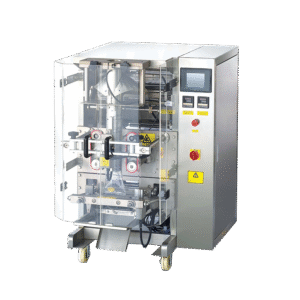
A vertical form-fill-seal (VFFS) machine forms a bag from a flat roll of film, fills it with your product, and seals it: all in one continuous operation, at speeds from 30 to 300+ bags per minute, with the lowest packaging material cost of any format.
That’s the elevator pitch. Now let’s get specific.
How VFFS Works
A VFFS machine pulls film from a roll, shapes it into a tube around a forming collar (called a forming tube or forming set), creates a bottom seal, fills the tube with product through the center of the forming tube, then creates a top seal, which also becomes the bottom seal of the next bag. The bags are cut apart by a rotating knife or sealing jaw.
The film travels vertically. The product drops by gravity into the forming tube. This vertical orientation is what makes VFFS ideal for loose products: powders, granules, snacks, frozen vegetables, candy, coffee beans. Anything that can be dropped or metered into a tube.
Bag Styles VFFS Can Produce
This is where VFFS flexes. A single VFFS machine can produce a wide range of bag styles by changing the forming set and sealing jaw configuration:
- Kissentasche (the standard flat bag, used for chips, candy, frozen peas
- Gusset bag), side-gusseted or bottom-gusseted bags that expand for bulkier products, common in coffee and pet food
- Quad seal bag (four-corner seal for a block-shaped package with premium appearance
- Flachbodenbeutel), a stable, freestanding bag with a rectangular base, increasingly popular for coffee and specialty snacks
- Stick pack: narrow single-serve tubes, produced on a multi-lane VFFS machine (see our stick packing machine guide)
What VFFS cannot do is produce a true stand-up pouch with a pre-formed gusset base and a ziplock reclosure. That requires a premade pouch machine.
VFFS Speed and Cost Profile
| Metric | Range |
|---|---|
| Geschwindigkeit | 30–300+ bags/min (single lane); up to 500+ with multi-lane |
| Machine cost | $15,000–$120,000+ depending on speed tier and automation |
| Film cost per bag | $0.005–$0.08 depending on film structure and bag size |
| Changeover time | 15–45 minutes for forming set and film change |
| Typical film structures | Polyethylene (PE), polypropylene (OPP/CPP), laminates, foil |
VFFS is the workhorse of high-volume packaging. If you’re running snack foods, frozen foods, fresh produce, or any loose product above 50 units per minute, VFFS is almost always the starting point. We cover the full range of these machines on our vertical form fill seal machine page.
When Does a Premade Pouch Machine Make More Sense?
A premade pouch machine (also called a rotary pouch machine or premade pouch filling and sealing machine) takes pre-manufactured pouches, opens them, fills them, and seals them, and it’s the only format that can produce stand-up pouches with zippers, spouts, and premium shelf presence at 10–80 pouches per minute.
Notice what’s different. The pouch is already made. A converter or pouch manufacturer has already formed it: the bottom gusset, the side seals, the zipper, the degassing valve, whatever your brand needs. The machine just opens, fills, and seals the top.
Why That Matters
Because the pouch design possibilities explode when the pouch is made separately. You can have:
- Stand-up pouch with a bottom gusset that holds the pouch upright on shelf
- Zipper reclosure (press-to-close or slider zip for resealability
- Spouted pouch), for liquids, baby food, sauces, with a twist-off cap
- Clear windows in custom shapes
- Matte/gloss spot varnish combinations
- Degassing valves for fresh coffee
None of these features are possible on a VFFS machine. The forming collar can’t create a pre-formed stand-up base. The seal jaws can’t attach a zipper or a spout. If your retail strategy requires premium pouch presentation, a premade pouch machine is your format.
How Premade Pouch Machines Work
Most premade pouch machines use a rotary indexing system. Pouches are loaded into a magazine, picked up by vacuum suction cups or grippers, and moved through a series of stations on a rotary dial or linear conveyor:
- Pouch pick-up and loading (from a magazine or pre-stacked pile
- Pouch opening), vacuum cups pull the pouch open; sometimes a blast of air assists
- Filling (auger filler for powders, piston filler for liquids, multihead weigher or volumetric cup for granules
- Versiegelung), heat sealing bars close the top seal (and the zipper, if present)
- Entladung: finished pouch exits to a conveyor or collection bin
Premade Pouch Speed and Cost Profile
| Metric | Range |
|---|---|
| Geschwindigkeit | 10–80 pouches/min (standard); up to 120 on high-speed models |
| Machine cost | $25,000–$200,000+ depending on features and speed |
| Pre-made pouch cost | $0.03–$0.50 per pouch depending on size, material, and features |
| Changeover time | 20–60 minutes for format parts and pouch size change |
| Typical pouch materials | PET/PE, PET/AL/PE, nylon/PE, Kraft paper/PE, recyclable mono-materials |
The pouch cost per package is where premade pouch gets expensive fast. A plain pillow bag from a VFFS might cost $0.01 in film. A custom-printed stand-up pouch with a zipper can cost $0.15–$0.50. Over a million units, that’s a six-figure difference in packaging material cost alone.
But if your product sells at a premium price point and needs to look the part on shelf, that cost is part of your brand investment. The full details are on our pouch filling machine page.
What About Flow Wrapping: Where Does That Fit?
A flow wrapper (also called a horizontal form-fill-seal machine or HFFS) wraps a solid product in a continuous tube of film, sealing the ends: it’s the dominant format for individual bars, cookies, crackers, and any discrete solid item, running at 50–500+ pieces per minute.
The key word is “solid.” Flow wrappers don’t make bags. They wrap items. The film forms a tube around the product as it travels horizontally on a conveyor, the long seam is sealed (either a fin seal or a lap seal), and rotary end-sealing wheels crimp and cut the film between each item.
How Flow Wrapping Works
- Product infeed: solid items are fed onto a horizontal conveyor, either manually, by a feeding system, or by an upstream feeder (vibratory bowl, bucket elevator, etc.)
- Film forming: film from a roll is folded around the product through a forming box (similar concept to VFFS but horizontal)
- Longitudinal seal (the bottom of the film tube is sealed along the length of the package (fin seal or lap seal)
- End seals and cut), rotary sealing wheels crimp and cut the film at both ends of each item
Fin Seal vs Lap Seal
This distinction matters for both appearance and material efficiency:
- Fin seal: the film edges meet and fold inward, creating a visible seam that sticks out from the package. Common on candy bars and snack packs. Works with mono-layer films like OPP.
- Lap seal: the film edges overlap and seal flat against the package, creating a cleaner look. Requires heat-sealable film on both sides (sealant layer on the outside as well). Preferred for premium products.
What Flow Wrapping Is Best For
Individual solid items. Period. If you can hold it in your hand and it has a defined shape, a flow wrapper can probably wrap it:
- Protein bars, granola bars, candy bars
- Cookies, crackers, biscuits
- Trays of mushrooms, berries, or fresh-cut produce
- Medical devices, surgical kits
- Hardware items, disposable razors
- Multipacks of smaller items (wrapped together)
Flow wrappers struggle with loose products. You can’t flow-wrap coffee beans or protein powder: there’s no solid item to carry the film. For those, you’re back to VFFS or premade pouch.
Flow Wrapper Speed and Cost Profile
| Metric | Range |
|---|---|
| Geschwindigkeit | 50–500+ pieces/min depending on product and machine |
| Machine cost | $10,000–$150,000+ depending on speed and features |
| Film cost per wrap | $0.003–$0.05 depending on film and item size |
| Changeover time | 10–30 minutes for forming box and film change |
| Typical film structures | OPP, CPP, PET/PE, foil laminates, compostable films |
Flow wrapping is the lowest-cost-per-package format for solid items. The film usage is minimal because there’s no wasted material on a formed base or gusset: it’s just a tight wrap around the product. See our flow packing machine page for the full product range.
Head-to-Head: The Full Comparison Table
This table puts all three formats side by side across the factors that actually determine which one wins for your product.
| Faktor | VFFS | Premade Pouch | Flow Wrapper |
|---|---|---|---|
| Best for | Loose products (powder, granule, snack, frozen) | Premium pouches (stand-up, zipper, spouted) | Solid items (bars, cookies, trays) |
| Speed range | 30–300+ bags/min | 10–80 pouches/min | 50–500+ pieces/min |
| Machine cost | $15K–$120K+ | $25K–$200K+ | $10K–$150K+ |
| Material cost/pkg | $0.005–$0.08 | $0.03–$0.50 | $0.003–$0.05 |
| Bag styles | Pillow, gusset, quad seal, flat bottom, stick | Stand-up, zipper, spouted, clear window, shaped | Flow wrap only (fin seal or lap seal) |
| Seal types | Heat seal (impulse or constant) | Heat seal, zipper seal | Fin seal, lap seal |
| Product types | Powder, granule, liquid, solid chunks | Powder, granule, liquid, paste | Solid items only |
| Shelf presence | Functional, standard | Premium, high-impact | Product-visible, tight wrap |
| Changeover time | 15–45 min | 20–60 min | 10–30 min |
| Reclosure option | No (single-use) | Yes (zipper) | No (single-use) |
| Typical industries | Snack, frozen, produce, coffee, pet food | Coffee, baby food, sauces, premium snacks, nutraceuticals | Bakery, confectionery, produce trays, medical, hardware |
| Floor footprint | Medium (vertical orientation saves space) | Medium to large (rotary table) | Medium to long (horizontal infeed) |
| Operator skill | Mäßig | Moderate to high | Low to moderate |
Read this table carefully. Notice where the formats overlap and where they don’t. VFFS and premade pouch both handle powders and granules (but the bag style, cost, and speed are completely different. Flow wrapping and VFFS both reach high speeds), but for entirely different product types.
The packaging format comparison comes down to three questions: What are you packaging? What does the package need to look like? How many do you need per minute?
Which Format Gives You the Lowest Cost Per Package?
VFFS wins on cost per package almost every time for loose products, but the real answer depends on whether you’re calculating film cost, total packaging cost, or fully loaded cost including machine depreciation and labor.
Let’s break it down with real numbers.
Scenario 1: 100g Snack Product, 10,000 Units/Day
| Cost Component | VFFS (Pillow Bag) | Premade Pouch (Stand-Up) | Flow Wrapper |
|---|---|---|---|
| Film/pouch cost | $0.012 | $0.18 | N/A (solid item) |
| Machine depreciation (5yr) | $0.008 | $0.025 | N / A |
| Labor (1 operator) | $0.005 | $0.008 | N / A |
| Total per package | $0.025 | $0.213 | N / A |
The premade pouch costs 8.5x more per package. Over a year (250 production days, 10,000 units/day), that’s $470,000 more in packaging cost. But if that stand-up pouch lets you sell at a $0.50 premium per unit, you net $780,000 more in revenue. The math can flip depending on your retail strategy.
Scenario 2: Protein Bar, 20,000 Units/Day
| Cost Component | VFFS (Pillow Bag) | Premade Pouch | Flow Wrapper (Lap Seal) |
|---|---|---|---|
| Film/pouch cost | $0.008 | $0.12 | $0.004 |
| Machine depreciation (5yr) | $0.004 | $0.015 | $0.003 |
| Labor | $0.003 | $0.006 | $0.002 |
| Total per package | $0.015 | $0.141 | $0.009 |
For a solid bar, flow wrapping is the clear cost winner, and it’s also the fastest format for this product type. VFFS can wrap a bar in a pillow bag, but it’s not optimized for it. The flow wrapper runs faster, uses less film, and produces a tighter, more professional wrap.
Scenario 3: Premium Coffee, 250g, 5,000 Units/Day
| Cost Component | VFFS (Gusset Bag) | Premade Pouch (Stand-Up + Zipper + Valve) | Flow Wrapper |
|---|---|---|---|
| Film/pouch cost | $0.035 | $0.32 | N / A |
| Machine depreciation (5yr) | $0.020 | $0.045 | N / A |
| Labor | $0.010 | $0.015 | N / A |
| Total per package | $0.065 | $0.38 | N / A |
Premium coffee is the classic premade pouch use case. The VFFS gusset bag is functional but doesn’t stand up on shelf, doesn’t have a zipper, and doesn’t communicate “premium.” The premade pouch costs nearly 6x more per package, but for a product selling at $12–$18 per bag, the shelf presence and resealability drive the purchase decision.
Real-World: Which Format Do Top Brands Actually Use?
The biggest brands in each category don’t pick a format at random: they match the format to their product’s retail requirements, volume, and price point. Here’s what they actually run.
Snack Foods: VFFS Dominates
Lay’s, Doritos, Cheetos: all VFFS. These brands run at massive volume (millions of bags per day across multiple lines) and need the lowest possible cost per package. The pillow bag is functional, cheap, and fast. Speeds of 150–250 bags per minute per line are standard.
Takis and some premium snack brands have shifted toward premade pouch for their smaller, premium-priced products. But the volume products (the ones you see in grocery store endcaps), are VFFS.
Coffee: Split Between VFFS and Premade Pouch
Mass-market coffee (Folgers, Maxwell House, store brands) uses VFFS with gusset bags or flat bottom bags. High volume, lower price point, functional packaging.
Specialty and premium coffee (Blue Bottle, Stumptown, Intelligentsia, local roasters) uses premade stand-up pouches with degassing valves and zippers. The pouch is part of the brand identity. Consumers expect to see a premium pouch at the $14+ price point.
Protein Bars and Confectionery: Flow Wrapping
Kind Bars, Quest, Clif Bar, Mars, Snickers: all flow wrapped. The format is fast, tight, and product-visible through a clear window or printed film. No other format makes sense for an individually wrapped bar.
Pet Food: All Three Formats Coexist
Dry kibble in large bags: VFFS (flat or gusset bags, 2kg–15kg). Premium pet food and treats: premade stand-up pouches with zippers. Individual treat sticks: flow wrapped.
The pet food industry is a perfect case study for why this packaging machine comparison matters: a single company like Purina uses all three formats across their product line.
Baby Food and Sauces: Premade Pouch Territory
Gerber, Plum Organics, Happy Baby: spouted premade pouches. The format enables shelf-stable liquid and puree products with a pourable spout. No other format can do this. Similarly, squeeze pouches for condiments, sauces, and energy gels are all premade pouch.
Häufig gestellte Fragen
Can a VFFS machine produce stand-up pouches?
No. A VFFS machine forms bags from a flat film roll using a forming collar. It can produce pillow bags, gusset bags, quad seal bags, and flat bottom bags, but it cannot create a pre-formed stand-up pouch with a bottom gusset base. For true stand-up pouches, you need a premade pouch machine.
Is flow wrapping cheaper than VFFS?
For solid items, yes. Flow wrapping uses less film per package than a VFFS pillow bag because it wraps tightly around the product with no wasted material on a formed base. Flow wrapper film costs typically run $0.003–$0.05 per package. However, flow wrappers cannot handle loose products: for powders, granules, and snacks, VFFS is the only option of the two.
What’s the fastest packaging machine format?
Flow wrappers reach the highest speeds: up to 500+ pieces per minute for small, regularly shaped items like candy or small bars. VFFS machines reach 300+ bags per minute in single-lane configurations and up to 500+ with multi-lane setups (like stick pack machines). Premade pouch machines are the slowest, typically maxing out at 80–120 pouches per minute because each pouch must be individually picked, opened, filled, and sealed.
Can one machine do VFFS and premade pouch?
No. These are fundamentally different machine architectures. A VFFS machine forms bags from roll stock film. A premade pouch machine processes pre-manufactured pouches. The mechanical systems, film paths, filling stations, and sealing mechanisms are completely different. If you need both formats, you need two machines.
How do I choose between VFFS and premade pouch for the same product?
Answer three questions. First, does your retail strategy require a stand-up pouch with premium shelf presence? If yes, premade pouch. Second, what’s your daily volume? Above 30,000 units per day, VFFS becomes significantly more cost-effective. Third, what’s your price point? If you’re selling at a premium, the higher per-package cost of a premade pouch is easier to absorb. If you’re competing on price, VFFS keeps your packaging cost low.
Which format is best for a startup with limited budget?
VFFS. Entry-level VFFS machines start around $15,000–$25,000, and the film cost per bag is the lowest of any format. You can start with a basic pillow bag and upgrade to gusset or flat bottom bags later by changing the forming set. Premade pouch machines are more expensive to buy ($25K+ entry) and significantly more expensive to run (pouches cost 3–8x more than roll stock film). Flow wrappers are also affordable at entry level but only work for solid items.

Bottom Line: Which Packaging Format Wins?
There’s no overall winner in this packaging machine comparison. There’s only the right winner for your situation:
- You need VFFS if you’re packaging loose products (powder, granules, snacks, frozen foods) at medium to high volume and need the lowest cost per package
- You need a premade pouch machine if your product demands premium shelf presence (stand-up pouches, zippers, spouts, custom finishes), and you can absorb the higher material cost
- You need a flow wrapper if you’re wrapping individual solid items (bars, cookies, trays) at high speed with minimal film cost
The companies that get this decision right don’t guess. They match the format to their product, their volume, and their brand requirements, and they run the numbers before they buy.
Ready to figure out which format wins for your product? Share your product dimensions, daily output, and shelf life requirements: we’ll tell you which format wins for your specific case. Contact us here and we’ll get back to you with a straight answer.







 English
 Spanish
 German
 Korean
 Arabic
 French
 Italian
 Japanese
 Thai
 Vietnamese
 Portuguese
 Swedish