A labeling machine applies pre-printed labels to your containers, and the right type depends on three things: your container shape, your line speed, and your label material. The six types you will meet on the market are manual and semi-automatic applicators, pressure-sensitive (sticker) labelers, wrap-around bottle labelers, roll-fed BOPP labelers, shrink sleeve applicators, and print-and-apply case labelers. For most small and mid-size producers, pressure-sensitive is the sensible default: it handles the widest range of container shapes and label designs with the simplest changeover.
النقاط الرئيسية:
- Container shape decides the architecture. Round bottles invite wrap-around or roll-fed machines, flat pouches and cartons need pressure-sensitive, and full-body graphics need shrink sleeve.
- Pressure-sensitive is the default choice. One machine covers bottles, jars, flat pouches, and cases at low to medium speed with no tooling changes.
- Roll-fed BOPP is a high-volume decision. It runs the cheapest label material per container, but only pays off above roughly 200 containers per minute on round containers.
- Changeover time matters more than top speed. A machine rated 120 per minute that needs 45 minutes for a format change loses to a 90-per-minute machine that changes over in 10.
- Test with your own containers. Container quality varies, and a labeler that runs perfectly on sample bottles can struggle on your actual supply. Always send samples before you order.
- Budget for the label, not just the machine. Label material cost per container usually exceeds the machine cost per container within the first year of running.
The 6 Labeling Machine Types at a Glance
| النوع | How it applies the label | الأفضل لـ | السرعة الواقعية | النطاق السعري الإرشادي |
|---|---|---|---|---|
| Manual applicator | Hand lever or foot pedal | Startups, under 500/day | 5–15/min | $200–$1,500 |
| Semi-automatic benchtop | Operator places container, machine applies | Small batches, 500–3,000/day | 15–30/min | $1,500–$8,000 |
| Pressure-sensitive automatic | Peel-and-apply from a roll | Bottles, jars, pouches, cases | 30–300/دقيقة | $8,000–$40,000 |
| Wrap-around | Label wraps a round body | Round bottles, cans | 60–400/min | $15,000–$60,000 |
| Roll-fed BOPP | Hot-melt glue, no label backing | High-speed water and soda bottles | 200–600/min | $60,000–$150,000+ |
| Shrink sleeve | Sleeve applied, then heat tunnel | Full-body decoration, shaped containers | 100–400/دقيقة | $40,000–$200,000 (applicator plus tunnel) |
Print-and-apply labelers for outer cases sit outside this table because they serve logistics, not product decoration; they cost $3,000–$15,000 and print variable data (batch numbers, barcodes, shipping marks) on demand.
Pressure-Sensitive Labelers: The Sensible Default
A pressure-sensitive machine peels a self-adhesive label off a backing paper and presses it onto the container. No glue, no heat, no water. That simplicity is why it is the most sold labeling machine type in the world.
What it does well:
- Almost any container shape: round, flat, oval, square, tapered
- Almost any label shape: front, back, neck, wrap (up to about 300 degrees)
- Clean changeover: swap a label roll and adjust guides, usually under 30 minutes
- Print-on-demand options: a thermal print engine on the machine prints date codes or batch numbers on each label as it applies
نقاط ضعفها:
- Very high speed on round containers: above roughly 300 per minute, roll-fed machines do the job cheaper per container
- Full-body decoration on shaped containers: that is shrink sleeve territory
- Extremely light or extremely soft containers, which deform under the application roller
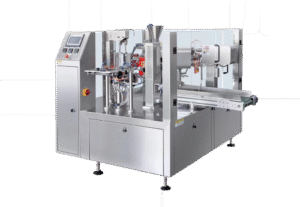
Premade pouches labeled after filling are a common case. The pouches come off a filling and sealing machine, move through a labeling station, and then ship or go into cases. The photo below shows the pouch filling side of that kind of line.
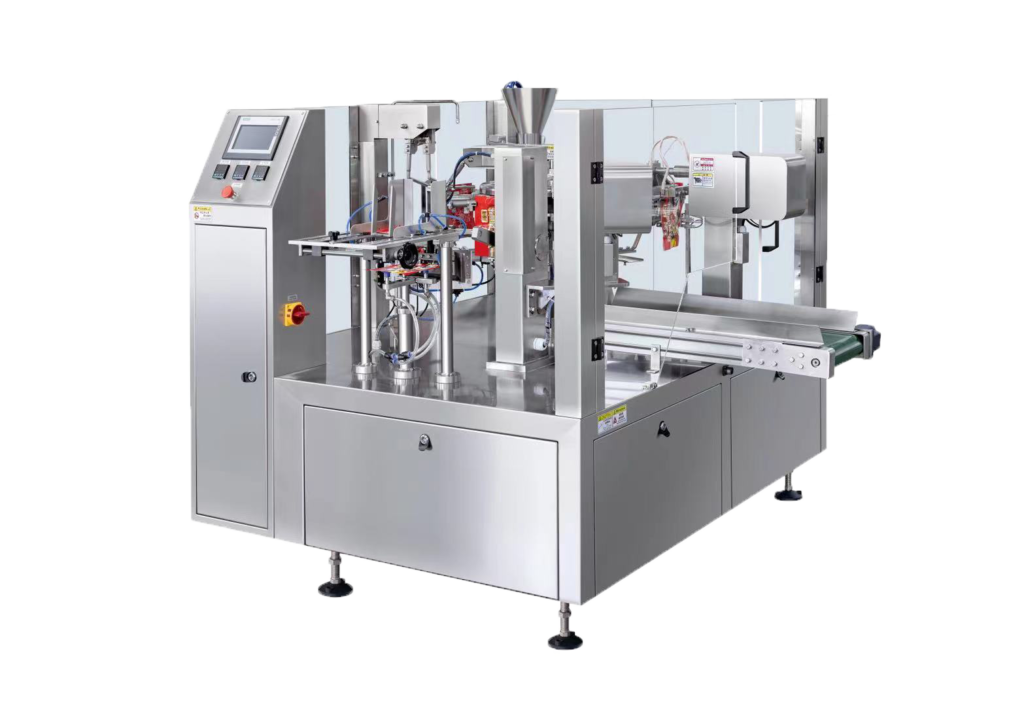
If your containers are pouches, confirm the labeler supplier has run pouch work before: flexible containers need supported transport through the labeling station.
Wrap-Around and Roll-Fed for Round Containers
Two machine families serve round containers, and people confuse them constantly.
Wrap-around pressure-sensitive machines apply a long adhesive label around the bottle body. The container rotates against a peel edge or a roller belt. Most also apply a separate front or back label in the same pass. This is the standard choice for round bottles between 60 and 300 per minute: sauces, juices, oils, chemicals, cosmetics.
Roll-fed BOPP machines are a different technology. They cut a plain printed plastic film (BOPP) to length, wrap it around the bottle, and seal the overlap with a strip of hot-melt glue. There is no backing paper at all, which is why the material cost per container is much lower. The tradeoffs are serious:
- Only round (or near-round) containers
- High machine cost, so the math only works at high volume: think 200+ per minute, one product, long runs
- Hot-melt systems add maintenance and temperature management
Simple rule: if you run fewer than about 15,000 bottles per hour of a single round-container product, roll-fed is usually not worth the capital.
Shrink Sleeve for Full-Body Decoration
A shrink sleeve machine drops a printed plastic sleeve over the container, then sends it through a heat tunnel that shrinks the sleeve tight against the surface. The sleeve can cover the whole container including complex shapes: hourglass bottles, tapered jars, double-grip juice bottles.
Why brands choose sleeves:
- 360-degree graphics, shelf impact, tamper-evidence bands built into the same sleeve
- One decoration process for containers of multiple shapes
- UV and abrasion resistance better than paper labels
What to watch:
- Total system cost includes the applicator and the tunnel, plus steam or electric heat infrastructure
- Per-container sleeve cost is usually the highest of any labeling format
- Seams and artwork distortion need testing: shrink percentage varies by container zone, and artwork must be pre-distorted
For a plain-language overview of shrink and related line equipment such as strapping, see our guide to labeling, shrink, sealing and strapping machines.
Print-and-Apply for Cases and Pallets
Print-and-apply machines sit at the end of the line and label shipping cases and pallet loads with live data: GS1 barcodes, lot numbers, consignment addresses. They print a thermal label and wipe or blow it onto the passing case.
They matter for two reasons. First, retailers increasingly fine suppliers for unreadable case labels; a print-and-apply machine with a verifier catches bad prints before they ship. Second, printing at the case beats pre-printing cases, because your batch data stays flexible.
Indicative budget: $3,000–$15,000 depending on print width, applicator type (wipe-on, tamp, blow), and whether you add a barcode verifier.
How to Match a Labeler to Your Containers and Speed
Work through these five questions in order:
- Container shape. Round only? Wrap-around or roll-fed. Flat or shaped? Pressure-sensitive or sleeve. Cases? Print-and-apply.
- Real speed need. Count containers per minute at your filler, not the machine brochure number. Add 10–15% headroom.
- Label placement. Front only? Front and back? Full wrap? Neck label? Each extra station adds cost and changeover time.
- Changeover frequency. Many SKUs per day rewards fast, servo-adjusted changeover. One SKU per week makes it irrelevant.
- Line integration. The labeler needs to take containers from your filler and hand them to your case packer at the same pitch. Match conveyor heights and accumulation.
That last point decides more projects than any spec sheet. Labelers usually sit in the middle of the line as one piece of the broader auxiliary equipment chain, and the interfaces (infeed conveyor, outfeed pitch, signals) are where integration projects succeed or stall.
Labeling Machine Prices: What to Budget
The table above lists indicative ranges. Read them as budgeting numbers, not quotes, because configuration moves the price a lot:
- Number of applicators (front, back, wrap stations)
- Servo vs mechanical adjustment
- Print engine inclusion
- Stainless and washdown build for food and pharma
- Tooling for your container range
جميع الأسعار الواردة في هذا الدليل هي تقديرات إرشادية لوضع الميزانية، تستند إلى مراقبة السوق. يرجى التأكد من الأسعار الحالية مع الموردين بالنسبة للتكوين المحدد الذي تريده.
Beyond the machine, budget for tooling per container (often $500–$3,000 per format) and for your label inventory. Tooling cost multiplies quickly if you run many container sizes.
Four Buying Mistakes That Cost Money Later
- Buying on top speed. Sales brochures quote ideal-container speed. Your slightly-oval, thin-walled bottle will not hit it. Test, then size.
- Skipping the sample run. Every serious supplier runs your containers and your labels before quoting final tooling. A supplier who will not run samples is telling you something.
- Ignoring label material quality. Cheap die-cut labels with variable backing tension cause wrinkles and stops. Get label stock approved for the machine, not just the printer.
- Forgetting the interface. Order the labeler with the conveyor heights and signal types your line actually uses. Retrofitting infeed and outfeed later costs more than specifying them upfront.
If you want a second opinion on matching a labeler to your line layout, اتصل بنا with your container photos and target speed.
الأسئلة الشائعة
What speed labeling machine do I need?
Take your filler’s container-per-minute output, add 10–15% headroom, and buy that. A labeler comfortably outrunning the filler gives you accumulation buffer; a labeler at 100% duty becomes your bottleneck within a year.
Can one labeling machine handle different bottle sizes?
Yes, within its tooling range. Pressure-sensitive machines typically handle a family of container sizes (for example 50–500 ml round bottles) with guide adjustments, and need new tooling only beyond that range. Ask the supplier for the exact container envelope in writing.
What is the difference between pressure-sensitive and roll-fed labeling?
Pressure-sensitive applies pre-glued labels from a backing roll: flexible, any container shape, moderate speed. Roll-fed wraps plain BOPP film with a hot-melt seam: cheapest material per container at very high speed, round containers only.
Do I need a print engine on my labeling machine?
If your labels carry variable data (expiry dates, batch codes, sequential numbers), yes: an integrated thermal print engine prints on demand and eliminates a pre-printing step. If every label is identical, skip it and pre-print.
How much floor space does a labeling machine need?
A benchtop semi-automatic fits on a table. An in-line automatic needs roughly 2–3 m of line length plus 0.8 m access on each side, and shrink sleeve systems need the tunnel footprint and its heat clearance on top of that.
How do I check my containers will run well?
Send sample containers and sample labels to the supplier and ask for a video of the trial run. Reputable suppliers do this as standard before final quoting. For help scoping the trial, اتصل بنا and we will tell you what to ask for.